
How Long Until 8 AM?
Around the world
The live countdown above gives the exact time left until 08:00 on your own device clock and in your own time zone. Before 8 AM it counts to this morning. After 8 AM it moves on to the next one, so it always shows a positive number.
Doing it by hand takes about ten seconds once you know that 8 AM is 480 minutes after midnight. Every method below builds on that single number.
The 480-minute shortcut
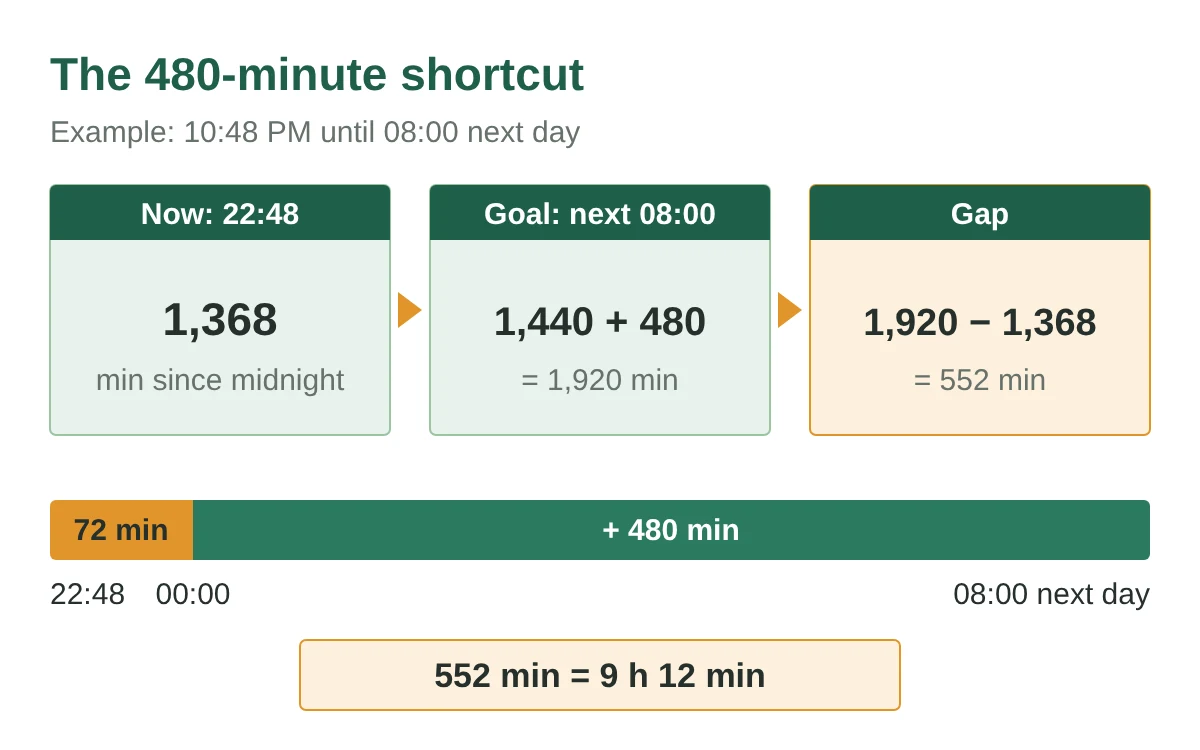
Convert the current time to minutes since midnight, then subtract that from 480. If the result is positive, that is how many minutes remain until 8 AM today. If it is zero or negative, add 1,440 (the minutes in a day) to get the wait until tomorrow’s 8 AM. You can fold both cases into one step: remaining = 1,920 minus your minutes since midnight, then subtract 1,440 if the answer is above 1,440.
Most people use the clock face instead and borrow hours, which is where errors creep in. Working in raw minutes avoids borrowing entirely. Divide the final minute count by 60 to get hours and a remainder.
A worked example with a made-up time
Suppose it is 10:48 PM, a purely hypothetical starting point. In 24-hour time that is 22:48, or 1,368 minutes after midnight. Since 1,368 is greater than 480, 8 AM has already passed today, so the target is tomorrow: 1,920 minus 1,368 gives 552 minutes. Divided by 60, that is 9 hours with 12 minutes left over.
There is a second route that needs no big numbers. Find the gap to midnight (10:48 PM to 12:00 AM is 1 hour 12 minutes), then add 8 hours. The sum is 9 hours 12 minutes, the same answer. If midnight is your anchor, the midnight countdown gives you the first half of that sum live.
Try this: Pick any time on your clock right now, write it in 24-hour form, and run both methods (the 1,920 formula and the midnight-plus-8 route). If the two answers differ by even a minute, one of them has a slip.
Why “tomorrow morning” can still be today
Between midnight and 8 AM, the next 8 AM is on the same calendar date. Someone checking at 1:30 AM who says “I need to be up by 8 tomorrow” usually means a few hours from now, not a day and a half away. A countdown that blindly targets “tomorrow” after midnight would be wrong, so a good one targets the next 8:00 on the clock, whichever date that falls on.
This matters when you share a deadline. “Until 8 AM” written at 11 PM and the same phrase written at 1 AM point to the same moment, but only the first one crosses a date boundary. If a message could be read the wrong way, add the weekday.
Clock changes that add or remove an hour
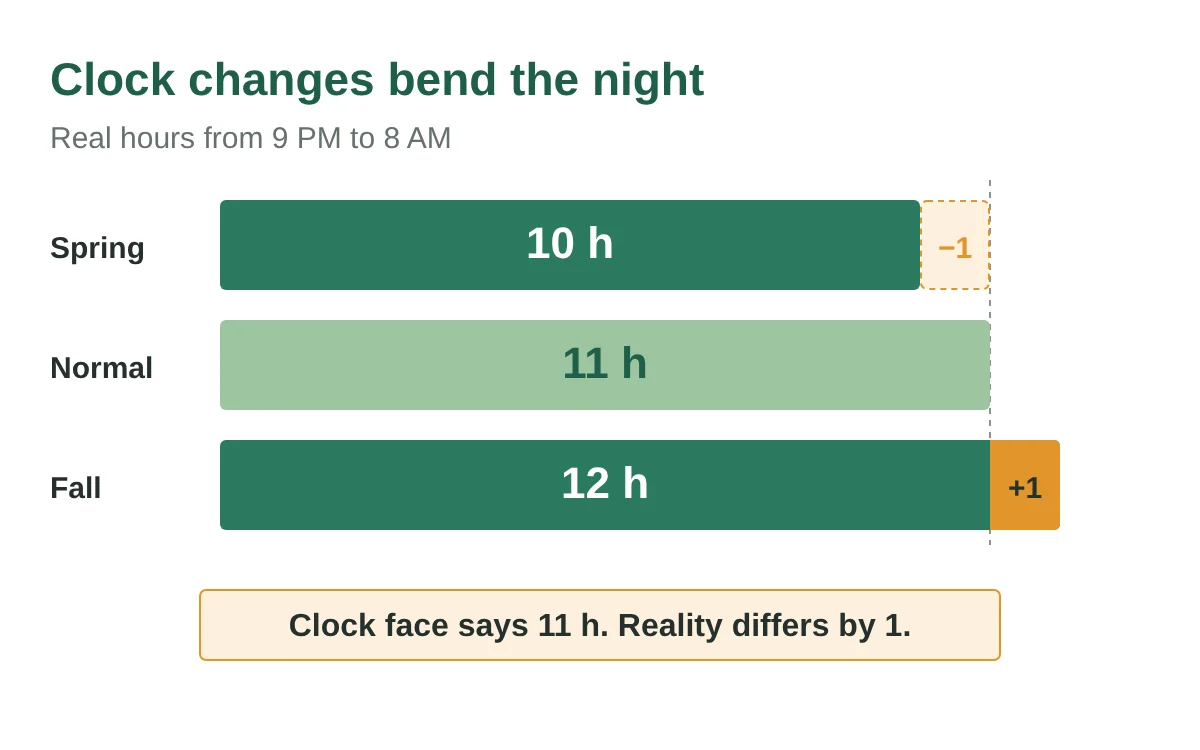
On the night clocks move, the hours on the clock face stop matching the real time that passes. When clocks spring forward, a 9 PM to 8 AM stretch contains only 10 real hours instead of 11. When they fall back, it contains 12 real hours. A subtraction on the face of the clock will be off by exactly one hour on those nights.
A properly built countdown measures real elapsed time, so it handles this for you. Your own mental maths does not, which is why an alarm or a handover planned across a clock change deserves a second look. In the US the change happens on a Sunday in March and a Sunday in November, and most of Europe changes on the last Sunday of March and October. The dates differ by region, so check yours rather than assuming.
When 8 AM is not your 8 AM
The widget counts to 8 AM in the time zone your device reports. If you are timing a call, a shop opening or an exchange on another continent, the target is still 8:00 on their clock, not yours. The fix is to convert their 8 AM to your local time first, then count. The time unit conversions page helps with the minutes and hours side of this.
Seasonal gaps catch people out. London and New York are normally five hours apart, but for a few weeks each spring and autumn the US and UK change clocks on different dates, so the gap briefly becomes four. A regular meeting at 8 AM London can land an hour away from where you expect it.
The reverse also holds. If you travel, your phone may switch zones silently, and a countdown you started earlier will suddenly show a different number. Nothing is broken: the same instant is simply measured against a different local clock.
Try this: Name one place you regularly deal with in another zone. Write down what 8:00 there is on your clock today, and again after the next clock change in either place, to see whether the gap moves.
Counting back from 8 AM for sleep
Many people check this countdown at night, and the useful question is what time to get into bed. Sleep runs in cycles averaging roughly 90 minutes, though the length varies between people and through the night. Counting back in 90-minute steps from 8:00 gives 6:30, 5:00 and 3:30 as natural wake points before it. For bedtime, 7.5 hours of sleep means lights out at 12:30 AM, and 9 hours means 11:00 PM.
Add 10 to 20 minutes for falling asleep, since the countdown measures time until the alarm, not time asleep. If the number on the screen reads 8 hours, you may be closer to 7 hours 40 minutes of actual sleep. A quick look at the 8 hours from now page shows the clock time that exact stretch ends.
Common mistakes
Most wrong answers come from one of four slips:
- Mixing up 8 AM and 8 PM, which are 12 hours apart. A result near 20 hours when you expected 8 almost always means this.
- Subtracting clock digits directly, such as 8:00 minus 10:48, instead of adding 24 hours first.
- Treating 7:60 style leftovers as valid. Minutes run to 59, so 552 minutes is 9:12, not 9.2 hours.
- Forgetting that a decimal hour is not minutes: 9.2 hours is about 9 hours 12 minutes, but 9.30 on a calculator display is 9 hours 18 minutes.
That last one is worth keeping in mind whenever a result is shown as a decimal. Multiply the part after the point by 60 to get the minutes.
Nearby start times worth comparing
Shift workers and early starters often check neighbouring times as well. The 7 AM and 9 AM countdowns use the same method with a target of 420 or 540 minutes after midnight. For any other time of day, the time-of-day countdowns hub lists the full set.
Frequently asked questions
How do I work out how long until 8 AM without a countdown?
Convert the current time to minutes since midnight and subtract it from 480. If the result is zero or negative, add 1,440 to get the wait until the next 8 AM. For example, 10:48 PM is 1,368 minutes after midnight, so 1,920 minus 1,368 leaves 552 minutes, or 9 hours 12 minutes.
Does the time until 8 AM change on the night clocks go forward or back?
Yes. From 9 PM to 8 AM there are only 10 real hours when clocks spring forward and 12 real hours when they fall back, so subtracting the clock-face times is off by one hour. A countdown that measures real elapsed time handles this automatically.
Is 9.2 hours the same as 9 hours 20 minutes?
No. The decimal part must be multiplied by 60, so 0.2 hours is 12 minutes and 9.2 hours is 9 hours 12 minutes. Minutes only run to 59, so a result of 552 minutes is 9:12, not 9.2 hours or 9:20.
What time should I go to bed to wake at 8 AM after full sleep cycles?
Sleep cycles average roughly 90 minutes, so 7.5 hours of sleep means being asleep by 12:30 AM and 9 hours means 11:00 PM. Since most people take 10 to 20 minutes to fall asleep, getting into bed slightly earlier than those times is sensible.