
How Many Hours Until 9am Today?
Around the world
The number of hours until 9am today is the gap between your device’s clock and 09:00 on the same calendar day. The live countdown above works it out on your own clock and time zone, so it is correct the moment you load the page. If 9am has already passed, the target rolls forward to the next morning, which is the answer most people actually want.
The rest of this page covers what the countdown does not show: a way to do the sum in your head in a few seconds, and the cases where the quick sum gives the wrong answer, such as clock changes and time zones.
The live countdown and what it counts
The countdown measures elapsed time, not the difference between two clock faces. Most of the time those are identical, but twice a year in many countries they are not (see the section on clock changes below). Real elapsed time is the right measure for anything physical, like sleep, travel or an alarm.
It also reads the clock on your device. If your phone or computer has the wrong time zone, the answer is wrong by the same amount, however accurate the maths is. A quick check is to compare the device time with a trusted clock before relying on a result for something important.
Why people check varies. Some want to know how much sleep is left before a 9am start, how long until a school or office day begins, or how long until a 9am appointment or call. Others are timing a market or a shop opening. For those, remember that 9am is a round number that many schedules do not use: the main US stock exchanges open at 9:30 am Eastern, so a countdown to 9am will be 30 minutes short of that bell.
The midnight shortcut for doing it in your head
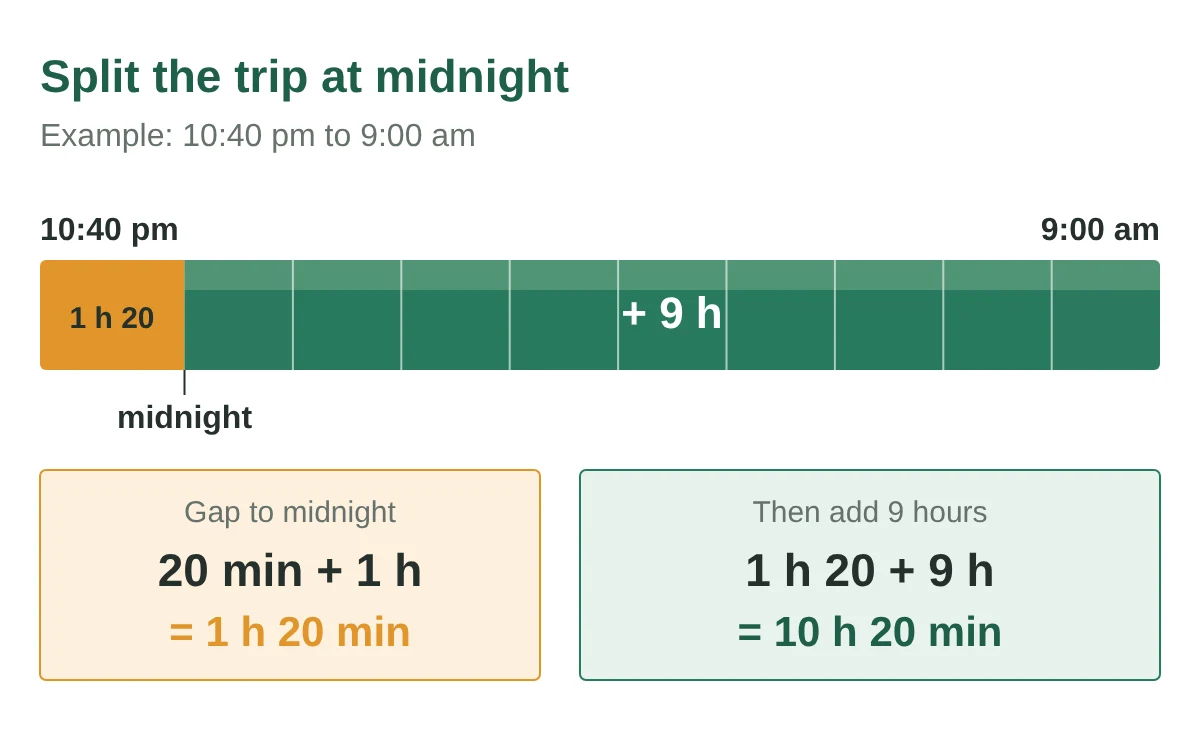
Subtracting times is awkward because hours and minutes are not decimal. A cleaner method is to split the trip at midnight. From any evening time, work out how long until midnight, then add 9 hours. From any morning time before 9, subtract directly using one borrowed hour.
The evening version is easier than it looks because the time to midnight is the “complement” of the clock. At 10:40 pm, the gap to midnight is 1 hour 20 minutes, because 40 minutes plus 20 minutes makes the hour. Add 9 and you have it. If you also need the time to midnight on its own, the midnight countdown gives it live.
Landmarks help as well. From 9 pm to 9 am is always exactly 12 hours, and from 3 am the gap is 6. Anchor on the nearest landmark and adjust by a few minutes instead of subtracting from scratch.
Try this: Pick the current time, say 11:25 pm, and find the gap to midnight first. Add 9 hours, then check yourself against the live countdown. Do it three times at different times of day and it becomes automatic.
A worked example with a made-up time
Take a hypothetical starting time of 10:40 pm on a Tuesday. Because 9am is still ahead only on Wednesday, the target is Wednesday at 09:00.
In 24-hour form, 10:40 pm is 22:40, which is 1,360 minutes after midnight. The next 9am sits at 1,440 + 540 = 1,980 minutes after Tuesday’s midnight. The difference is 1,980 minus 1,360, which is 620 minutes, or 10 hours 20 minutes. That matches the midnight shortcut: 1 hour 20 minutes to midnight plus 9 hours.
For a morning example, start at 6:25 am. Rewrite 9:00 as 8:60, then subtract 6:25 to get 2 hours 35 minutes. Borrowing one hour turns the minutes subtraction into plain arithmetic, so nothing ever goes negative.
When 9am is already behind you
After 09:00 has passed, “9am today” no longer exists in the future. The sensible target is tomorrow, and the formula is 24 hours minus the time since 9:00. At 2:00 pm, five hours have gone by, so the next 9am is 19 hours away.
This is a common source of confusion with the phrase itself. Someone searching at 3 pm for “hours until 9am today” almost always means the following morning, and a countdown that ignores that and shows a negative number is not helpful. If you want the hours between now and another time of day, 10 AM and 8 AM work the same way.
A second trap is the am and pm label. Nine hours from midnight is 9 am, but 9 pm is 21:00, and mixing them up shifts the answer by exactly 12 hours. Writing the target as 09:00 removes the ambiguity.
When the clocks change overnight
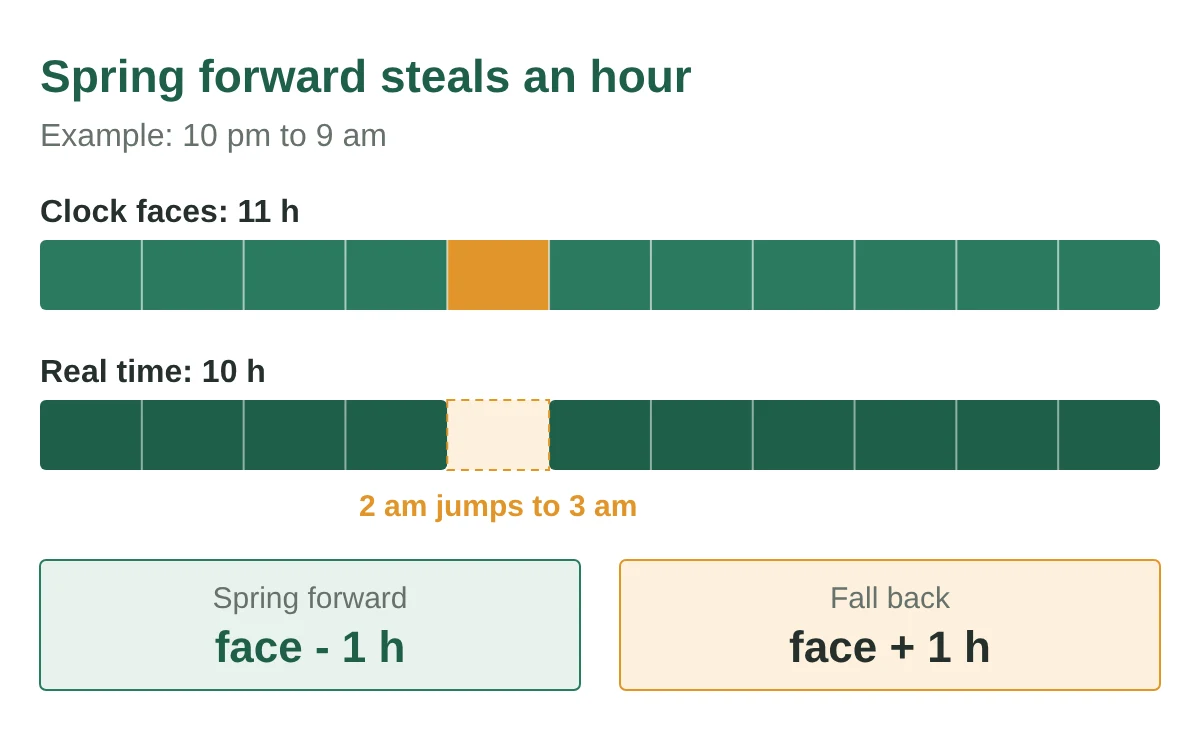
Clock face subtraction fails on daylight saving nights. When clocks spring forward, the gap from 10 pm to 9 am is 11 hours on the face but only 10 real hours, because an hour vanishes at 2 am. When they fall back, the same gap holds 12 real hours.
The rule: if a clock change falls between now and 9am, adjust the face difference by one hour, subtracting for spring forward and adding for fall back. A live countdown does this for you because it counts real elapsed time.
The change date also varies by country. The US and the EU switch on different weekends, so for a few weeks a year the gap between New York and London is an hour different from usual. Many regions, including most of Asia and parts of the US such as Arizona, do not change at all.
Try this: Look up the next clock change date for your region and mark it. On the night before, work out the hours to 9am by subtraction and compare with the live countdown to see the one-hour difference for yourself.
Time zones and 9am somewhere else
The countdown above assumes 9am in your own zone. If you need 9am in another city, convert first: a 9am meeting in New York is 14:00 in London for most of the year, so from London the target is 2 pm local. You can see a quick comparison on the Central time page when you need a reference zone.
Travel creates a subtler error. A device that has not updated its zone, or a laptop set manually, will count to the wrong 9am. The safest habit before a time-critical start is to confirm the zone label on the clock as well as the digits.
For other targets, the full set of time-of-day pages is on the countdowns to a time of day hub. If you need hours as a unit rather than a target, use the time conversions page.
Planning backwards from 9am
The same arithmetic works in reverse. To arrive by 9am after a 45 minute commute and a 30 minute buffer, leave by 7:45. For sleep, count back from 9am: eight hours of sleep needs a 1:00 am bedtime, and adding the 15 minutes most people take to fall asleep makes it 12:45 am.
A simple offset check is the 8 hours from now page, which shows the clock time eight hours after any moment. Use it to test a sleep window before you commit to a late night.
Alarm planning has one more detail: a countdown reaching zero is the start of 9:00:00, not the end of it. If a deadline is “before 9am”, the last safe second is 8:59:59.
Frequently asked questions
How many minutes are there until 9am?
Multiply the whole hours by 60 and add the leftover minutes. The live countdown shows this directly. As a fixed reference, 9:00 am is 540 minutes after midnight, so any time before 9am has 540 minus its own minutes-since-midnight left.
What if 9am has already passed today?
Then the next 9am is tomorrow, and the gap is 24 hours minus the time that has passed since 9:00 this morning. A good countdown switches to tomorrow automatically at 09:00:00.
Is 9am the same as 09:00 or 0900?
Yes. 09:00 and 0900 are both 24-hour notation for 9:00 am. The 12-hour label matters only for the am and pm part: 9 pm is 21:00.
Why does my answer differ by an hour on some nights?
Daylight saving changes add or remove an hour from the real elapsed time. Subtracting clock faces ignores that change, while a live countdown counts actual time and stays correct.