
How Many Hours Until 5am?
Around the world
The live counter above gives the exact time left until 05:00 on your own clock and in your own time zone. If 5 AM has already passed today, it counts to tomorrow’s 5 AM, so the answer is never more than a day.
To check it by hand, convert both times to a 24-hour scale and subtract, adding 24 hours if the result is negative. The sections below cover faster shortcuts and the situations where a simple subtraction goes wrong.
The 17 minus shortcut
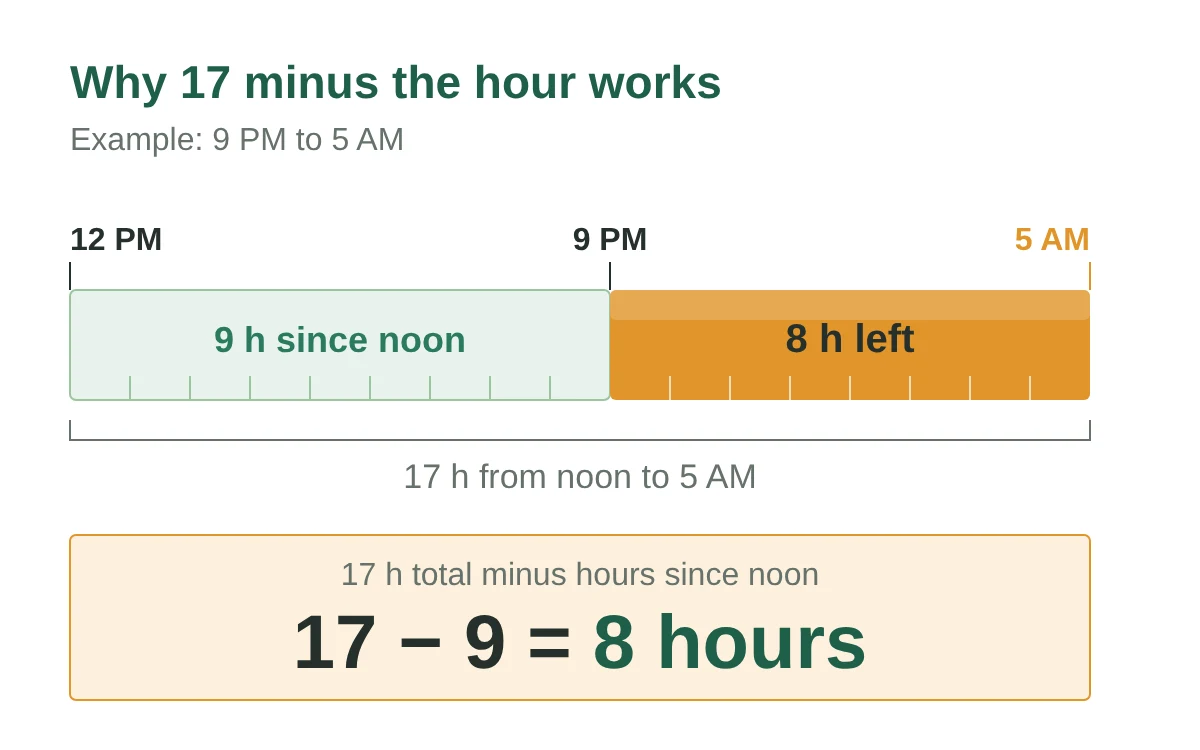
For any evening hour on a 12-hour clock, hours until 5 AM equal 17 minus the hour number. At 9 PM that is 8 hours. At 11 PM it is 6. The rule works because 5 AM sits 17 hours after 12 noon, so each hour that passes after noon takes one hour off the total.
For times after midnight but before 5, the rule is simpler: 5 minus the hour. At 2 AM there are 3 hours left. At 4 AM there is 1.
Between 5 AM and noon, use 29 minus the hour (24 plus 5). At 8 AM that gives 21 hours until the next 5 AM. Most people never need this version, but it explains why the answer shrinks by an hour per hour all day.
Minute maths that never fails
When the time has minutes, the cleanest method is to count to midnight first, then add 300. Five AM is exactly 300 minutes after midnight, so the number is easy to remember.
Take a hypothetical start of 11:25 PM. The minutes left until midnight are 35. Add 300 and you get 335 minutes, which is 5 hours 35 minutes. To convert, divide by 60: 335 is 5 remainder 35.
A second method suits mental maths. Round up to the next whole hour, then take away the extra minutes. From 10:40 PM, the whole-hour count (using 17 minus 10) is 7 hours. Subtract 40 minutes and you get 6 hours 20 minutes. If you need the conversion in the other direction, the time conversions page covers it.
Try this: Pick any time on the clock right now and work out the wait to 5 AM using the midnight-plus-300 method. Then compare it with the live counter above. If they differ, you almost certainly mixed up AM and PM.
Why people check this time
Five AM is a working boundary for a surprising number of routines. Early shifts, airport check-ins, gym openings, paper rounds, fishing trips and sunrise hikes all cluster around it. Students use it for revision deadlines, and people on night shifts use it to see how close the end of the shift is.
It also matters for markets and servers. A market that opens in another region, or a scheduled job that runs at 05:00 UTC, may land at an inconvenient local time. Check which zone the “5 AM” belongs to before you rely on it, because the hours left can change by several hours depending on the answer.
If your real target is a little later, the pages for 6 AM and 5:30 AM work in the same way.
The night the clocks change
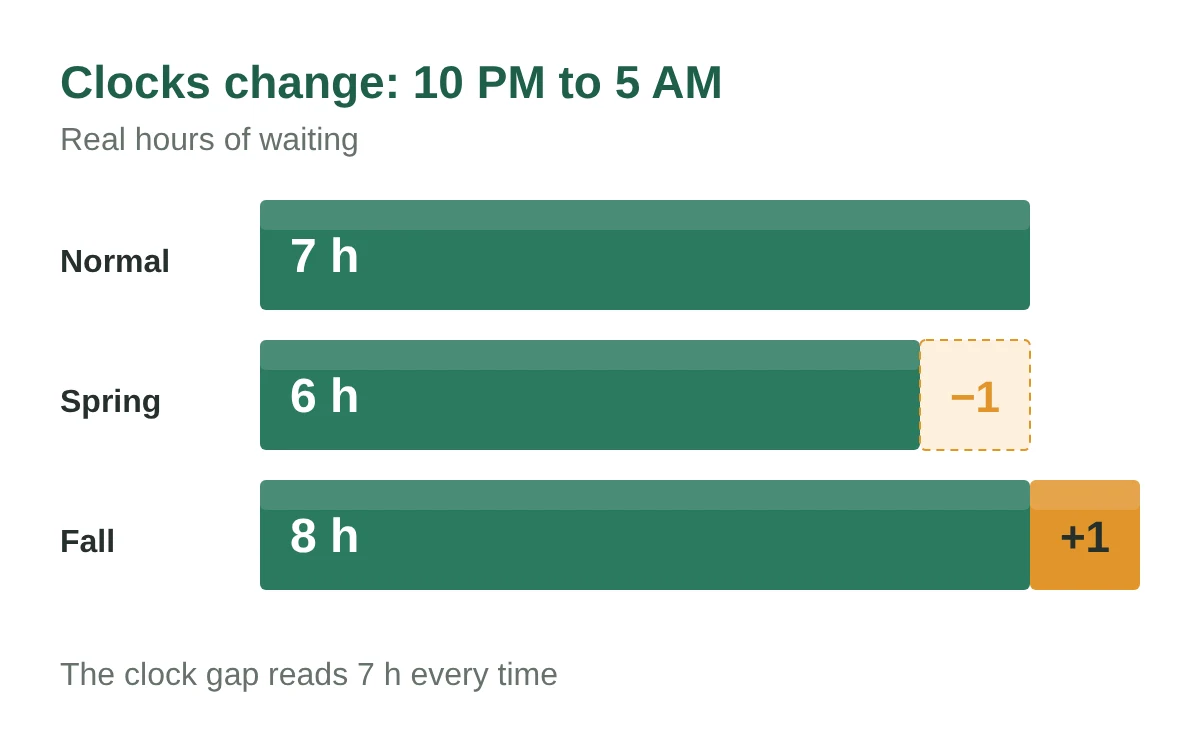
The simple subtraction fails on the night daylight saving time begins or ends. Take a hypothetical 10 PM start. On an ordinary night the gap to 5 AM is 7 hours. On the night clocks spring forward, one hour vanishes from the small hours, so the real time left is 6 hours even though the clock faces differ by 7. On the night clocks fall back, an hour repeats, and the real wait is 8 hours.
This matters most to anyone who sets an alarm manually or plans a trip by arithmetic. Phones adjust on their own, but a hand calculation does not. The live counter uses your device’s clock rules, so it handles the change correctly.
Most regions that change their clocks do so in the early hours of a Sunday, which means 5 AM is almost always already on the new time. That makes it one of the few times of day where the change is guaranteed to have taken effect.
When 5 AM is in another time zone
If someone says “5 AM” and they live elsewhere, convert first, then count. The most common error is to count from your own clock to their 5 AM figure as if both clocks were the same. Subtract the zone offset first.
For example, with a hypothetical 5-hour lead between two cities, 5 AM in the eastern city is midnight in the western one. The wait to it, from the western side, is simply the time left until midnight. Our midnight countdown covers that case.
Be careful in March and again in autumn. Countries do not switch clocks on the same weekend, so the gap between two cities can briefly differ by an hour for a few weeks. To see the current time in a US zone for comparison, the Central Time now page is a quick reference.
Counting back to a bedtime
Reversing the sum gives a bedtime. Sleep runs in cycles of about 90 minutes, so waking at the end of one tends to feel better than waking in the middle of one. Counting back from 5:00 AM in 90-minute steps gives 3:30, 2:00 and 12:30 for the three-cycle, four-cycle and five-cycle marks. From the other direction, falling asleep at 9:30 PM gives five full cycles (7.5 hours) before 5 AM.
Add about 15 minutes for falling asleep. So a bedtime for five cycles is roughly 9:15 PM, and for four cycles it is roughly 10:45 PM.
Try this: Choose the number of cycles you want (five is a common target), multiply by 90 minutes, then subtract that and 15 more minutes from 5:00 AM. The answer is your lights-out time.
Common mistakes
Most wrong answers come from one of four sources:
- Reading 5 as 5 PM, which is 17:00 and 12 hours away from 5 AM.
- Forgetting to add 24 hours when the starting time is later than 5 AM.
- Treating 12:30 AM as 12:30 PM, which swaps the whole result.
- Counting calendar days instead of elapsed time across midnight.
A useful sanity check is that the answer to “how long until 5 AM” must always be between 0 and 24 hours. If your sum gives a negative figure or one above 24, an AM/PM slip is the likely cause. For a quick check on offset questions, what is 8 hours from now shows the same clock-crossing logic in a forward direction.
The same method works for later morning targets such as 7 AM.
Frequently asked questions
How many hours until 5am if it is midnight?
Exactly 5 hours. Midnight is 00:00, and 5 AM is 05:00, so the gap is 300 minutes. That is the anchor for every other calculation.
What does the countdown show at exactly 5:00 AM?
Most countdowns jump to the next 5 AM, which is almost 24 hours away. The longest possible wait for 5 AM is always just under a full day.
Does daylight saving time change how long until 5am?
Yes, on the night clocks change. When clocks spring forward overnight, the real wait is one hour shorter than the clock face suggests. When they fall back, it is one hour longer.
How do I work out hours until 5am from a PM time?
Subtract the PM hour from 17. From 9 PM that gives 8 hours. If the time has minutes, subtract those minutes from the result.