
How Long Until 5:30 AM?
Around the world
The time left until 5:30 a.m. is the gap between your current clock time and the next 05:30 on that same clock. The live widget above computes it to the second using your device’s own time and zone. If 5:30 a.m. has already passed today, it counts to tomorrow’s.
Everything below is for checking the widget by hand, spotting the cases where a simple subtraction goes wrong, and using the number sensibly once you have it.
The one formula that always works
Convert your current time to minutes after midnight, subtract it from 330, and if the result is negative, add 1,440. That is the whole method. In symbols: remaining = (330 minus now) mod 1,440.
The add-1,440 step is what handles the awkward case. Most mistakes come from people who subtract only when 5:30 a.m. is still ahead and forget that a countdown at 2 p.m. is really a countdown to tomorrow. A negative answer is not an error. It is the formula telling you the target is on the next calendar day.
To get seconds, multiply the minutes by 60. Thirty minutes left is 1,800 seconds, and each extra hour adds 3,600.
A worked example with a made-up time
Suppose, purely as an example, it is 9:47 p.m. Here is the full calculation:
- Convert 9:47 p.m. to 21:47, which is 21 x 60 + 47 = 1,307 minutes.
- Subtract from 330: 330 minus 1,307 = negative 977.
- Add 1,440: 463 minutes.
- Convert back: 463 = 7 hours 43 minutes.
Check it with the next section’s shortcut and you should land on the same answer.
Try this: Pick a random time on any clock around you, run the four steps, then compare your result with the widget. Do it three times at different hours and the method becomes automatic.
The midnight shortcut
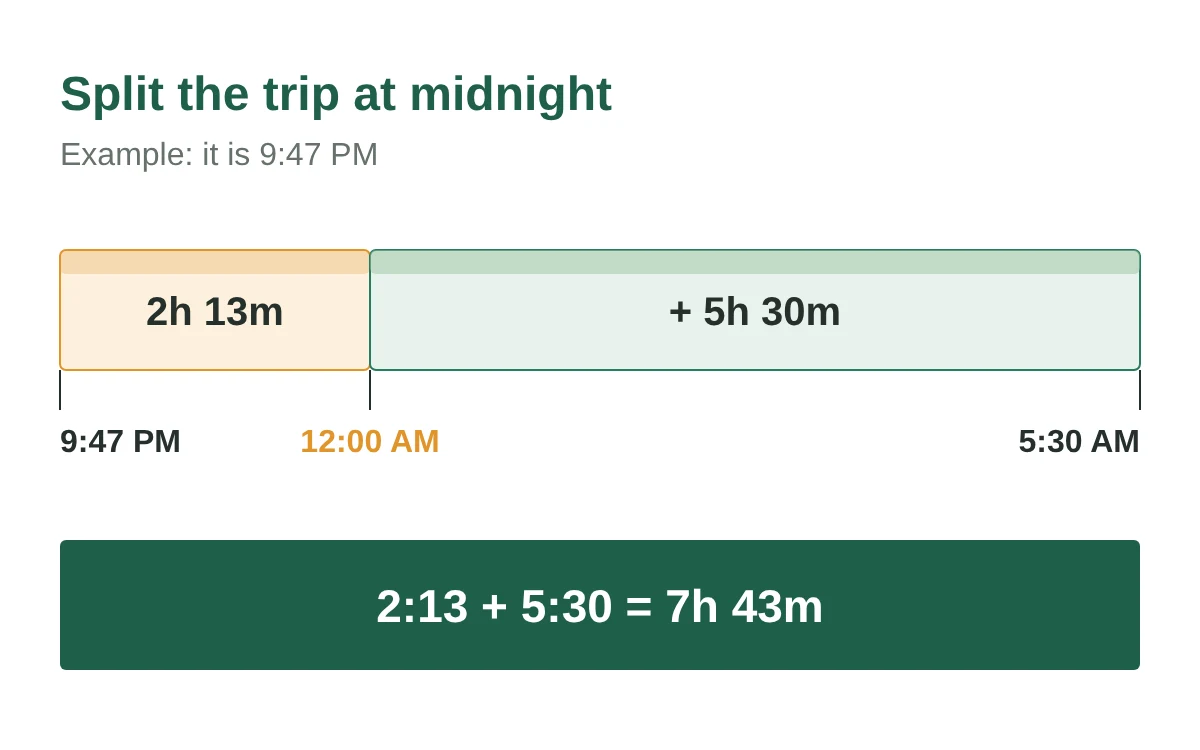
For any time between noon and midnight, there is a faster route that skips the 24-hour conversion. Work out the time to midnight, then add 5 hours 30 minutes. At 9:47 p.m., midnight is 2 hours 13 minutes away, and 2:13 plus 5:30 gives 7:43. Same answer, and easier in your head.
This works because midnight is the one point where the clock face resets, so the trip splits cleanly into two easy pieces. If the time to midnight is awkward, the page on how long until midnight covers that half on its own. After midnight, skip the shortcut: it is just 5:30 minus the current time, with borrowing from the hour.
What happens at exactly 5:30
At 5:29:59 the countdown shows one second. At 5:30:00 it reaches zero and then rolls over to a fresh 24 hours, because the next 5:30 a.m. is tomorrow. Some calculators show 24:00:00 for a moment instead, and others hold at zero. Both are reasonable, but only one reading means your alarm has gone off.
A related slip is mixing up the 12-hour pair. 5:30 a.m. and 5:30 p.m. are exactly 12 hours apart, and a countdown to the wrong one is off by half a day. If your target is the evening one, use how long until 5:30 PM instead.
Time zones and your device clock
The widget does not ask where you are. It reads the zone your device reports, so a laptop left on the wrong zone, or a phone using a VPN, gives a perfectly accurate answer to the wrong question. If the number looks off by a whole hour or more, check the system zone first.
Planning across zones works best when you convert the target, not the countdown. Decide what 5:30 a.m. is in the other place, then count in your own time. A handy quirk: India’s offset is UTC+5:30, so 5:30 a.m. in India is exactly midnight UTC. And 5:30 a.m. Pacific is 8:30 a.m. Eastern, the time many US economic reports are released, which is why traders on the West Coast treat it as a real deadline. Our central time now page helps if you need a quick zone check.
Clock-change nights
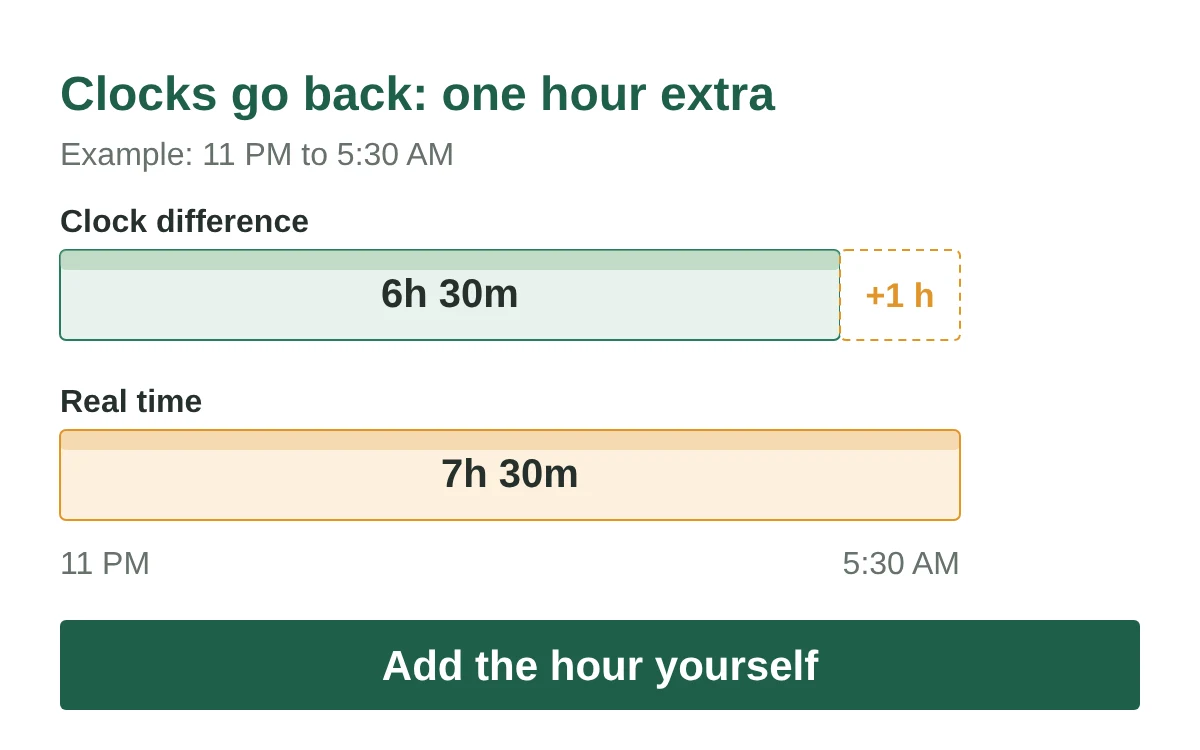
A countdown has two meanings: the difference on the clock faces, and the real time that passes. They agree on most nights. On a night when clocks go back, a countdown from 11 p.m. to 5:30 a.m. shows 6.5 hours on paper but is 7.5 hours in real time. When clocks spring forward, the reverse is true: you get one hour less than the subtraction suggests.
The widget accounts for this because it works with real elapsed time. Hand calculations do not, so add or subtract the hour yourself when the change falls inside your window. Regions change on different dates (the US and Europe do not move on the same weekend), which means the gap between two cities can briefly differ for a week or two.
Why people check, and what the number is useful for
The most common reasons are practical and a little different from each other:
- Early shift starts, bus pickups and school-run alarms, where the useful figure is the time before you must leave, not the time before 5:30.
- Flight check-ins and airport transfers, where 5:30 a.m. is often a departure from home rather than from the gate.
- Pre-market and overseas market hours, where a 5:30 a.m. local time can be mid-morning somewhere else.
- Workouts and early starts that people plan to the minute.
In all of these, the countdown to 5:30 is only half the plan. Subtract your travel or prep time and you get the real deadline. Nearby targets such as how long until 5 AM and how long until 6 AM are useful for building a buffer on either side.
Counting back from 5:30 for sleep
Sleep cycles run about 90 minutes, so a 5:30 a.m. wake-up lands cleanly at certain bedtimes. Count back from 5:30 in 90-minute steps:
- 5 cycles (7.5 hours): asleep by 10:00 p.m.
- 6 cycles (9 hours): asleep by 8:30 p.m.
- 4 cycles (6 hours): asleep by 11:30 p.m.
Most people take around 15 minutes to fall asleep, so aim for being in bed that much earlier. If you only need a flat block of sleep, 8 hours from now shows the matching clock time for any moment you choose.
Try this: Look at the widget tonight. If the countdown shows a multiple of 90 minutes (plus about 15 for falling asleep), you are in the sweet spot. If not, shift your bedtime to the nearest one.
If you often check other times of day, the countdowns to a time of day hub lists every target in one place, and time unit conversions handles the minutes-to-hours arithmetic when you want a different format.
Frequently asked questions
How many minutes is 5:30 a.m. after midnight?
5:30 a.m. is 330 minutes after midnight (5 x 60 + 30). In 24-hour notation it is 05:30, or 0530 in military style.
What if it is already past 5:30 a.m.?
The countdown moves to 5:30 a.m. tomorrow. By hand, add 24 hours (1,440 minutes) to the target before subtracting your current time.
Does the countdown change when daylight saving time starts or ends?
Yes, if a clock change falls between now and 5:30 a.m. A night that gains an hour has one more real hour to wait than the clock faces suggest, and a night that loses an hour has one fewer.
Is 5:30 a.m. the same moment everywhere?
No. The same instant is 5:30 a.m. only in zones sharing your offset. The live widget uses your device time zone, so a VPN or a wrong system setting can shift the answer.