
How Many Hours Until 6am?
Around the world
The number of hours until 6am depends on what time it is for you right now, so the live widget above gives the exact figure on your own clock and time zone. By hand, convert the current time to the 24-hour clock and subtract it from 30. If it is already past midnight and before 6am, subtract it from 6 instead.
Everything below is about doing that quickly in your head, and about the few situations where the obvious answer is off by an hour.
The 30 minus trick
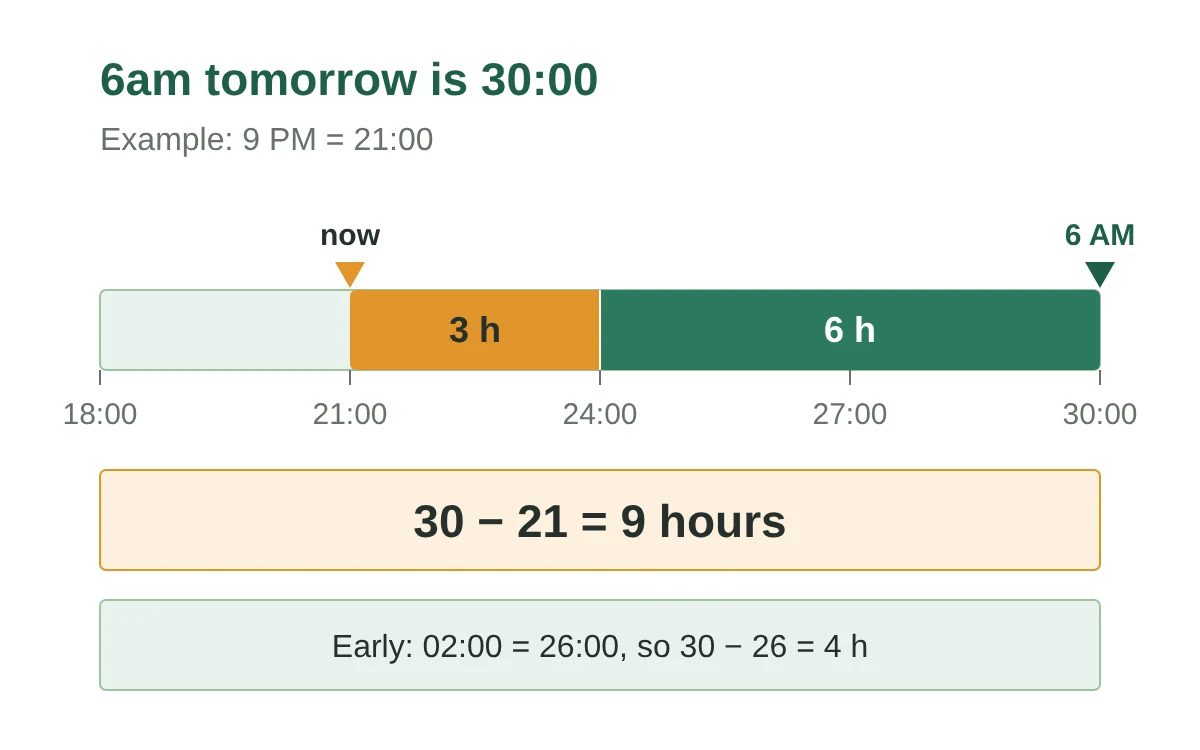
Most explanations tell you to add the hours left until midnight to 6. That works, but it needs two steps. A single step does the same job: treat 6am tomorrow as 30:00 (24 plus 6) and subtract the current time on the 24-hour clock. At 21:00, 30 minus 21 is 9 hours. At 15:00 it is 15.
The rule only applies to evening and daytime clock readings. From midnight to 5:59am you are already on the right side of the line, so just subtract from 6. Anyone who finds that split annoying can use the 30 version for everything by adding 24 to early-morning times first: 02:00 becomes 26:00, and 30 minus 26 is 4.
A handy check: at noon the answer is 18, and at 6pm it is exactly 12. Every hour that passes drops the answer by one, so you can anchor on those two points and count from whichever is closer.
A worked example with minutes
Take a hypothetical moment: 10:47 PM. On the 24-hour clock that is 22:47. Subtracting from 30:00 means borrowing an hour: 29:60 minus 22:47 gives 7 hours 13 minutes.
The shortcut that avoids borrowing is the complement. Find the minutes to the next full hour (60 minus 47 is 13), then count whole hours from that next hour (23:00 to 30:00 is 7). Result: 7 hours 13 minutes.
To check it, work in minutes. 22:47 is 1,367 minutes after midnight, and 6am tomorrow sits at 1,800. The difference is 433 minutes, which is 7 × 60 + 13. For converting between minutes and hours in either direction, the time conversions page has the factors.
Try this: Glance at a clock and predict the time left until 6am using the complement method before you look at the widget. Do it three times at random moments and you will rarely need a calculator for this again.
When “today” and “tomorrow” are the same 6am
If you ask at 1am, the 6am you mean is five hours away, even though many people would call it “tomorrow morning”. The label and the calendar date disagree after midnight. Calculators that always target the next occurrence handle this correctly, and a hand calculation does too if you stick to the subtract-from-6 rule.
The second edge is the exact moment of 6:00. At that instant the next 6am is 24 hours away, yet a simple “6 minus now” formula returns zero. Both answers are defensible, which is why alarms and schedules usually care about the strict “later than now” version.
When the clocks change overnight
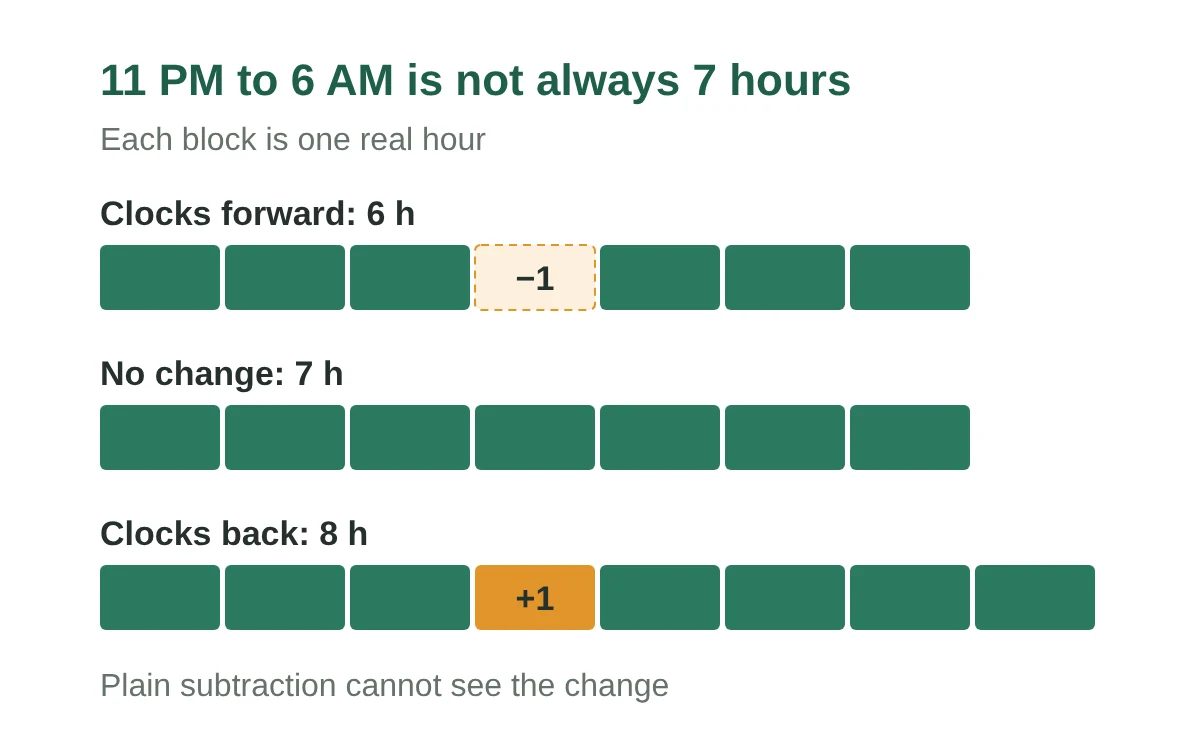
Nearly every clock change happens between midnight and 6am, which is the worst place for it if you are counting down to 6. On a night clocks go forward an hour, the span from 11pm to 6am is 6 real hours, not 7. When clocks go back, the same span is 8.
A plain subtraction cannot see this, because it only compares two clock faces. A live countdown that works from exact timestamps can. If you are working by hand, check whether your region changes the clocks on that date, and adjust by one hour in the right direction. Many regions have no clock change at all, so this only matters where one is observed.
Time zones and the device clock
The widget uses the time zone set on your device. A phone on airplane mode that has not updated, or a laptop with a VPN-driven location, can quietly put you in the wrong zone and shift the answer by whole hours.
When the 6am belongs to another place, such as a flight departure or a meeting in another city, convert it to your zone first and then count. Half-hour zones add a wrinkle: 6:00 in India is 00:30 UTC, so the offset is not a whole number of hours. For a quick sense of the other side of the day, the central time page shows what a given Central clock reading looks like.
Why people check, and what the number is for
The most common use is sleep. If you need to be awake at 6, subtract your sleep target from 6:00 to get a bedtime. Sleep is often described in cycles of roughly 90 minutes, so 7.5 hours (five cycles) points to 10:30 PM, and about 10:15 PM if you allow time to fall asleep.
The same arithmetic applies to early shifts, school runs, flights, and markets that open overnight in your zone. For trading, the useful habit is to convert the exchange’s opening time into your own zone once and then count to that, rather than counting to 6am on a local clock and hoping it lines up.
If you want to know when a block of time ends, rather than how long remains, 8 hours from now and 16 hours from now answer the reverse question. At 2pm, for example, you are exactly 16 hours from the next 6am.
Neighbouring times and quick references
A few reference points save arithmetic. Midnight to 6am is 6 hours, 360 minutes, or 21,600 seconds. Noon to 6am the next day is 18 hours. Each is a fixed anchor you can count from.
If your actual target is slightly different, the same method applies with a different constant. How long until 5am and how long until 7am cover the neighbours, and how long until midnight is the first half of the two-step method described above.
Common mistakes
- Mixing up 12 AM and 12 PM. Midnight is 12 AM, so 12 AM to 6 AM is 6 hours, while 12 PM (noon) to 6 AM is 18.
- Reading 6 PM as 6 AM. They are 12 hours apart, and a late-afternoon check at 6pm gives 12 hours, not 0.
- Forgetting to borrow. 30:00 minus 22:47 is not 7:53 or 8:13. Borrowing an hour first gives 7:13.
- Ignoring seconds. If you are reading a countdown to the second, an answer of “7 hours” may really be 6 hours 59 minutes and some seconds, depending on how the counter rounds.
Try this: Pick tonight’s planned bedtime, convert it to the 24-hour clock, and subtract it from 30. If the result is under 7.5, your plan cuts into a full five-cycle night.
Frequently asked questions
How many hours is it from midnight to 6am?
Six hours, or 360 minutes, on an ordinary night. On the night clocks go forward it is 5 hours of real time, and on the night they go back it is 7.
How many hours until 6am if it is 6am right now?
The next 6am is 24 hours away, because the current one has just arrived. Counters differ on whether they show 0 or 24 at exactly 6:00, so check the widget's wording.
How many hours from 10pm to 6am?
Eight hours. That is 2 hours to midnight plus 6 hours after it. Using the 24-hour clock, 30 minus 22 gives the same 8.
Does the countdown change if I travel to another time zone?
Yes. The widget reads your device clock, so it follows whatever zone your device is set to. If you want 6am in your home city while abroad, convert that time to your current zone first.