
How Many Hours Until 6 PM Today?
Around the world
The number of hours until 6 PM today is 18:00 minus your current time, and the live countdown above already does that on your own device clock, down to the second. If 6 PM has passed, it switches to tomorrow’s 6 PM, so a long result in the evening is expected, not a bug.
The rest of this page covers what the widget does not explain: a way to do the subtraction in your head without borrowing, the traps in converting minutes to decimals, and the situations where a clock-face answer and the real elapsed time disagree.
The 17:60 shortcut for counting in your head
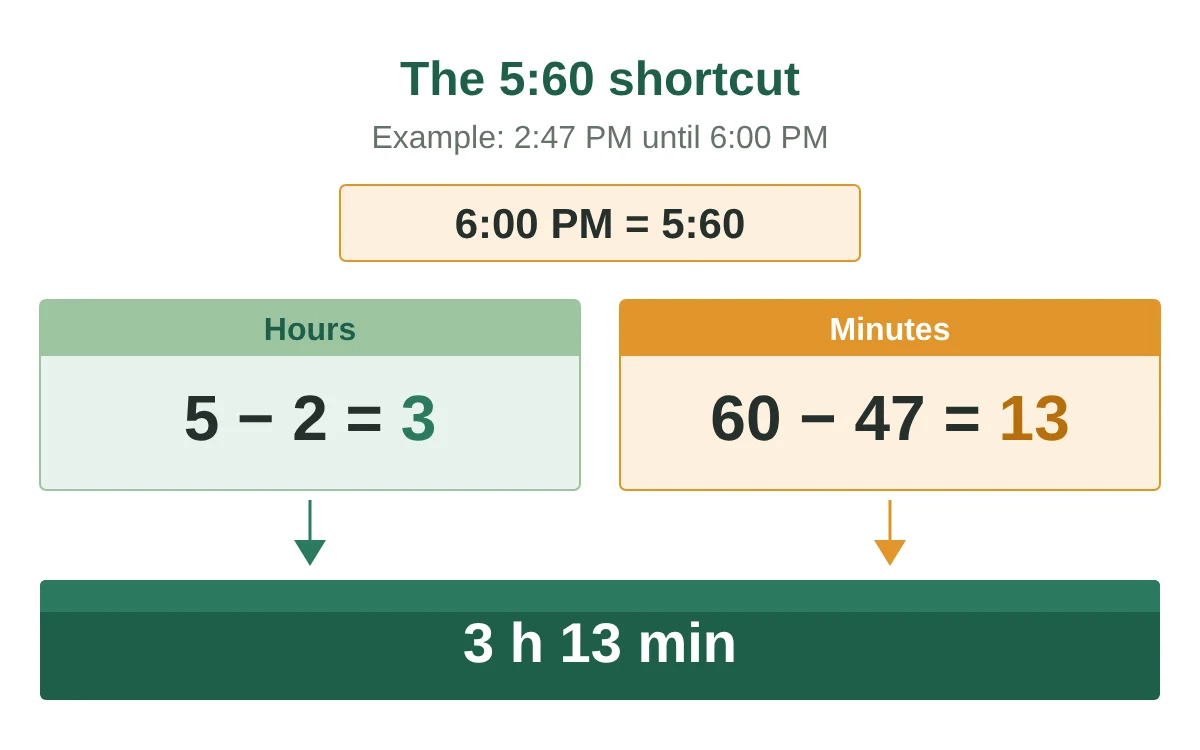
Subtracting a time like 14:47 from 18:00 forces you to borrow an hour. Skip that by treating 18:00 as 17:60. Subtract the hour from 17 and the minutes from 60, and the two results are your answer directly.
On a 12-hour clock with a PM time, use 5 instead of 17. At 2:47 PM, that gives 5 minus 2 hours and 60 minus 47 minutes: 3 hours 13 minutes. For morning times, use 17 minus the hour (9:20 AM gives 8 hours 40 minutes). The one exception is an exact hour such as 3:00 PM, where there is nothing to borrow, so the answer is simply 3 hours, not 2 hours 60 minutes.
Try this: Glance at any clock and, before checking the widget, say the time left until 6 PM out loud using the 17:60 trick. Then compare. Five or six tries and the borrowing disappears.
A worked example with a hypothetical time
Suppose a clock reads 1:48 PM (a made-up moment, used only to show the method). Run it in three steps:
- Hours: 5 minus 1 gives 4.
- Minutes: 60 minus 48 gives 12.
- Result: 4 hours 12 minutes, or 252 minutes.
Check by adding forward: 1:48 PM plus 4 hours is 5:48 PM, and 12 more minutes lands on 6:00 PM. Always verify this way, because an off-by-one-hour slip is the most common mistake in manual time maths.
If you want to count in minutes only, remember 6 PM is minute 1,080 of the day. Convert your current time to minutes after midnight (1:48 PM is 13 times 60 plus 48, which is 828) and subtract: 1,080 minus 828 is 252. The page on 100 minutes to hours covers the reverse conversion if you need it.
Why 2 hours 40 minutes is not 2.4 hours
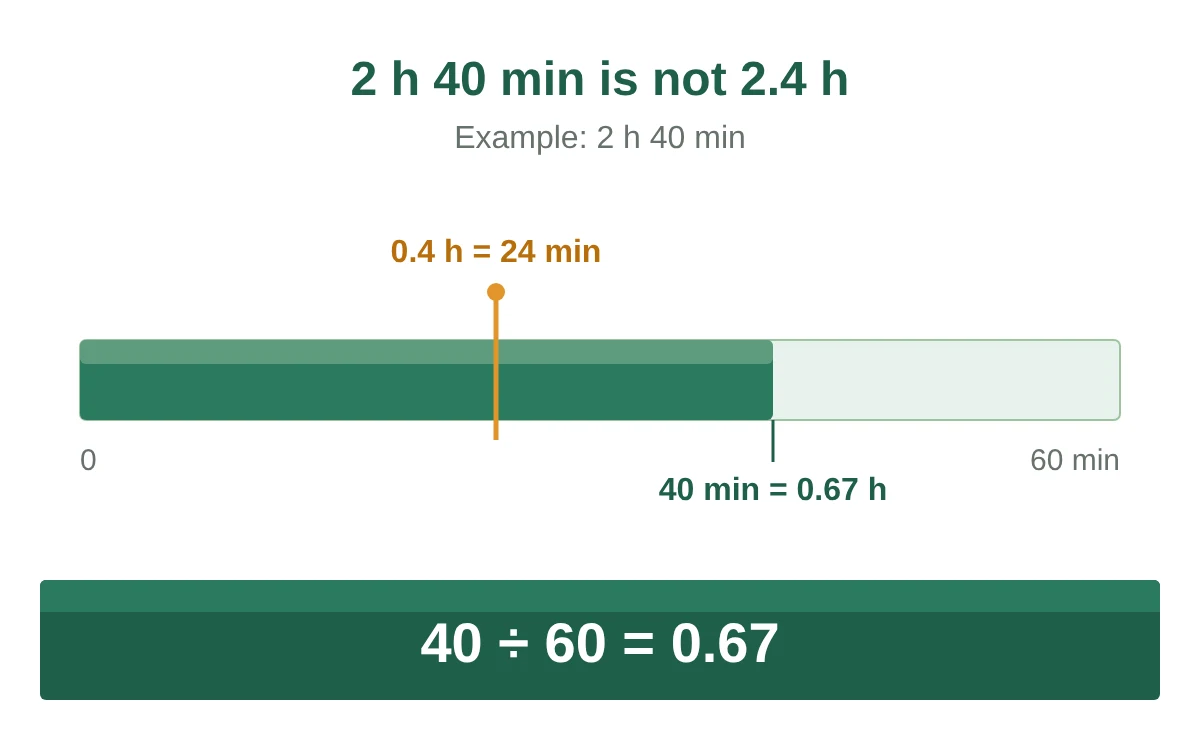
Hours and minutes are base 60, so the digits after a decimal point do not match the minutes. 2 hours 40 minutes is 2.67 hours, and 4 hours 12 minutes is 4.2 hours. Writing 2.40 is the classic error on timesheets and invoices.
The fix is to divide the minutes by 60. Useful anchors: 15 minutes is 0.25, 30 is 0.5, 45 is 0.75, and 6 minutes is 0.1. That last one is worth memorising, since every extra 6 minutes adds one tenth of an hour. If you are billing time up to a 6 PM finish, this is the number that keeps the invoice honest. More unit swaps are on the time conversions page.
When 6 PM has already passed
After 18:00, “today” no longer works. The next 6 PM is 24 hours after the last one, so the time left is 24 hours minus the time since 6 PM. At 8:15 PM, 2 hours 15 minutes have passed, which leaves 21 hours 45 minutes.
A quick sanity check: the answer should always fall between 0 and 24 hours. If your hand calculation lands outside that range, a day has gone missing or been counted twice. For a later evening target, how long until 7 PM works on the same logic, and how long until midnight gives the end-of-day figure.
Time zones and the clock being counted
The widget counts against the clock on the device in front of you. A VPN changes your apparent location but not your system clock, so the countdown ignores it. If you are waiting on someone else’s 6 PM, such as a colleague, a market or a shop in another city, convert their 6 PM to your time first, then count.
Offsets between regions are not constant through the year. London and New York are usually 5 hours apart, but for a couple of weeks each spring and autumn the two countries change their clocks on different dates and the gap becomes 4 hours. A recurring 6 PM call can quietly shift by an hour in your local time. To check a specific zone, Central Time right now shows what the clock reads there.
Daylight saving days change the real answer
Clock changes in most regions happen between about 1 AM and 3 AM, and 6 PM itself is never skipped or repeated. The catch is only for counts that start before the change. On a spring-forward day, the real time from 12:30 AM to 6 PM is one hour shorter than the clock difference suggests, and on a fall-back day it is one hour longer.
This matters if you set a countdown overnight. If you start counting after breakfast on changeover day, plain subtraction is exact. The widget uses the real elapsed time, so it will always be right, even when your mental arithmetic is not.
Try this: Next time clocks change in your region, work out the hours until 6 PM before bed, then again after waking. The one-hour jump shows exactly how the adjustment works.
Why people check 6 PM
For many offices, 6 PM is the soft end of an extended working day, and for shift workers it can be the start of an evening block. Counting down from a 9 AM start gives a 9-hour span, which helps in planning a lunch break and breaks. For a standard workday span, the page on 8 hours from now is the shorter version.
Traders watch it too. US stock markets close their regular session at 4 PM Eastern, but extended-hours trading continues until 8 PM Eastern, so 6 PM Eastern falls inside the after-hours session, where volume is thinner and spreads wider. For earlier cut-offs, how long until 5 PM is the usual office-close check.
Frequently asked questions
How many hours until 6 PM today?
The live countdown above reads your device clock and shows the exact hours, minutes and seconds left. By hand, subtract the current time from 18:00. If it is already past 6 PM, the remaining time is the gap to tomorrow's 6 PM.
What is 6 PM in 24-hour time?
6 PM is 18:00, written 1800 in military style. It sits exactly 1,080 minutes after midnight, which is handy if you prefer to subtract in minutes.
How long till 6pm if it is already evening?
Once 18:00 has passed, the next 6 PM is tomorrow. Add 24 hours to 18:00 before subtracting, or work out how long ago 6 PM was and take that away from 24 hours.
Does daylight saving time change how long until 6 PM?
Only if a clock change falls between now and 6 PM. Changes happen in the small hours, so after about 3 AM on a changeover day the count is unaffected. Before that, the real time left differs from the clock-face difference by one hour.