
How Many Days Until 2030?
Calendar
Countdown chart
The number of days until 2030 is the count from today to midnight at the start of Tuesday, January 1, 2030. The live widget above calculates it on your own clock, so it already reflects your time zone and the exact minute you opened the page. The rest of this page covers how to verify the number by hand and where counts tend to go wrong.
Because the answer changes every day, the useful skill is the method, not a memorized figure. Once you know three anchor numbers and one leap-day rule, you can check any count in under a minute.
Count to the start, not the end
“Until 2030” means until 2030 begins. The target is 00:00 on January 1, 2030, which is the instant 2029 ends. A countdown to December 31, 2030 is a different question (the end of the year 2030) and lands exactly 364 days later, because 2030 is a common year and the gap from January 1 to December 31 is one day short of 365.
This is the most common reason two countdown pages disagree. If a figure looks about a year too large, it is probably aimed at the wrong end of 2030. If it is off by one, it is probably a rounding choice (see the time zone section below).
A worked example by hand
Take a hypothetical starting date of March 15, 2027, and count to January 1, 2030. Split the span at year boundaries, because whole years are easy:
- March 15 to the end of 2027: March 15 is day 74 of the year (31 + 28 + 15). A common year runs to day 365, and January 1 of the next year is day 366 on that scale, so 366 minus 74 gives 292 days to January 1, 2028.
- January 1, 2028 to January 1, 2029: 366 days, since 2028 is a leap year.
- January 1, 2029 to January 1, 2030: 365 days.
Total: 292 + 366 + 365 = 1,023 days. As a check, 1,023 is 146 weeks plus 1 day, and March 15, 2027 is a Monday, so the count should land on a Tuesday. It does.
Try this: Pick any date within the next three years, split the span at January 1 of each year, and add the pieces. Then confirm the total with the date calculator. If the two differ, the usual culprit is a missed leap day.
Anchor dates that make it quick
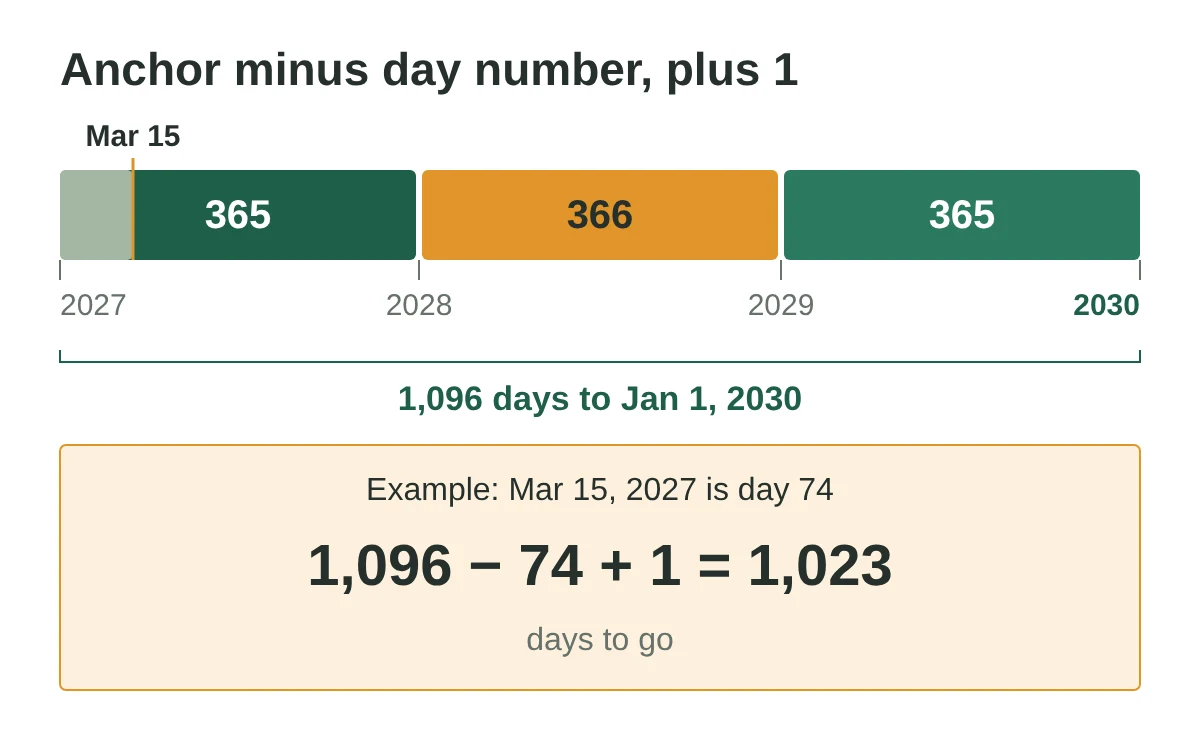
Memorize three distances to January 1, 2030: from January 1, 2027 it is 1,096 days, from January 1, 2028 it is 731 days, and from January 1, 2029 it is 365 days. The 1,096 includes the leap day, which is why it is one more than three times 365.
Then you only need the day of the year for your start date. Subtract it from the matching anchor, then add 1 to correct for day 1 being January 1 itself. For a date in 2028, for example, use 731 minus the day-of-year plus 1. The same trick works toward the next year boundary: the count to January 1, 2027 plus 1,096 gives the count to 2030 from the same starting day, with no leap-day bookkeeping.
The only leap day in the way
Between now and 2030, February 29, 2028 is the only extra day. Any count that starts on or before February 28, 2028 contains it. Any count that starts on March 1, 2028 or later does not. Forgetting it produces a result one day short, which is the classic by-hand error.
The four-year block from January 1, 2026 to January 1, 2030 is 1,461 days (4 x 365, plus the one leap day). That figure is handy for sanity checks: your count from any 2026 date should be at most 1,461.
Why your time zone changes the answer
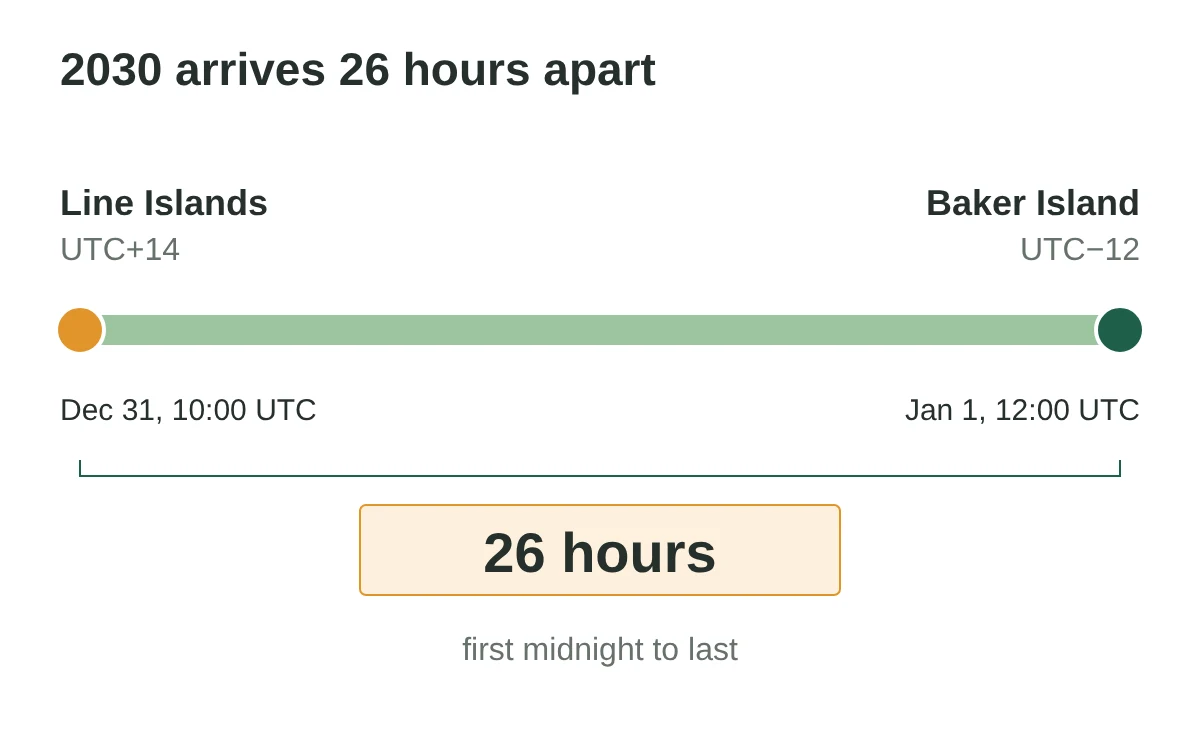
The widget counts to local midnight, so the answer depends on where you are. New Year arrives first in the Line Islands of Kiribati (UTC+14) and last at Baker Island (UTC-12), a spread of 26 hours. Two people opening this page at the same instant can legitimately see different day counts, and a person in Auckland reaches 2030 many hours before one in Los Angeles.
Partial days matter too. At 3 pm, the time left until midnight is under a day, and some tools round that up to a full day while others round it down. The widget shows the days, hours, minutes and seconds together, so there is no rounding to argue about. If you only need the final hours, how long until midnight works the same way for tonight.
Hours and minutes: why dividing by 24 can mislead
Converting a day count to hours by multiplying by 24 is correct for a plain calendar span, but a real clock does not always agree. In places that observe daylight saving time, the clock change in spring removes an hour and the one in autumn adds one. Several of those changes fall before 2030, so the true elapsed time to midnight can differ by an hour or more from days x 24.
Counting calendar days avoids the problem entirely, because a day on the calendar is one day regardless of its length in hours. For converting between units on a clean basis, the time conversions page is the place to start.
Try this: Multiply the widget’s day count by 24 and compare it to its hours figure. If the two differ by one, a daylight saving change sits between now and 2030 in your time zone.
Counting weekdays instead
For deadlines, you often want working days, not calendar days. Every full week holds exactly 5 weekdays, so divide the day count by 7, multiply the whole weeks by 5, and then count only the leftover days by name. In the example above, 146 full weeks give 730 weekdays, and the single leftover day is the Tuesday of January 1, 2030, bringing the total to 731 (counting January 1, not the start date).
Public holidays shrink that figure further, and they vary by country. January 1, 2030 falls on a Tuesday, so in most places the holiday is observed on the day itself instead of being moved to a Monday.
Does the 2030s decade start in 2030?
In everyday use, yes: the 2030s begin on January 1, 2030. Strictly, because the calendar has no year zero, a decade counted from year 1 would run 2031 to 2040. Both usages exist. Pages, products and “by 2030” targets almost always mean the first reading, so a countdown to January 1, 2030 is the right one for them.
Targets written as “by 2030” are usually deadlines that end on December 31, 2029 or, loosely, at the end of 2030. If an official target matters to you, check whether it names the start or the end of the year, since that choice shifts the count by a full year.
Doing it in a spreadsheet
In Excel or Google Sheets, type =DATE(2030,1,1)-TODAY() to get the whole-day count. The function TODAY drops the time of day, so the result is an integer. Use NOW() instead and you get a fraction, which you can format as days and hours.
To work with other targets or start dates, the days until hub lists many ready-made countdowns, and the date calculator accepts any two dates.
Frequently asked questions
How many days until 2030?
The live widget above counts to midnight at the start of Tuesday, January 1, 2030, using your own clock and time zone. To check it yourself, subtract today's date from January 1, 2030 in any date calculator or spreadsheet.
Is there a leap day between now and 2030?
Yes, exactly one: February 29, 2028. It adds a day to any count that starts before that date and ends in 2030. 2030 itself is a common year with 365 days.
What day of the week is January 1, 2030?
It is a Tuesday. December 31, 2029 is a Monday, so the final stretch of 2029 ends on a Monday night.
Why do some countdowns show a different number for 2030?
Some count to December 31, 2030 (the end of the year) instead of January 1, 2030 (the start). That gap is 364 days. Others round partial days up or down, or use a different time zone.