
How Many Days Until April 11th?
Calendar
Countdown chart
The live counter above gives the exact answer for your clock and time zone, down to the second. The next April 11 is a Sunday (April 11, 2027), and the rest of this page covers how to get the same number yourself, why different sites disagree by one day, and how to turn it into weeks, weekdays and useful milestones.
April 11 is a fixed date, so the countdown restarts every year. Once the day passes, the target moves to the following April 11, and the live widget switches automatically.
The by-hand method with a worked example
Count what remains of the current month, add the full months in between, then add 11. Take a purely hypothetical start of September 14 in a non-leap stretch, aiming at April 11 of the next year:
- Rest of September: 30 minus 14 gives 16
- October, November, December, January, February, March: 31 + 30 + 31 + 31 + 28 + 31 gives 182
- April: 11
The total is 16 + 182 + 11 = 209 days. The one trap is February. If a February 29 falls between your start and April 11, add one more day.
A faster route: the day of the year
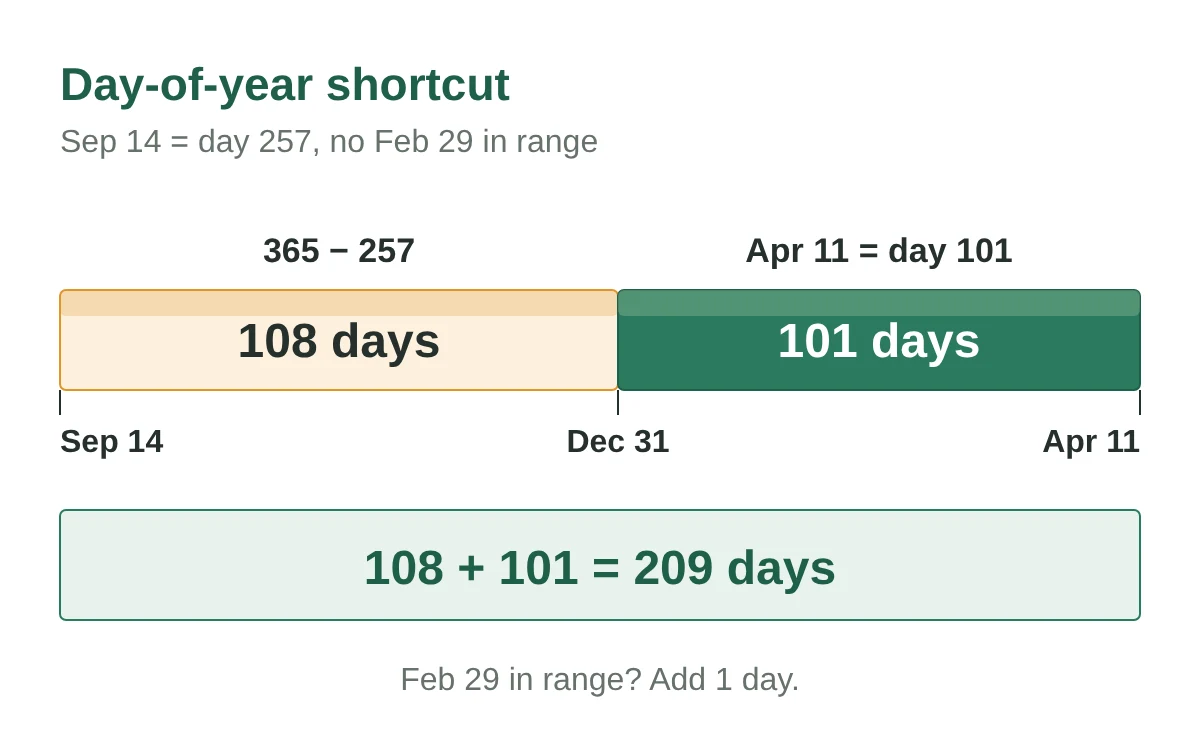
April 11 is day 101 of a normal year and day 102 in a leap year. That lets you skip the month-by-month addition: take the days left in the current year (365 minus today’s day number) and add 101.
Check it against the example above. September 14 is day 257, so 365 minus 257 leaves 108, and 108 + 101 is 209. Same answer, one subtraction fewer. In a leap year, use 366 and 102 instead.
Try this: Pick any date this year, find its day number (month lengths summed, plus the day), and run the day-of-year shortcut. Then compare with the live widget. If you are off by one, the cause is almost always a leap year or an inclusive count.
Does today count?
Two sites can show answers one day apart and both be right. The standard convention, and what the spreadsheet formula =DATE(2027,4,11)-TODAY() returns, is exclusive: today is not counted, so tomorrow is 1 day away. Some calculators count today in full instead, which adds one. A published comparison of this exact countdown states that its answer counts today in full, so it will sit a day higher than an exclusive count.
For a countdown, exclusive is almost always what you want. Choose inclusive only for things like a trip where the first and last days are both lived days. For a gap between two arbitrary dates, the date calculator lets you handle either convention.
Counting weeks and weekdays to April 11
Divide the day count by 7: the quotient is whole weeks and the remainder is the extra days. In the worked example, 209 days is 29 weeks and 6 days. Because 2027’s April 11 is a Sunday, a start date that is also a Sunday always gives a remainder of zero.
Weekdays need one extra step: multiply full weeks by 5, then check the leftover days one by one. The hypothetical September 14 is a Monday, so 29 weeks give 145 weekdays, and the 6 leftover days run Tuesday to Sunday, adding 4 more. That is 149 weekdays, before subtracting any public holidays. Do not use days × 5/7 as an exact answer, since it can be off by a day or two depending on the weekday you start from.
In a spreadsheet, NETWORKDAYS(start, end) counts both end dates if they are weekdays, so subtract one when your start is today and you want to exclude it.
Clock changes and time zones
A countdown in days is immune to daylight saving. A countdown in hours is not. In the United States, clocks go forward on March 14, 2027, and in the EU on March 28, 2027. Any count in hours that spans those dates is one hour short of days × 24, because one local day lasts 23 hours.
Time zones matter at the edges. April 11 begins in Auckland roughly 17 to 19 hours before it begins in Los Angeles, so someone in New Zealand reaches the date well before someone on the US West Coast. The live widget uses your device’s zone, so it reaches zero at your own local midnight. If you are coordinating with someone abroad, agree on whose midnight counts. The midnight countdown shows the time left today in your zone.
What April 11 is known for
April 11 is not a national holiday in the United States or the UK, but it carries several recognised days:
- National Pet Day in the US
- World Parkinson’s Day, held on the birthday of James Parkinson
- Juan Santamaría Day, a public holiday in Costa Rica
In history, Apollo 13 launched on April 11, 1970, and the Titanic made its last stop at Queenstown (now Cobh) in Ireland on April 11, 1912. In astrology, the date falls under Aries, which runs until April 19.
For deadlines, the date sits just before US federal tax day, normally April 15. In 2027 that is a Thursday, only four days after April 11, so the April 15 countdown is the natural companion. Western Easter 2027 falls on March 28, which puts April 11 two weeks after it, a point that matters for school break planning.
The weekday pattern across years
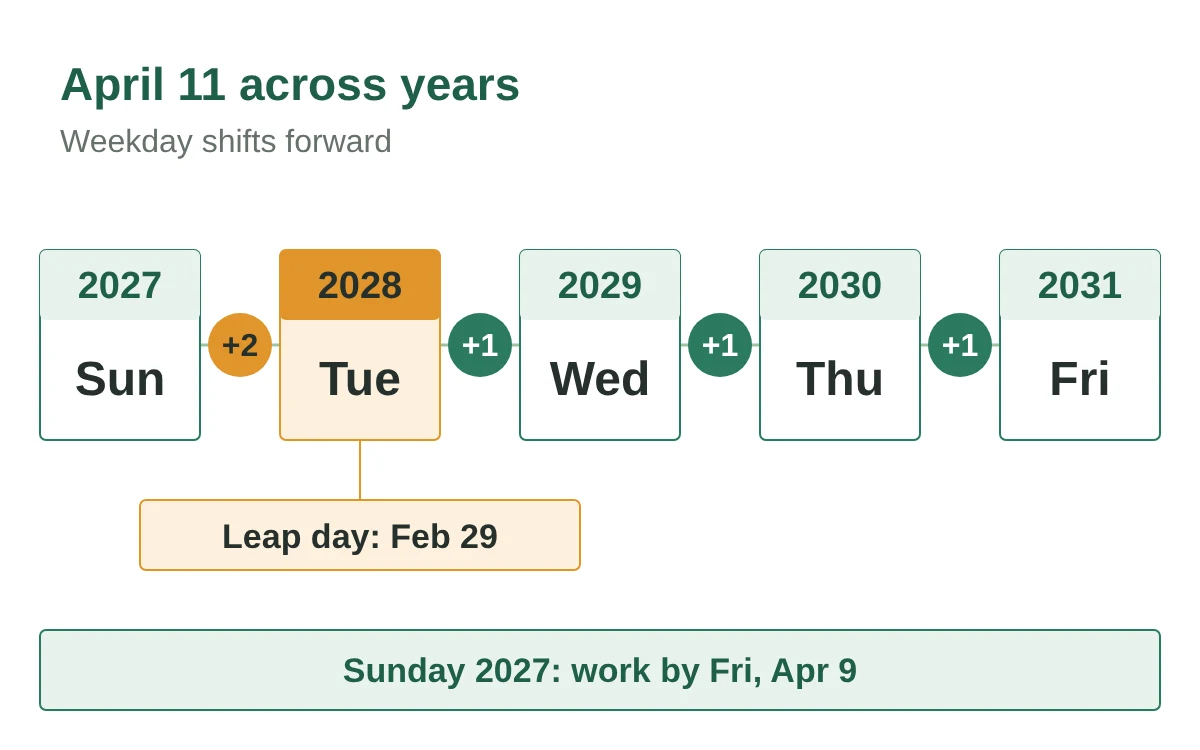
The weekday of a fixed date moves forward one day each year, and two days after a leap day passes. April 11 is a Sunday in 2027, a Tuesday in 2028 (the jump of two comes from February 29, 2028), then Wednesday, Thursday and Friday in 2029, 2030 and 2031.
This is useful when the date is a deadline. A Sunday target means the last working day before it is Friday, April 9, and the first one after is Monday, April 12. If a payment or delivery must land on a business day, count to those dates instead. The April 9 and April 12 countdowns cover each one.
Planning milestones before April 11
Working backwards from a fixed date gives round numbers that are easy to remember. In a non-leap year, April 11 is exactly 100 days after December 31, so the 100-day mark lands on New Year’s Day. The January 1, 2027 countdown is the same checkpoint. Day 90 before is January 11, and the 30-day mark falls on March 12.
Weekly planning is easier when you stack the milestones on Sundays, since April 11 itself is one. Every multiple of 7 days before it is also a Sunday, so a 12-week plan has twelve clean Sunday checkpoints with no extra arithmetic. For a plan measured in months, the April countdown gives the start of the month instead.
Try this: Write April 11 at the top of a page, then list the Sundays going back 4, 8 and 12 weeks. Assign one task to each date and check them off as each Sunday passes.
Frequently asked questions
Use the questions below for the quick answers, and the live widget above for the exact number on your clock.
Frequently asked questions
Does the countdown to April 11 include today?
The standard convention is exclusive: today is not counted, so tomorrow is 1 day away. This is also what the spreadsheet formula =DATE(2027,4,11)-TODAY() returns. Some calculators count today in full, which makes their answer one day higher.
What is the quickest way to calculate days until April 11 without adding up months?
Use the day of the year. April 11 is day 101 in a normal year and day 102 in a leap year, so add 101 to the days left in the current year (365 minus today's day number). In a leap year, use 366 and 102 instead.
What day of the week is April 11, and does it change each year?
April 11, 2027 is a Sunday. The weekday of a fixed date moves forward one day each year, or two after a leap day, so April 11 is a Tuesday in 2028, then Wednesday, Thursday and Friday in 2029, 2030 and 2031.
Why can a countdown in hours be off by one hour around April 11?
A countdown in days is unaffected by daylight saving, but one in hours is not. Any hour count that spans the spring clock change, such as March 14, 2027 in the US or March 28, 2027 in the EU, is one hour short of days times 24, because one local day lasts only 23 hours.