
How Many Days Until April?
Calendar
Countdown chart
The live countdown above gives the exact answer for your own clock and time zone, down to the second. If you are reading this in April itself, it counts to the start of next April, because the month you are standing in has already begun.
The number it shows is the gap between now and 00:00 on April 1. That detail explains why different sites report numbers that differ by one, and the sections below show how to check the result yourself and what can quietly change it.
What the countdown actually measures
“Until April” is ambiguous. It can mean the moment April begins (midnight at the start of April 1), the first full day of April, or the end of the month on April 30. The widget uses the first meaning: the instant April 1 starts on your device’s clock.
Whole-day counts differ by convention. Some sites count today as a full day, which adds one. Others count only complete midnights still ahead of you. A countdown that shows days, hours and minutes avoids the argument, since the remainder is visible: 100 days and 6 hours is simply a little over 100 days.
If you need the count for a different purpose, such as a deadline on April 30, use the April 30 version of the sum, not the April 1 version. For a specific date, the pages for April 2nd or April 15th do the work directly.
Calculating it by hand with day-of-year numbers
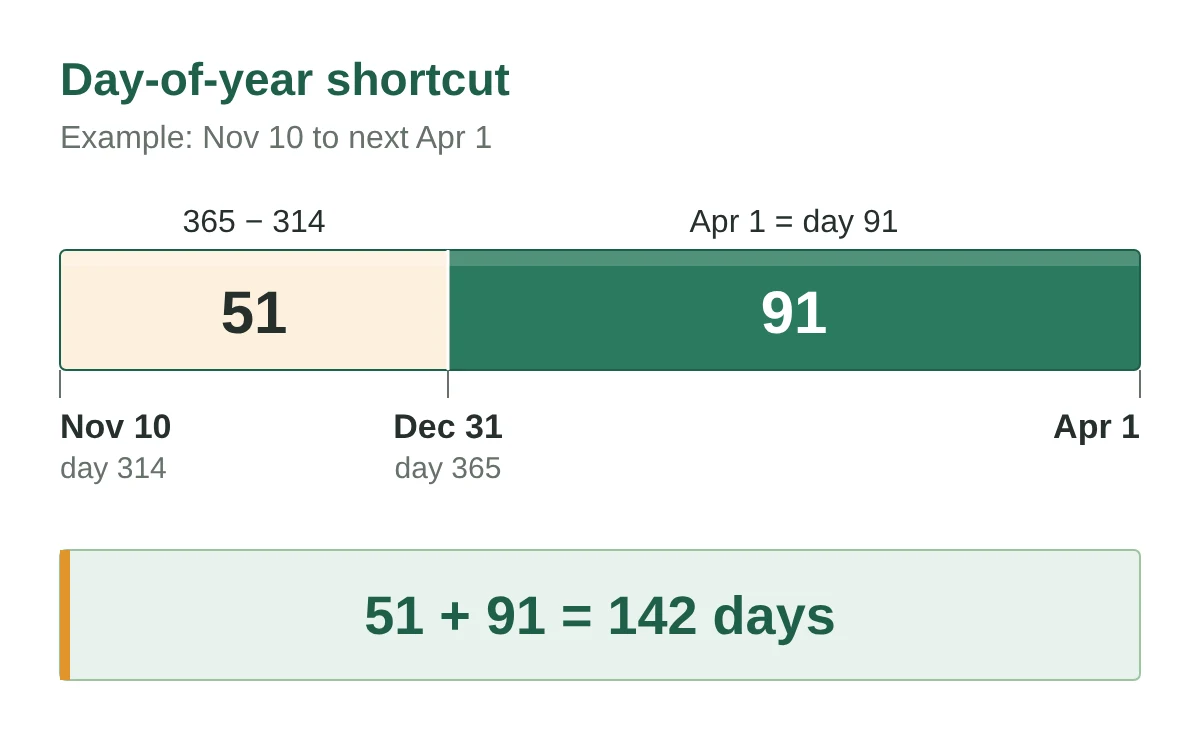
Month-by-month addition invites slips. A cleaner method uses day-of-year numbers. In a common year, April 1 is day 91 (31 + 28 + 31 days for January to March, plus 1). In a leap year it is day 92.
Take a hypothetical starting date of November 10. Its day number is 314 (304 days through October, plus 10). A common year has 365 days, so 365 minus 314 leaves 51 days to the year’s end. Add 91 for April 1 of the following year and the total is 142 days.
You can verify it the long way: 20 days left in November, then 31 for December, 31 for January, 28 for February, 31 for March, and 1 to land on April 1. That is 142 again. If a calculator and your hand sum disagree by one, the cause is almost always whether today was counted.
Try this: Pick any date in the next few weeks and work out the gap to April 1 using the day-of-year method: (365 minus your day number) plus 91. Then check it against the date calculator. If you are off by one, find out which side counted today.
The leap year trap
If February 29 falls between now and April 1, the count is one higher than the common-year arithmetic suggests. The rule is simple, but it catches people who memorise “91” as the day number of April 1 and reuse it every year.
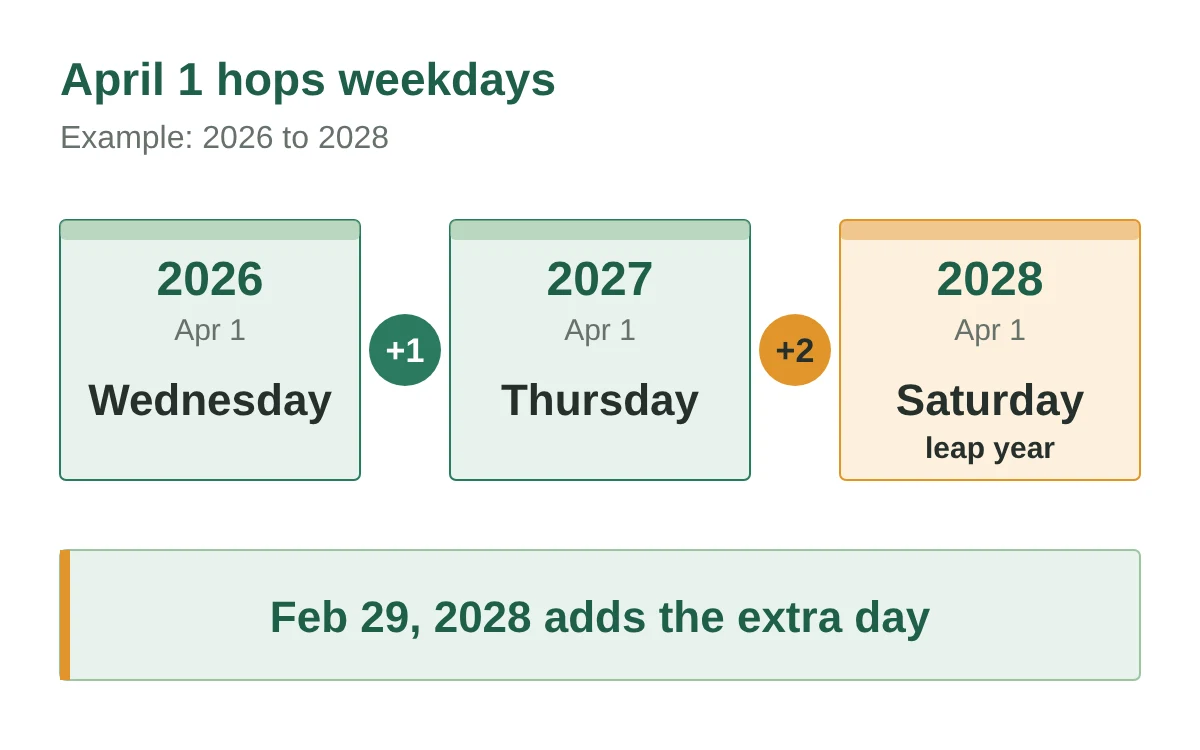
The count only changes when the leap day is still ahead of you. From a date in November 2026, the next April 1 is in 2027, which has no leap day. But a countdown started in, say, December 2027 toward April 1, 2028 crosses February 29, 2028 and runs a day longer. Start a countdown after February 29 and the leap day no longer matters for that year’s April.
The same logic applies to anything measured across March. The March 1st countdown is the point where the leap day has just passed or is about to count.
Time zones and daylight saving
April does not start everywhere at once. Auckland reaches April 1 many hours before Los Angeles does, so two people looking at “days until April” can legitimately see different numbers for part of the day. The widget uses your device’s time zone, so the answer matches your wall clock, not UTC.
Daylight saving adds a subtler wrinkle. In the United States, clocks spring forward in March, and the European change comes at the end of March. A countdown that crosses that change contains one 23-hour day. If you multiply the day count by 24 to get hours, you will be off by one hour. Counting by calendar dates, as the widget does, avoids the error.
For a point-in-time check on a particular clock, how long until midnight shows the final stretch of any day, which is the stretch April 1 begins with.
Converting days into weekdays
Most people asking this question really want working days or weekends. Divide the day count by 7. Each full week holds 5 weekdays, and the remainder days need a look at the calendar. For the 142-day example, 142 is 20 weeks and 2 days, which gives 100 weekdays plus however many of the 2 leftover days are Monday to Friday.
April 1 itself shifts weekday from year to year: one weekday later each common year, two after a leap year. That is why an April 1 deadline feels like a Tuesday one year and a Thursday the next. Public holidays inside the window, such as Christmas Day and New Year’s Day, remove further working days, so subtract them after the weekday count.
Try this: Take the day count shown in the widget, divide by 7, and multiply the whole weeks by 5. Add only the weekdays among the leftover days. That is your working-day estimate in about thirty seconds.
Counting to a specific April date
April 1 is only the threshold. Add the day of the month minus 1 to the countdown to reach any later April date. April 15, the common US tax deadline, is 14 days after the April 1 figure. Easter is movable: it can land anywhere from March 22 to April 25, so some years it falls before April starts at all.
April also has fixed dates people search for on their own, such as April 6th and April 25th. Each of those counts to its own midnight, so the “minus 1” shortcut applies. If your target is the start of the following month, how many days until May 1st is the natural next stop, and how many months until May gives the broader view.
Common mistakes that shift the answer by a day
Three errors account for nearly every disagreement. The first is counting both the start and end dates, which inflates the total by one. The second is forgetting that April 1 begins at midnight, so “April 1 at 9 a.m.” is not zero days away at 00:00. The third is mixing up “until April” with “until the end of April”, which differs by 29 days because April has 30.
A fourth, rarer one is trusting a cached page. A static article quoting “125 days” is wrong the next day. A live counter reads your clock each time it loads, which is why the figure above is the one to rely on.
FAQ
Answers to the questions most often asked about this countdown are listed in the FAQ section of this page. faq:
- q: “How many days until April 1?” a: “The live countdown at the top of the page shows the exact number for your own clock and time zone. It counts to 00:00 on April 1, so the figure reaches zero at the very start of the day.”
- q: “Does the count include today?” a: “The widget counts the time remaining until midnight at the start of April 1, so today is counted only as the part of the day still left. Sites that count today as a full day will show a number one higher.”
- q: “Is April 1 always 91 days into the year?” a: “In a common year, April 1 is day 91. In a leap year, February 29 pushes it to day 92.”
- q: “How many days are in April?” a: “April has 30 days. That means April 30 is 29 days after April 1.”
Frequently asked questions
Why do different sites show a different number of days until April?
The usual cause is whether today is counted as a full day. Some sites add one for today, and others count both the start and end dates, which also inflates the total by one. A countdown that also shows hours and minutes removes the ambiguity.
Does a leap year change how many days are left until April 1?
Only if February 29 still lies ahead of you. A countdown that crosses February 29 runs one day longer, while one started after the leap day is unaffected for that year's April.
How do I find the days until a later April date like April 15?
Take the count to April 1 and add the day of the month minus 1. For April 15 that means adding 14 days, because each April date is counted to its own midnight.
Can daylight saving time make multiplying days by 24 give the wrong hours?
Yes. A spring clock change inside the window creates a 23-hour day, and a fall change creates a 25-hour day, so days times 24 can be off by an hour. Counting by calendar dates avoids the problem.