
How Many Days Until April 6th?
Calendar
Countdown chart
The live countdown above gives the exact answer for the next April 6, calculated on your own device clock and time zone. It repeats every year, so once April 6 passes, the counter simply points to the following one. The rest of this page covers how to check the number yourself and where the usual mistakes come from.
The next April 6 falls on a Tuesday (April 6, 2027). That matters if you are counting working days, planning travel or booking something that cannot happen on a weekend.
What the countdown is really measuring
A countdown to a date normally targets the first moment of that day, 00:00 local time. So on the morning of April 5 the counter shows a few hours, not “1 day” and not “0”. If you want to reach the end of April 6 instead, add one day to whatever you read.
Time zones shift this too. Someone in Auckland reaches April 6 many hours before someone in Los Angeles. If you are counting to an event in another city, use that city’s clock rather than your own.
Counting by hand with day-of-year
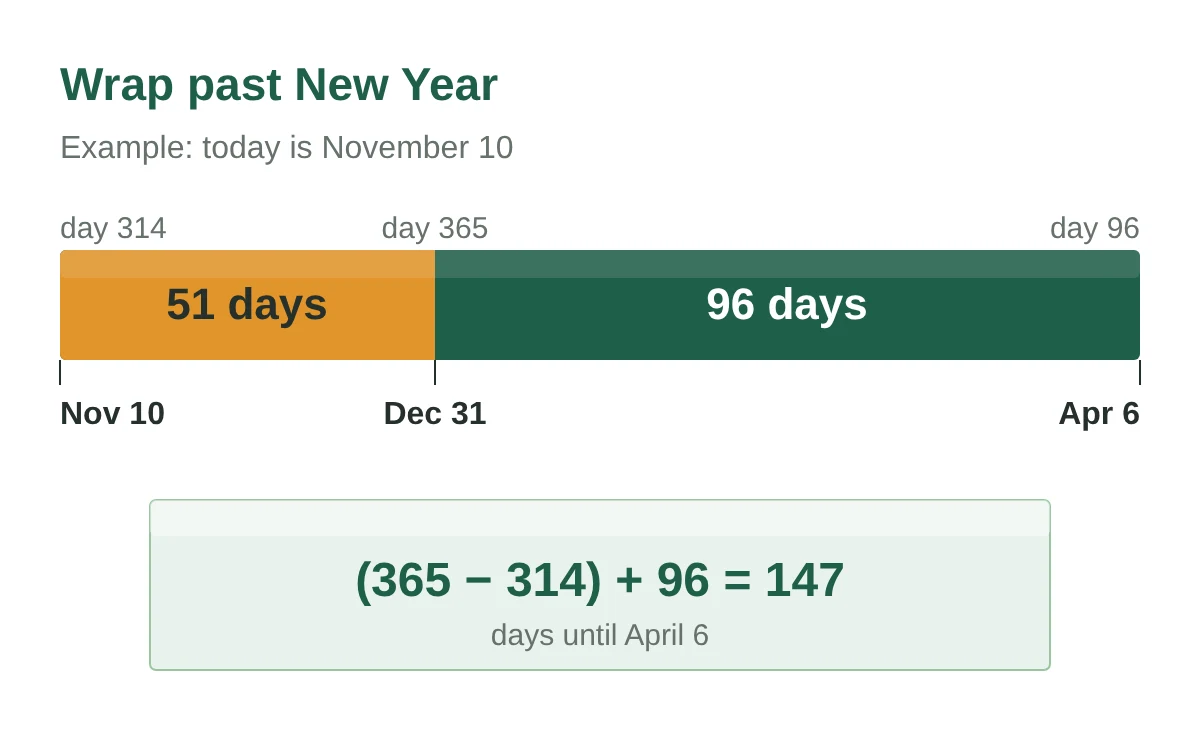
The fastest manual method skips month-by-month arithmetic. April 6 is the 96th day of 2027, and it is day 97 in any leap year, because April 6, 2040 is the 97th day of that leap year. Subtract today’s day-of-year from that number and you have the answer, as long as you are counting within the same calendar year.
If today falls after April 6, subtract today’s day-of-year from 365 (or 366), then add 96 (or 97). That handles the year boundary without counting months. Most people get stuck here because they try to add partial months and lose a day somewhere.
A worked example
Take a hypothetical start date of November 10, in a year where the next February has 28 days.
- Days left in November: 30 minus 10 is 20.
- Add December (31), January (31), February (28) and March (31): that is 121.
- Add the 6 days of April: 20 plus 121 plus 6 is 147.
Check it by another route: November 10 is day 314 of a common year, so 365 minus 314 is 51 days to the new year, plus 96 gives 147. Both methods agree.
If the span includes a February 29, add one day. That is the only edge case in this calculation, and it only affects counts that cross a leap day.
Try this: Pick any date you like, work out the count to April 6 with the day-of-year method, then confirm it in the date calculator. If the two differ by exactly one, you have a leap day or an inclusive-versus-exclusive slip.
Counting weekdays and weeks
Divide the day count by 7 to get whole weeks and a remainder. The weekday count is five per whole week, plus however many weekdays fall in the leftover days. Whether the remainder holds weekdays depends on the weekday you start on. For the 147-day example above, 21 whole weeks means exactly 105 weekdays with no remainder to worry about.
When the span is an exact multiple of 7, the start and finish land on the same weekday. This gives a quick sanity check: if your start day and April 6 fall on different weekdays, your day count cannot be divisible by 7.
Weekday counts from other sites often disagree by one. The reason is whether the start day, the end day, or both are counted. Decide that first. For a deadline, the end day usually counts as a working day only if work is still possible on it. Public holidays are never subtracted automatically, so take those off yourself. In 2027, Good Friday and Easter Monday fall before April 6 in many countries, because Easter is March 28. If you are curious about that date, see how many days until March 28th.
The hour trap when clocks change
Multiplying days by 24 to get hours is accurate only if no clock change sits between now and April 6. In most of the United States and Canada the clocks go forward on the second Sunday of March, and in much of Europe on the last Sunday of March. A count that crosses one of those dates contains one fewer real hour than days times 24.
The live widget uses your local clock, so it already handles this. A hand calculation or a spreadsheet that works in plain 24-hour blocks will be an hour out. For converting between units without this problem, the time conversions page is the safer route.
Which weekday April 6 lands on
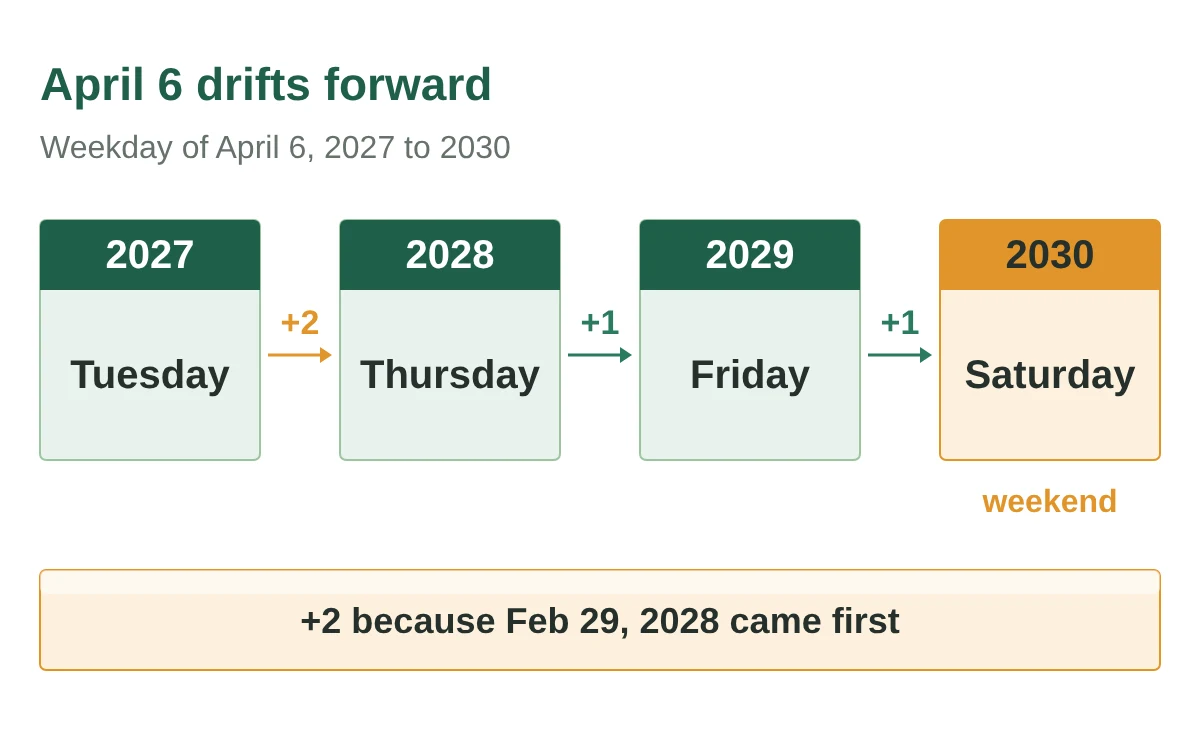
April 6 moves forward one weekday each year, or two after a leap day has passed in between. That produces a predictable sequence: Tuesday in 2027, Thursday in 2028 (the jump comes from February 29, 2028), then Friday in 2029 and Saturday in 2030. The same shift is noted in the pattern of one day forward each year, or two after a leap year.
So if April 6 is a deadline that you can only meet on a working day, check the year first. In 2029 and 2030 it will be a Friday and a Saturday, so the practical deadline moves.
Try this: Write down the weekday of April 6 for the next four years, then circle any that fall on a weekend. Those are the years where a “by April 6” plan needs an earlier real date.
What April 6 is known for
The date carries a mix of history and observances, and a few are well documented. National Tartan Day honors Scottish heritage in the United States, and it was chosen for the 1320 Declaration of Arbroath. Thailand observes Chakri Day on April 6, honoring the 1782 founding of the Chakri dynasty, and it is a public holiday there.
The modern Olympics also began on this date: the first modern Olympic Games opened in Athens on April 6, 1896. Greece still used the Julian calendar then, so locally the opening was dated March 25. The United Nations also marks the International Day of Sport for Development and Peace on April 6. In California, the law was amended in 1973 to designate April 6 as California Poppy Day. In the United States, the date also marks the anniversary of the country’s entry into World War I in 1917.
Easter Monday sometimes lands on April 6. It did in 2026, but not in 2027, so check the year before assuming a public holiday.
The UK tax year starts on April 6
In the United Kingdom, the personal tax year runs from April 6 to the following April 5. The odd date is a leftover from the 1752 calendar reform, which dropped 11 days. The old tax year start of March 25 became April 5, and a further adjustment in 1800 moved it to April 6.
For anyone in the UK, the April 6 countdown is therefore also the countdown to new allowances, new rates and a fresh savings or pension allowance period. In the United States, the better-known tax date is April 15; see how many days until April 15th.
Planning around the countdown
Work backwards in blocks that fit the way you work. For a project due on April 6, a deadline expressed in whole weeks (for example, 8 weeks before, which is 56 days, see 8 weeks in days) is easier to schedule than a raw day count. Mark the weekly checkpoints on the same weekday as the due date.
If April 6 is a milestone and not a deadline, such as a trip, a birthday or an exam, compare it with nearby dates. How many days until April shows the start of the month, which is useful for splitting the run-up into two stages.
FAQ
Use the questions below for the short answers.
Frequently asked questions
Does the countdown to April 6 include April 6 itself?
A countdown normally targets 00:00 local time at the start of April 6, so it stops counting as the day begins. To count through the end of April 6, add one day to the number shown.
What day of the week is April 6 in 2027 and the years after?
April 6 is a Tuesday in 2027, a Thursday in 2028 (the jump of two comes from February 29, 2028), a Friday in 2029 and a Saturday in 2030.
Why does the UK tax year start on April 6?
The 1752 calendar reform dropped 11 days, which moved the old March 25 start of the tax year to April 5. An 1800 adjustment pushed it one more day to April 6, and the tax year still runs from April 6 to the following April 5.
Which day of the year is April 6?
April 6 is day 96 in a common year and day 97 in a leap year, because February 29 adds one day earlier in the calendar. Subtracting today's day-of-year from that number gives the days remaining within the same year.