
How Many Days Until April 12th?
Calendar
Countdown chart
The live countdown above gives the exact answer. It runs on your own clock and time zone, so it is correct for where you are. This page covers what that number means, how to check it by hand, and the traps that make two countdowns disagree.
April 12 comes around every year, so the widget always targets the next one. April 12, 2027, is a Monday, and the weekday changes from year to year, which matters if you are planning around it.
Why two counters can disagree
Two honest countdowns can differ by one day, and the cause is nearly always a counting rule. Some tools count today as a full day and stop at the start of April 12. Others stop at the end of April 12. A third group subtracts the dates and ignores the time of day. All three are defensible, but they give different numbers for the same moment.
Time zone is the second source. April 12 begins at different instants around the world, so a countdown fixed to UTC can be off by up to a day for someone in Los Angeles or Auckland. The widget above uses your device’s zone, which is why its number can differ from a screenshot a friend sends from another country.
When you need a number for a contract, a ticket or a deadline, decide the rule first: is April 12 itself included, and which clock governs it?
Count it by hand with one subtraction
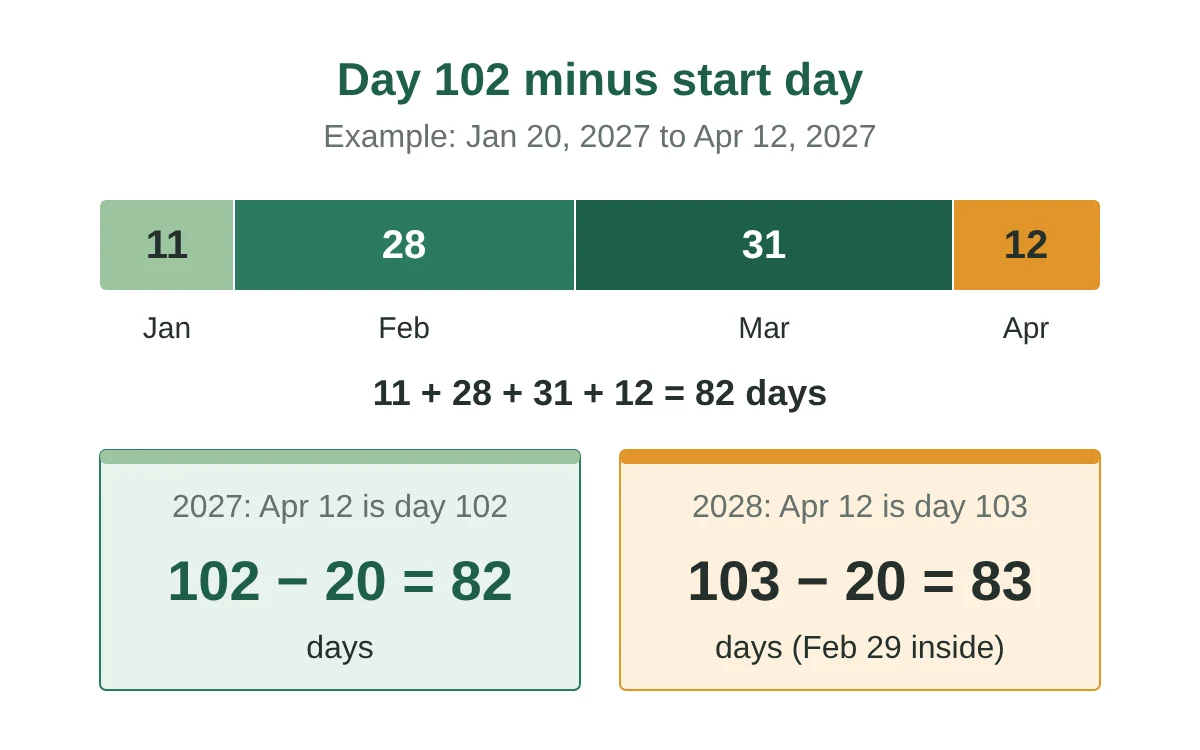
The fastest method is day-of-year arithmetic. April 12 is day 102 of a normal year (31 + 28 + 31 + 12) and day 103 in a leap year. Find the day-of-year of your start date, then subtract it from 102.
Worked example with a hypothetical start: January 20 is day 20. In a normal year, 102 minus 20 is 82 days. In a leap year the target is day 103, so the answer is 83. The only time Feb 29 matters is when it falls between your start and April 12, so the leap year that counts is the one containing the Feb 29 in your span.
To check yourself, add the pieces: 11 days left in January, 28 in February, 31 in March, then 12 in April gives 82. If your two methods disagree, one of them probably counted the start day.
Weeks and weekdays to April 12
Divide the day count by 7 and keep the remainder. In the example, 82 days is 11 weeks and 5 days. The remainder tells you how the target day sits against your start: 5 days after a Wednesday is a Monday. For a quick weeks-to-days conversion, the 8 weeks to days page shows the same idea at a different size.
For working days, count the full weeks first (11 weeks is 55 weekdays), then check which of the leftover days are Saturday or Sunday. With a Wednesday start, the five leftover days are Thursday, Friday, Saturday, Sunday and Monday, so three more weekdays, for 58 in total (counting April 12 but not the start day).
Public holidays are a separate subtraction. Good Friday, Easter Monday and similar days vary by country and sometimes land close to April 12, so a weekday count is an upper limit for work planning.
The daylight saving trap in hour counts
Day counts are safe, but hour counts can be off by one. Clocks in the US and most of Europe spring forward in March, before April 12. If you start counting in winter, the real number of elapsed hours is one less than days times 24, because the night the clocks change has only 23 hours.
The reverse can happen in parts of the Southern Hemisphere, where clocks often go back around early April. A countdown that ignores this will be an hour out for people there.
Try this: Take the day count from the widget, multiply by 24, then subtract 1 if you live somewhere that springs forward before April 12. Compare it with the widget’s hours. They should match.
The weekday April 12 lands on
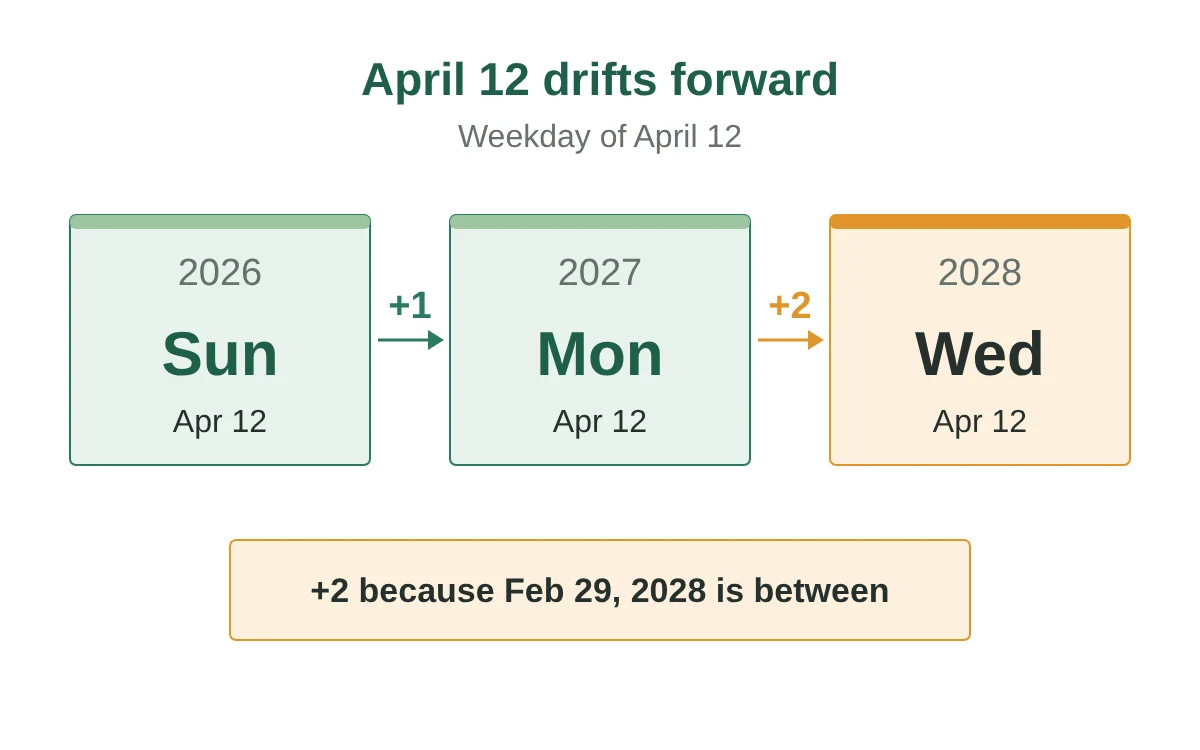
A fixed date moves one weekday later each year, and two after a leap year. It shifts forward by 1 day each year (or 2 days after a leap year). That is why April 12 is a Monday in 2027 and a Wednesday in 2028. In 2028 the extra jump comes from Feb 29.
The practical effect is on how many working days you have. Years when April 12 falls on a Saturday or Sunday often push deadlines and events to the following Monday, which can shorten or lengthen a plan by a couple of days.
What April 12 is known for
April 12 has a strong association with spaceflight. On this date in 1961, Yuri Gagarin became the first person in space, and the United Nations marks it as the International Day of Human Space Flight. Russia observes it as Cosmonautics Day. Exactly 20 years later, in 1981, the first Space Shuttle mission, Columbia’s STS-1, launched on the same date.
It also has American history attached. Confederate forces opened fire on Fort Sumter on April 12, 1861, the start of the Civil War, and Franklin D. Roosevelt died on April 12, 1945. North Carolina marks Halifax Day for the Halifax Resolves of 1776.
Easter can land on it too, since Western Easter ranges from March 22 to April 25. It fell on April 12 in 2020, for example, and the next time will be years away, so check the calendar rather than assuming.
April 12 and the tax deadline
In the US, the federal income tax filing deadline is normally April 15, only three days after April 12. It moves when April 15 lands on a weekend or the Washington, DC, Emancipation Day holiday, which is why some years it falls on April 16 or 17. If April 12 is your personal cutoff to file early, the days until April 15 page gives you the extra runway.
If you are comparing nearby dates, the days until April 11 and days until April 13 pages let you see how a one-day shift changes your plan.
Planning backward from April 12
A countdown is most useful when you work backward from it. Split the total into fixed milestones: 12 weeks before for bookings, 6 weeks before for invitations or applications, 2 weeks before for final checks. Using whole weeks keeps each milestone on the same weekday as April 12.
The date calculator can subtract any number of days from April 12 for you. If your plan runs past the date, the follow-on dates are just as easy to count, such as May 1.
Try this: Pick one task due by April 12. Subtract 28 days and write down the date. That is when you should have a draft finished, and it lands on the same weekday as April 12.
Frequently asked questions
Why does my countdown to April 12 show a different number than another website?
Counters use different rules: some count today as a full day, some stop at the start of April 12, and others stop at the end of it. Time zone also matters, since a countdown fixed to UTC can be off by up to a day for someone far from that zone. Deciding whether April 12 itself is included and which clock governs settles most disagreements.
How do I calculate the days until April 12 by hand?
Subtract the day-of-year of your start date from 102, which is April 12's position in a normal year. In a leap year April 12 is day 103. A leap year only changes the answer when Feb 29 falls between your start date and April 12.
What is April 12 famous for?
On April 12, 1961, Yuri Gagarin became the first person in space, and the date is now the International Day of Human Space Flight. The first Space Shuttle mission, STS-1, launched on April 12, 1981, and Fort Sumter was fired on April 12, 1861, opening the US Civil War.
Does daylight saving time change a countdown to April 12 in hours?
It can. Where clocks spring forward in March, such as the US and most of Europe, a countdown started in winter has one fewer hour than days times 24 because one night is only 23 hours long. Day counts are not affected.