
How Many Days Until April 22nd?
Calendar
Countdown chart
The exact answer is in the live countdown above, calculated from your own clock and time zone, so it is always right for where you are today. If you want to check it yourself, the fastest method is to compare day-of-year numbers: April 22 is day 112 in a normal year and day 113 in a leap year.
The sections below cover that shortcut, how to count weeks and working days, the edge cases that cause off-by-one mistakes, and what is worth planning around on this date.
Which April 22 is the countdown aiming at?
The widget targets the next April 22 that has not yet started on your clock. Before April 22, that means this year’s date. From the moment the date begins until the end of the year, it jumps to next year’s. On April 22 itself it shows zero days, because the day has arrived even though it is not over.
This matters if you are planning around a specific year. A countdown that rolls over automatically is handy for a recurring date, but for a one-off event two years out, use the date calculator and enter the full date.
The day-of-year shortcut
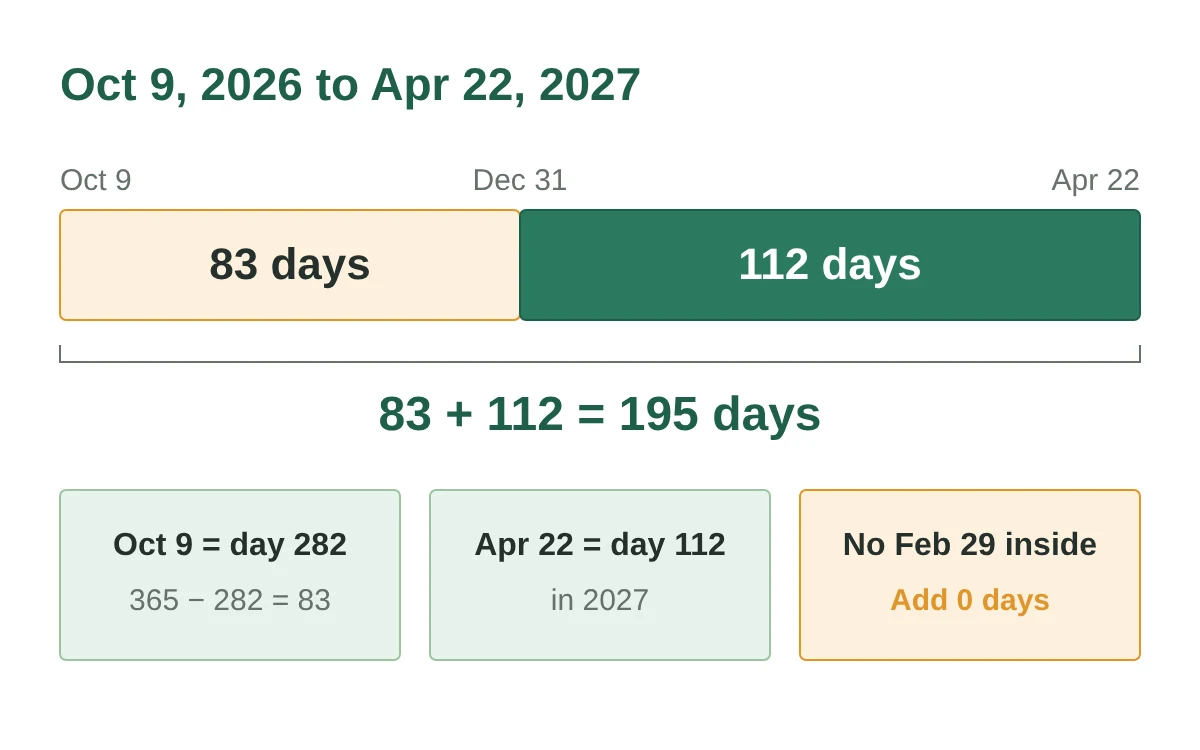
Subtracting month by month is slow and error-prone. Day-of-year numbers turn it into one subtraction. In a non-leap year, April 22 is day 112 (31 + 28 + 31 + 22). Any date’s day number minus 112 gives the distance, and if the start date falls later in the year, add the days remaining in that year first.
Worked example with a hypothetical start of October 9, 2026:
- October 9 is day 282 of 2026 (273 days through September, plus 9).
- Days left in 2026: 365 minus 282 is 83.
- Add 112 for April 22, 2027.
- Total: 195 days.
Check it the long way: 22 days to the end of October, plus 30, 31, 31, 28 and 31 for November through March, plus 22 in April, also gives 195. The one trap is February. If a February 29 sits between your start date and April 22, add one day. In a leap year, March and April dates all shift up by one, so April 22 is day 113.
Try this: Pick any start date and compute the gap twice, once by day-of-year and once month by month. If the two answers differ, the culprit is almost always February or an end-of-month day count.
Counting weeks and weekdays
Divide the day count by 7 and keep the remainder, because the remainder is what decides the weekday math. In the example above, 195 days is 27 weeks and 6 days. Since April 22, 2027 is a Thursday, the start date in that example (October 9, 2026) must be a Friday, and the arithmetic confirms it: six days past a weekday is one weekday earlier.
For working days, multiply the full weeks by 5, then count the weekdays in the leftover stretch by walking backward from the target. The example gives 27 × 5 = 135, plus 4 weekdays in the final six days (Saturday through Thursday), so 139 weekdays counting April 22 itself. Public holidays are not removed by this method, so subtract them separately.
Off-by-one and time zone traps
Two people can get different answers for the same date and both be right. Counting from today to April 22 excludes one end, while counting every calendar day on the list includes both. Online counters often disagree by one for this reason, and weekday counts disagree by one more when the start or end falls on a weekday.
Time zones add a second layer. The widget counts to local midnight at the start of April 22. A friend two time zones east will see the date arrive earlier by your clock. Daylight saving can also bend hour counts: in places that spring forward in March, the stretch to April 22 holds one hour fewer than days times 24. Places that end daylight saving in early April, such as Australia and New Zealand, gain an hour instead.
Why the weekday keeps shifting
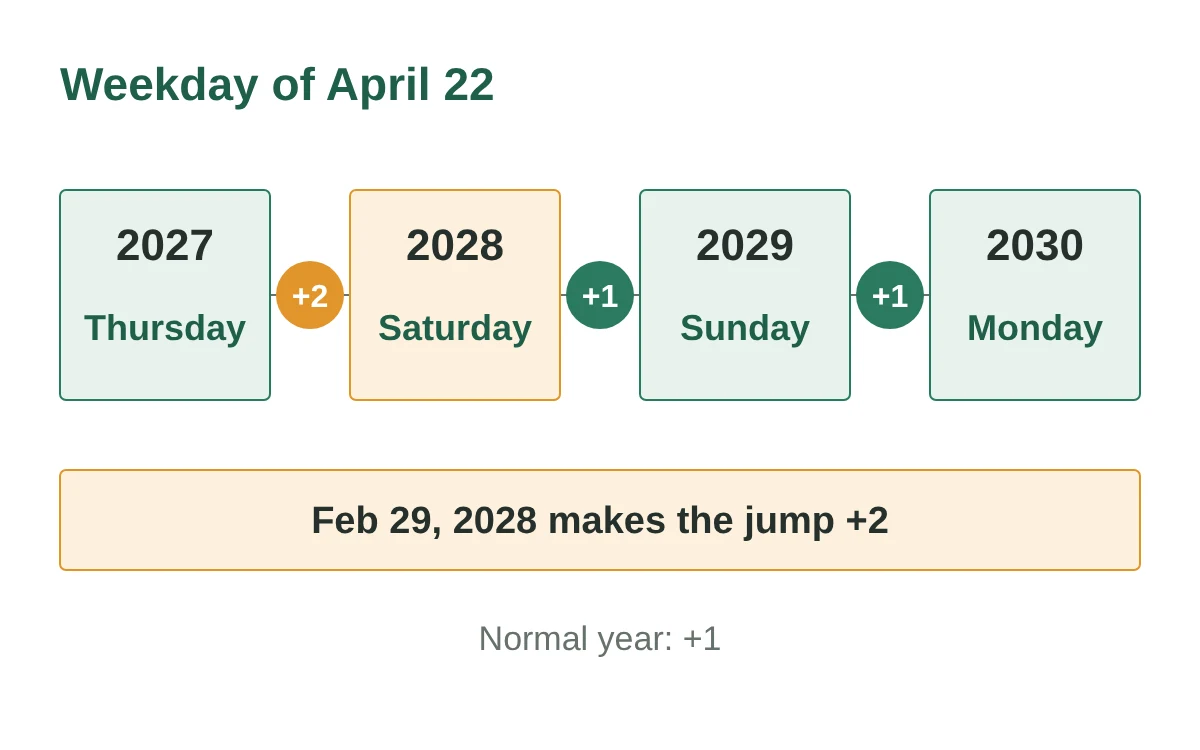
April 22 shifts forward by 1 day each year, or 2 days after a leap year. One fixed date therefore cycles through the whole week over time. April 22, 2027 is a Thursday, 2028 is a Saturday, 2029 is a Sunday and 2030 is a Monday. The jump from Thursday to Saturday is the leap year in action: 2028 has a February 29, so the weekday moves two steps.
The same logic works for any date in the Gregorian calendar. If you know last year’s weekday and whether the February in between had 29 days, you know this year’s.
What April 22 is known for
April 22 is Earth Day, first held in 1970 and now observed in many countries. The United Nations also recognises it as International Mother Earth Day. It is a day for cleanups, tree planting and school activities rather than a day off.
It also falls inside the possible range for Easter, which can land anywhere from March 22 to April 25, so in some years a Christian holiday weekend overlaps with this date. The Lyrid meteor shower, active in mid to late April, peaks around April 22, and a dark sky helps most when the Moon is thin. In the United States, April 22 comes about a week after the usual income tax filing date, a useful anchor if you are tracking April 15 as well.
Try this: Search an Easter calendar for the year you are planning. If Easter falls within a week of April 22, book travel and venues earlier, since that stretch gets busy.
Planning backwards from April 22
A countdown is most useful when it is cut into milestones. Work backward in blocks of whole weeks so every checkpoint lands on the same weekday as the event. Eight weeks before is 56 days, which suits a seed-starting schedule for a garden you want ready by Earth Day. Use the 8 weeks to days page for quick conversions.
For a larger project, mark the 100-day, 50-day and 10-day points and write each date on a calendar rather than relying on the live number. The 10 days from now page helps with that final stretch.
Nearby dates worth comparing
If your plans span several days around it, the April 21 and April 23 pages give the neighbouring counts. For a longer horizon, May 1 is a handy follow-on marker for the same season.
One formatting note: in day-first notation, April 22 is written 22/4, which cannot be misread, because there is no month 22. The month-first form 4/22 is safe for the same reason. Dates like 4/5 are the ones that cause confusion, so write the month name out for anything shared internationally.
Frequently asked questions
What day of the week is April 22?
It changes every year. The weekday moves forward by one each year, or by two after a leap year. April 22, 2027 is a Thursday, and 2028 lands on a Saturday.
Is April 22 a public holiday?
Not as a general rule. It is Earth Day, which is widely observed but is not a day off in the United States or most other countries. Check local rules, since some regions have their own observances around that date.
Does the countdown change if I travel to another time zone?
Yes. The widget uses the clock and time zone on your device, so it counts to the moment April 22 begins where you are. Move east and the date arrives sooner by the clock, move west and it arrives later.
How do I count only working days until April 22?
Count full weeks first and multiply by five, then add the weekdays in the leftover days. Subtract any public holidays that fall in between, because simple weekday counts do not remove them.