
How Many Days Until April 23rd?
Calendar
Countdown chart
The live widget above gives the exact answer for your own clock and time zone, down to the second. April 23 comes around every year, so the number it shows always points to the next occurrence, and it resets the moment the date arrives on your clock.
If you want to verify the number yourself, or work out weeks and weekdays, the methods below take under a minute once you know the day-of-year trick.
The day-of-year shortcut
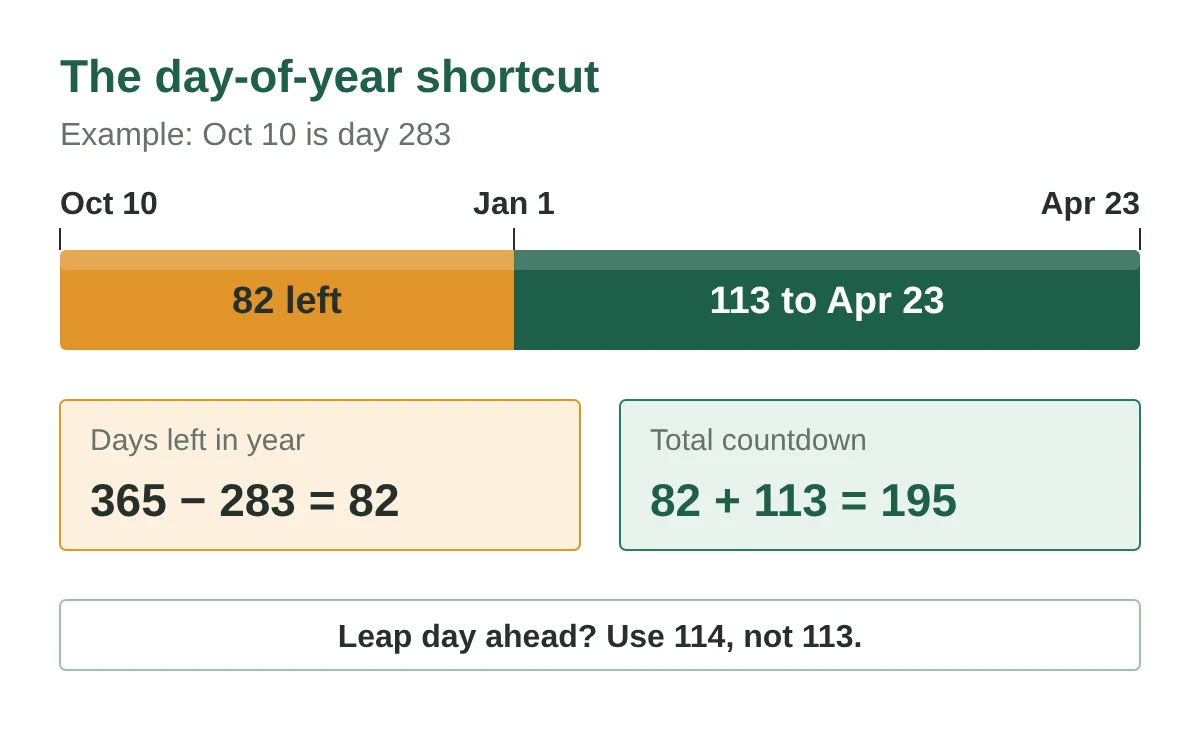
Counting month by month works, but it is slow and easy to botch. A faster route is to compare day-of-year numbers. In an ordinary year, April 23 is day 113 (31 + 28 + 31 for January to March, plus 23). In a leap year it is day 114.
Take today’s day-of-year number, subtract it from 365, and add 113. That gives the days remaining in this year plus the days from January 1 to April 23 in the next. If you start in January to April of the same year, simply subtract your day number from 113.
The leap-year rule only matters when February 29 sits between your start date and April 23. If it does not, ignore it. If it does, use 114 for the target year or 366 for the year length, whichever year contains the extra day.
A worked example with a hypothetical start
Suppose the starting date is October 10 and no leap day is in the way. October 10 is day 283 of a common year (273 days through September, plus 10). The days left in that year are 365 minus 283, which is 82. Add 113 for the stretch from January 1 to April 23: the total is 195 days.
Check it the slow way: 21 days left in October, then 30 for November, 31 for December, 31 for January, 28 for February, 31 for March and 23 for April. That adds up to 195 as well. If the two methods disagree, the slip is almost always a month length or a missing 28.
Try this: Pick any date you like and run both methods on it, the day-of-year subtraction and the month-by-month sum. Then compare your result with the date calculator. Doing it once makes the leap-year edge case stick.
Counting weeks and weekdays
Divide the day count by 7 for weeks and keep the remainder. The hypothetical 195 days is 27 weeks and 6 days. For a sense of scale on the weeks side, 8 weeks is 56 days, so 195 days is a little under 3.5 of those blocks.
Weekdays need one extra step. Every full week holds exactly 5 weekdays, so multiply the week count by 5 (here, 27 × 5 = 135). Then count the weekdays in the leftover days, which depends on the weekday you start from. Starting on a Monday, the 195th day lands on a Sunday, so the 6 leftover days run Tuesday to Sunday and contribute 4 weekdays. That makes 139 in total.
Public holidays are not subtracted in any plain weekday count. If you are counting working days to a deadline, remove those by hand.
When the hours count is off by one
Multiplying days by 24 gives the right number of hours only if no clock change sits in between. If you are in a Northern Hemisphere time zone that springs forward in March, the real hours until April 23 is one less than days × 24. In parts of the Southern Hemisphere where daylight saving ends in early April, it is one more.
Your time zone also decides when the countdown ends. The date begins at local midnight, so someone in Sydney reaches April 23 many hours before someone in London, and later still in Los Angeles. When you are coordinating with people elsewhere, agree on whose midnight counts. The Central Time page is a handy check if one end of the plan is in that zone.
Which weekday April 23 lands on
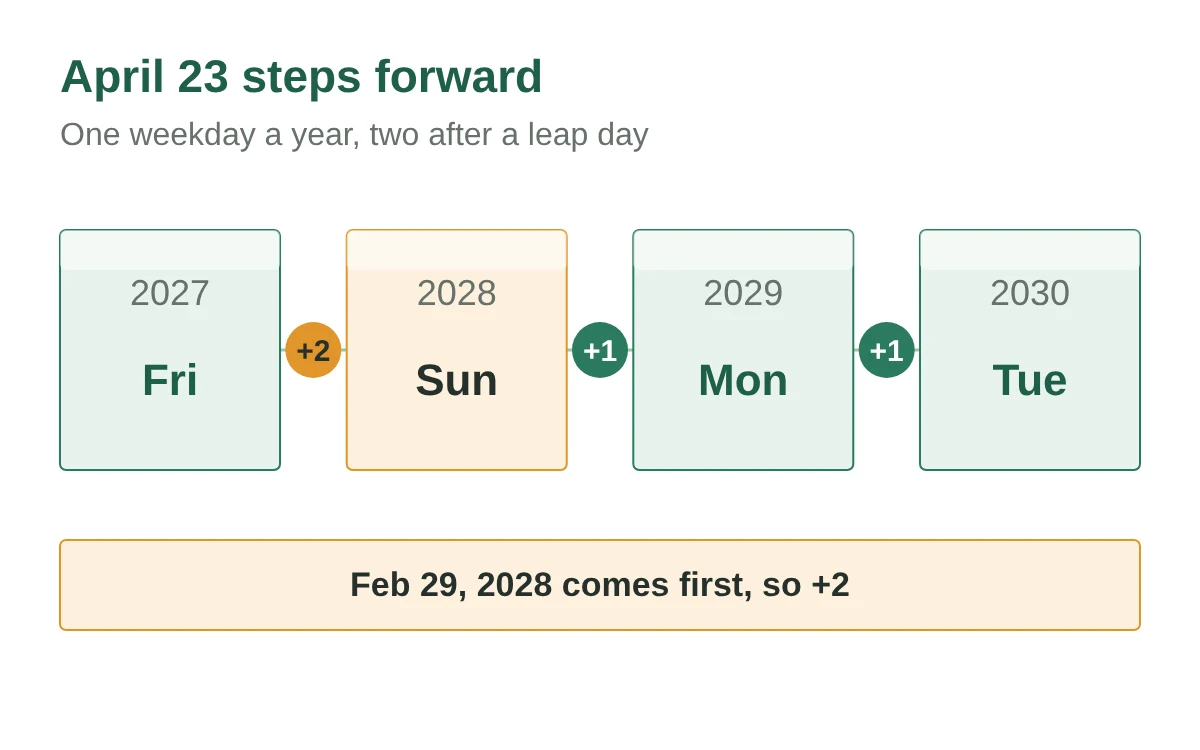
The weekday of a fixed date steps forward one each year and two after a leap day. That gives a short pattern worth knowing if you plan around a weekday:
- 2027: Friday
- 2028: Sunday (leap year, so the step is two)
- 2029: Monday
- 2030: Tuesday
Because the cycle repeats only every 28 years or so (with some century exceptions), a Friday April 23 like 2027’s is a good candidate for a long weekend or a trip. In 2028 it falls on a Sunday, which makes the Monday the practical deadline for anything due “by April 23”.
What April 23 is known for
The date carries an unusually heavy load of observances. UNESCO chose it for World Book and Copyright Day, first marked in 1995, and a new World Book Capital city begins its year-long term on this date. The UN also uses April 23 for English Language Day and Spanish Language Day.
In Catalonia it is Sant Jordi, when people trade books and roses. In England it is St George’s Day, the feast of the patron saint, which the Church can move when it clashes with Holy Week or the days after Easter. In Turkey it is National Sovereignty and Children’s Day, a national holiday, and in Aragon it is a regional holiday for San Jorge.
Why Shakespeare and Cervantes share the date
April 23, 1616 is the date given for Shakespeare’s death, and it is part of why the day became a book day. Two details are rarely mentioned. Only his baptism is recorded (April 26, 1564), so his April 23 birthday is a tradition, not a documented fact. And England still used the Julian calendar in 1616, while Spain used the Gregorian one.
So the two writers did not die on the same day as people actually lived it. Shakespeare’s date in the Gregorian calendar is May 3, and records usually place Cervantes’s death a day earlier than April 23. The shared date is a neat coincidence of calendars, which is the kind of thing a date calculator is oddly good at exposing.
Planning ideas for the countdown
A countdown to a book day invites a reading plan. Divide the page count of a book by the weekdays remaining, not the days, so your daily target matches the days you will actually read. Then add a buffer: finishing a few days early leaves room for illness and travel.
If April 23 is a deadline of your own, set a checkpoint at the halfway day-of-year and one at about 10 days out. The 10 days from now page shows how quickly that last window arrives. Nearby dates have their own counters too, including April 22, April 15 and May 1, which are handy for bracketing a plan.
Try this: Choose a book, divide its pages by the weekdays left until April 23, and write that daily page target on the first page. Recalculate the target if you miss two days in a row.
Frequently asked questions
What day of the week is April 23, 2027?
April 23, 2027 is a Friday. The same date falls on a Sunday in 2028, a Monday in 2029 and a Tuesday in 2030, because the weekday moves forward one step a year and two after a leap day.
Does the countdown include April 23 itself?
The usual convention counts the days from tomorrow up to and including April 23, so the number reaches zero when the date begins on your clock. Some tools exclude the target day and show one fewer. If you need a deadline, check which convention your tool uses.
Is April 23 a public holiday?
Not in most countries. It is a national holiday in Turkey (National Sovereignty and Children's Day) and a regional holiday in Aragon, Spain. St George's Day in England is a observance rather than a day off.
Why does a hand count sometimes differ by a day from a calculator?
Usually the cause is inclusive versus exclusive counting, or a February 29 that falls between the two dates. Check both before assuming either answer is wrong.