
How Many Days Until the 28th of March?
Calendar
Countdown chart
The live counter above gives the exact number of days until the 28th of March, calculated from your own clock and time zone. The next one is Sunday, March 28, 2027, and once that day begins the counter rolls over to 2028. The rest of this page covers what the counter cannot show: why that date is unusual, how to check the number yourself, and where counts tend to go wrong.
March 28 is the 87th day of a normal year and the 88th in a leap year. That single fact is the basis of the quickest hand method, covered below.
Which March 28 is the next one?
March 28 moves forward one weekday each year, and two weekdays when a leap day falls in between. That gives Sunday in 2027, Tuesday in 2028 (the jump of two), Wednesday in 2029 and Thursday in 2030. The pattern is useful for anything you schedule ahead, because you can guess the weekday of a future March 28 without opening a calendar.
The year matters for one more reason. If you are reading this in January or February, the next March 28 is this year’s. If you are reading after March 28, the counter targets the following year, and the gap can be close to 365 or 366 days.
Why 2027 is an unusual March 28
In 2027, March 28 is Western Easter Sunday. Easter is tied to the moon, not to a fixed date: it falls on the first Sunday after the first full moon on or after the March equinox. In 2027 that full moon arrives on Monday, March 22, which puts Easter on the very next Sunday, March 28.
That is early. Western Easter can fall anywhere between March 22 and April 25, so 2027 sits near the early end. In most other years March 28 is an ordinary date with no connection to Easter at all. If you are counting down to Easter specifically, treat the 2027 match as a coincidence of the lunar calendar, not a rule.
Count it by hand with the day-of-year trick
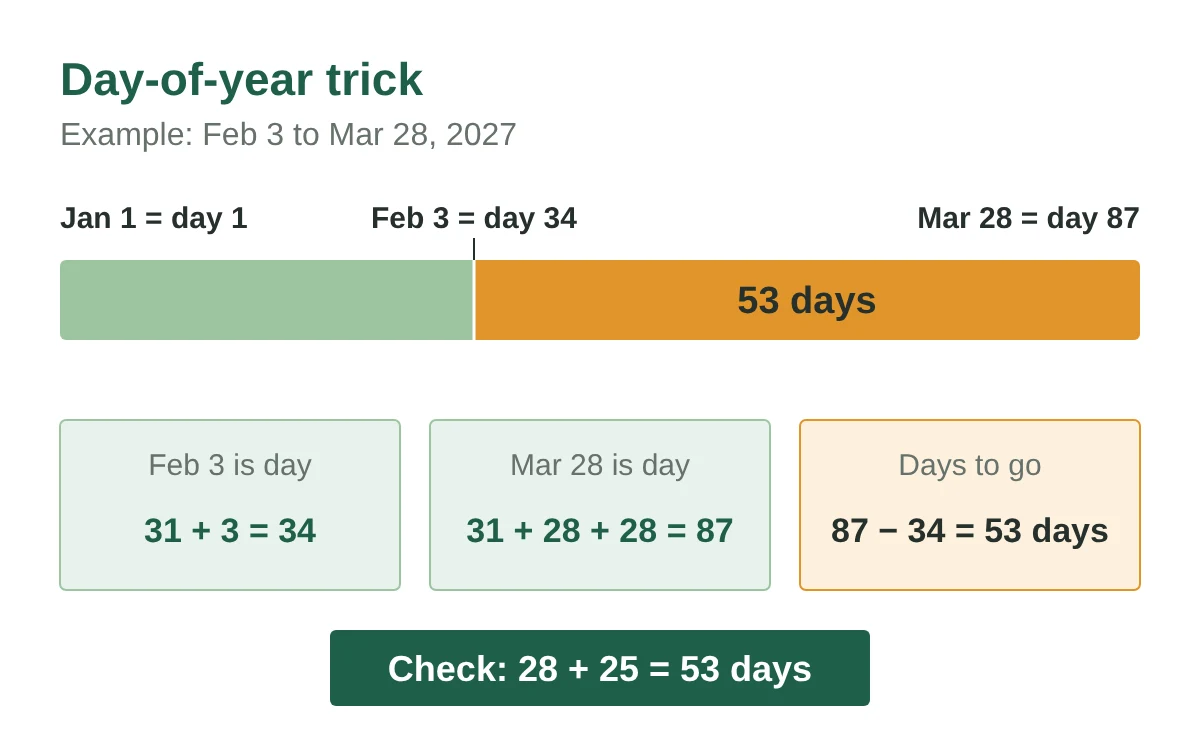
Month-by-month arithmetic is where most slips happen. A cleaner method is to convert both dates to day-of-year numbers and subtract. March 28 is day 87 in a common year (31 + 28 + 28). Your starting date’s day number comes from the same sum.
Take a hypothetical start of February 3, 2027. February 3 is day 34 (31 + 3). Then 87 minus 34 gives 53 days. Check it the slow way: February 3 to March 3 is 28 days, and March 3 to March 28 is 25 more, which is also 53.
The trick fails only in leap years, where everything after February 28 shifts up by one. In a leap year use 88 for March 28. If your start date is in January or February, remember the leap day is still ahead of you and adds a day to the gap.
Try this: Pick any date in the next month and work out its day-of-year number in your head. Subtract it from 87 (or 88 in a leap year), then compare your answer with the live counter above.
Counting weeks and weekdays
Divide the day count by 7 and keep the remainder, because the remainder tells you the weekday shift. In the example above, 53 days is 7 weeks and 4 days. February 3, 2027 is a Wednesday, so seven weeks later is Wednesday, March 24, and four more days lands on Sunday, March 28.
Weekdays are trickier. Count the full weeks first (each holds 5 weekdays), then walk through the leftover days one by one. In the example, 7 full weeks give 35 weekdays, and the leftover days (Thursday and Friday before the weekend) add 2, for 37 weekdays after the start date. Good Friday, March 26, 2027, is a public holiday in many countries, so a working-day count there is one lower.
Also decide whether the target day itself counts. Because March 28, 2027 is a Sunday, it adds no weekday either way, which makes that year easy. In 2028 it is a Tuesday, and the choice changes the answer by one.
Inclusive or exclusive: why two sites disagree
Countdown tools differ on whether today is counted. Some count the current day in full, others count only the nights between now and the target. Neither is wrong, but a gap of one day between two tools is almost always this.
The live counter on this page measures from your exact current moment to the start of March 28 on your own clock. That means the days figure drops when your local midnight passes, and not at a fixed time in another country. If you are comparing it with a friend abroad, you will see different numbers for part of each day. For a plain date-to-date count with no time of day involved, the date calculator lets you choose both endpoints.
The clock change trap
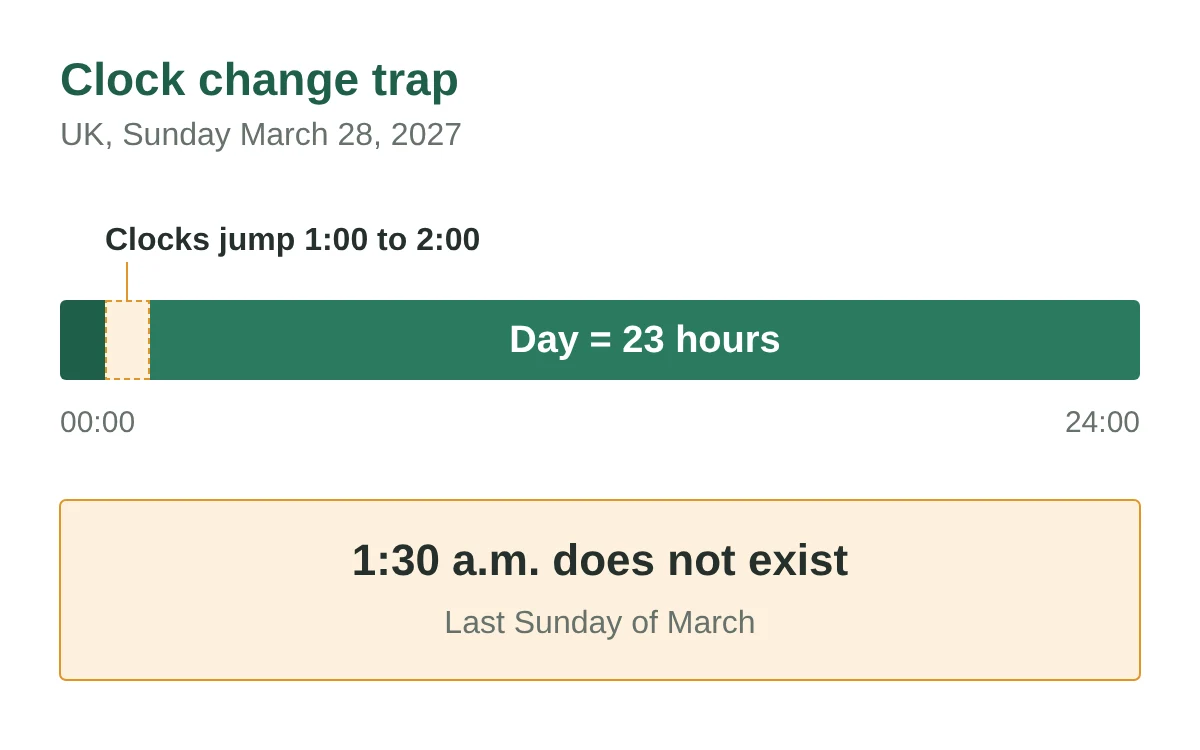
If you convert the countdown to hours, do not assume days multiplied by 24. A daylight saving change inside the span removes or adds an hour. In the United States, clocks move ahead on March 14, 2027, so any countdown crossing that date in the US is one hour shorter than the simple multiplication suggests. The March 14 page covers that date.
Europe has a sharper coincidence. Clocks in the UK and EU go forward on the last Sunday of March, and in 2027 that Sunday is March 28 itself. In those regions the day of the countdown target is only 23 hours long, and the change happens at 1:00 UTC, early in the morning. An event planned for the early hours of that day needs a second look, because 1:30 a.m. local time does not exist in the UK that night.
Try this: If you count down to a specific hour on March 28, write the time in two zones (yours and the event’s). Check whether either zone changes its clocks between now and then.
What March 28 is known for
Outside Easter 2027, the date has no worldwide holiday. A few real anchors exist. Czechia marks Teachers’ Day on March 28, the birthday of the educator Comenius. The Three Mile Island nuclear accident in Pennsylvania began on this date in 1979, and the singer Lady Gaga was born on it in 1986.
Calendars of novelty days also list the date for items such as Respect Your Cat Day and Something On a Stick Day. Treat those as light-hearted occasions with no official status. March 28 is not a US federal holiday and not a standard tax deadline, though the quarter ends three days later on March 31, which is the date many companies and schools use for reports and fiscal year closes (see March 31).
Planning around it
For 2027, Holy Week shapes the whole stretch: Palm Sunday on March 21, Good Friday on March 26, Easter on March 28 and Easter Monday on March 29. Good Friday falls on March 26 and Easter Monday on March 29, so many schools, banks and offices in Europe and elsewhere close around the weekend. Travel and restaurant bookings for that weekend usually fill earlier than for a normal Sunday, and the next day is a holiday in many places, so see the March 29 page if your plans extend a day.
For a countdown that feels useful, mark the milestones backward from the target. Setting reminders at the 100-day, 50-day and 14-day points suits most projects, and the equinox on March 20 gives a natural last checkpoint a week before. The March 21 page is handy for that first day of spring week. faq:
- q: “What day of the week is March 28?” a: “It depends on the year. March 28 is a Sunday in 2027, a Tuesday in 2028, a Wednesday in 2029 and a Thursday in 2030. The weekday moves forward by one each year, or two after a leap year.”
- q: “Is March 28 Easter?” a: “Only in some years. Easter follows the moon, and in 2027 Western Easter falls on March 28. In most other years the date is an ordinary day.”
- q: “How many weeks until March 28?” a: “Divide the number of days shown in the live counter by 7. The whole number is the weeks, and the remainder is the extra days. For example, 53 days is 7 weeks and 4 days.”
- q: “Why does another site show a different number of days?” a: “Most often one tool counts today and the other does not, which makes a difference of one day. Time zones can also shift the answer by a day for part of each day, since this counter uses your own clock.”
Frequently asked questions
What day of the year is March 28?
March 28 is the 87th day of a common year and the 88th day of a leap year. Subtracting a start date's day-of-year number from 87 (or 88 in a leap year) gives the days between them without month-by-month counting.
Do the clocks change on March 28, 2027?
In the UK and EU, yes. Clocks go forward on the last Sunday of March, which is March 28 in 2027, so that day has only 23 hours and 1:30 a.m. local time does not exist in the UK. The US changes earlier, on March 14, 2027.
Is Easter 2027 on March 28?
Yes, Western Easter Sunday falls on March 28, 2027, the Sunday after a full moon on March 22. Good Friday is March 26 and Easter Monday is March 29. Easter can land anywhere from March 22 to April 25, so this is an early one.
How do I count the days to March 28 in a leap year?
Use 88 as the day number for March 28 instead of 87, because the extra February 29 shifts every later date up by one. If the start date is in January or February of a leap year, the leap day is still ahead and adds one day to the gap.