
How Many Days Until August 13th?
Calendar
Countdown chart
The live counter above gives the exact answer: days, hours, minutes and seconds until the next August 13, calculated from your own device clock and time zone. It rolls over to the following year the moment this year’s August 13 begins, so you never need to update anything.
The rest of this page covers what the counter cannot show you: how to verify the number on paper, how weeks and weekdays behave on the way to this date, and what August 13 actually means on the calendar.
What the countdown really measures
A countdown to “August 13” ends at the first instant of that date, which is midnight at the start of the day in your time zone. On the evening of August 12 the display is already in hours, and during the day itself the date has arrived. If you want to count until the end of August 13, add one day to whatever you read.
This is the source of most disagreements between two countdowns. One tool counts the start day, another does not, and a third quietly uses UTC. A person who is travelling will see the number shift by a day if their device changes zones. For anything with a deadline, such as a flight or a booking, check which clock the other party is using.
Count it by hand with the day-of-year trick
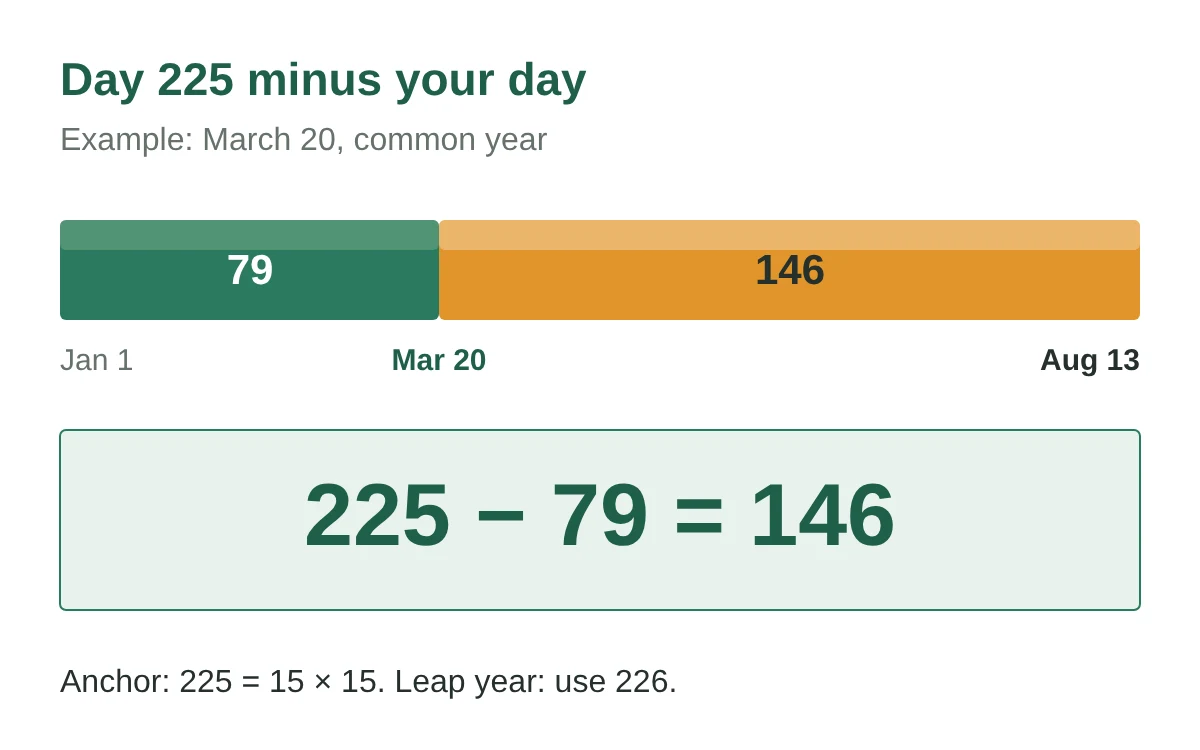
August 13 is day 225 of a common year and day 226 in a leap year. A handy way to remember it: 225 is 15 squared. Once you know that anchor, any count becomes a subtraction.
- Find the day-of-year of your start date. Cumulative month totals at the end of each month are 31, 59, 90, 120, 151, 181 and 212 for January through July.
- Subtract it from 225 (or 226 if February 29 of the target year has already happened by then).
- The result is the number of days until August 13, with the start day not counted.
For a starting point in the second half of the year, after August 13 has passed, subtract from 365 (or 366) and add 225. The date calculator does the same thing between any two dates if you want to check your arithmetic.
A worked example with a hypothetical start
Say the starting date is March 20 in a common year. March has 11 days left after the 20th, then April adds 30, May 31, June 30 and July 31, and August contributes 13. That is 11 + 30 + 31 + 30 + 31 + 13 = 146 days.
The shortcut agrees. March 20 is day 79 (59 for January and February, plus 20), and 225 minus 79 is 146. If the two methods disagree, one of them has an off-by-one slip, and it is almost always the month-end remainder.
Try this: Pick any date six months from now, calculate the days to August 13 using both the month-by-month method and the day-of-year subtraction, then compare the result with the live counter above.
The leap year trap
Leap days only matter when February 29 sits between your start date and August 13. If you are counting from January or February in a leap year, the answer is one larger than the common-year answer. If you start on or after March 1, the extra day is already behind you.
The more subtle error is counting across two years. Starting in October and counting to next August, the leap day matters only if next year is the leap year, not the one you are starting in. Checking the year of the February that actually falls inside your span avoids this.
Weeks and weekdays to August 13
Dividing by 7 gives weeks and a remainder, and the remainder is where the useful information lives. In the hypothetical example, 146 days is 20 weeks and 6 days. The remainder tells you which weekday you are starting from relative to the target.
For weekdays, multiply the full weeks by 5, then walk through the leftover days starting from the day after your start date and count the Monday to Friday ones. In the example above, with a Saturday start, the 6 leftover days run Sunday to Friday and include 5 weekdays, giving 105 weekdays when August 13 itself is a weekday and you count it. Public holidays are not subtracted in that figure, so remove them separately if you are planning working days. For a rougher week count to a nearby anchor, how many weeks until August 1st is a useful comparison.
Which weekday August 13 lands on
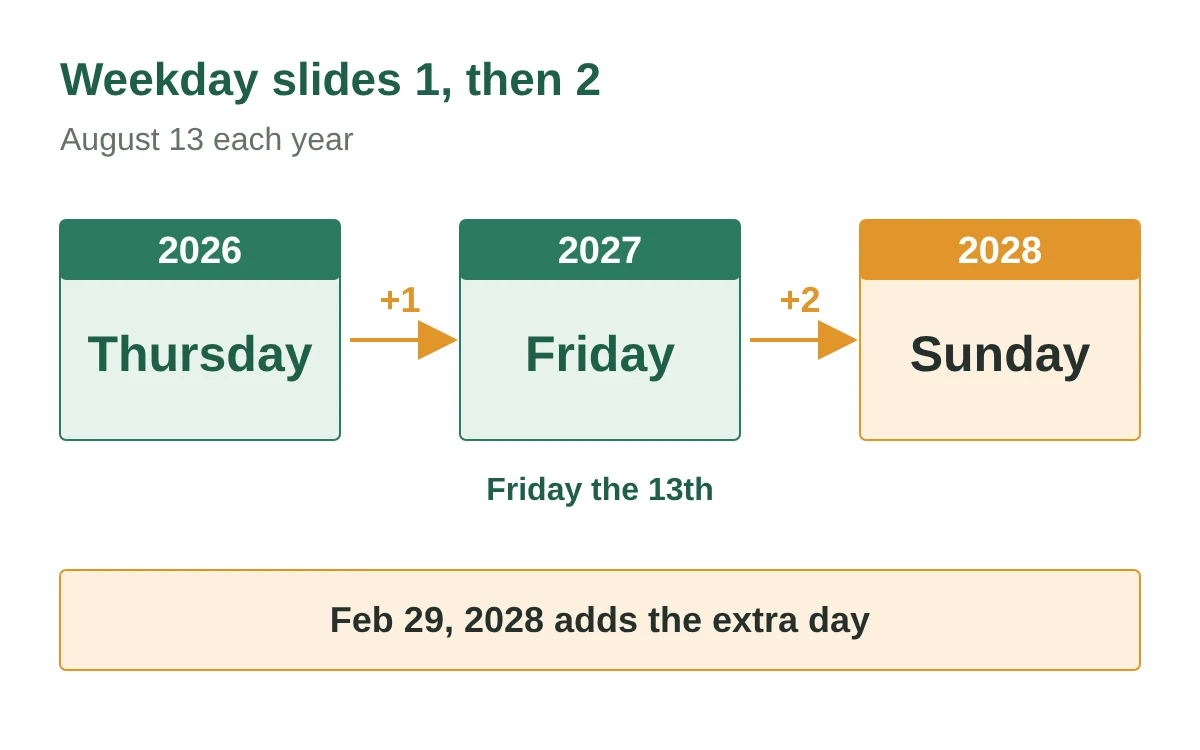
The weekday moves forward by one each year, or by two when a February 29 sits between this year’s August 13 and the next. The sequence from 2026 is Thursday, then Friday in 2027, Sunday in 2028, Monday in 2029 and Tuesday in 2030. It shifts forward by 1 day each year (or 2 days after a leap year).
That means August 13 is a Friday the 13th in 2027 and again in 2032. The same date lands on a weekend in 2028 (Sunday), which matters if your countdown is for a trip, an event or a deadline that needs business hours. If the weekday matters more than the exact day count, check the neighbouring dates too: August 12 and August 14 each have their own live counter.
What August 13 is known for
International Left Handers Day has been celebrated annually on August 13 since 1976, thanks to Dean R. Campbell. It is an unofficial observance rather than a public holiday, and it highlights how many everyday tools, from scissors to desks, are designed for right-handers. Food calendars also list National Filet Mignon Day and National Prosecco Day on the same date, which are informal and not legally recognised.
Outside the US, Women’s and Family Day in Tunisia marks the August 13, 1956 legal reforms. In Japan, August 13 is commonly the first day of the Obon festival of remembering ancestors, which typically runs to August 16 in many regions. Historically, construction of the Berlin Wall began on August 13, 1961. The date also falls near the typical peak of the Perseid meteor shower, so clear dark skies around then can be worth planning for, though the exact peak shifts a little each year.
No national tax deadline or federal holiday in the US falls on August 13, so for most people the date is a personal milestone rather than an official one.
Planning around the countdown
Back-planning works better than watching the number fall. Set checkpoints at round distances, such as 100, 60 and 30 days out, and attach one task to each. A 90 days from now calculation is a good way to find the date for the first checkpoint without counting manually.
Because mid-August is peak summer holiday season in much of the Northern Hemisphere, travel and venue bookings for this date tend to fill earlier than for spring or autumn dates. If the date is a deadline rather than a celebration, aim to finish a few days before it, since the counter reaches zero at midnight, not at the end of the working day.
Try this: Write down the weekday August 13 falls on next year, then count back in whole weeks (7, 14, 21 days) to find three Fridays or Mondays that make clean checkpoint dates.
FAQ
Because the frequently asked questions are handled in the structured section of this page, the figures to rely on are the ones in the live counter above.
Frequently asked questions
Does the countdown to August 13 include August 13 itself?
The countdown ends at midnight at the start of August 13 in the device's time zone, so the day itself is not counted. To count through the end of August 13, add one day to the number shown.
How can you work out the days until August 13 without a counter?
August 13 is day 225 of a common year and day 226 in a leap year. Subtract the start date's day-of-year from that number. If the start date falls after August 13, subtract it from 365 (or 366) and add 225.
When does August 13 fall on a Friday the 13th?
The next Friday the 13th on this date is in 2027, and the one after that is in 2032. The weekday moves forward by one each year, or by two when a February 29 falls in between.
What is August 13 known for?
August 13 is International Left Handers Day, observed since 1976. It is an unofficial observance, not a public holiday. The date also marks the start of the Berlin Wall's construction in 1961 and, in many parts of Japan, the first day of Obon.