
How Many Days Until August 14th?
Calendar
Countdown chart
The live counter above gives the exact answer for your own clock and time zone, so use it for the number. It always points to the next August 14, and on the day itself it reads zero. The rest of this page covers what the counter does not show: how to check the figure by hand, how to turn it into weeks and working days, and where counts most often go wrong.
August 14 is a fixed date that lands on a different weekday each year. That makes it easy to plan around once you know a couple of shortcuts.
The fastest way to count it by hand
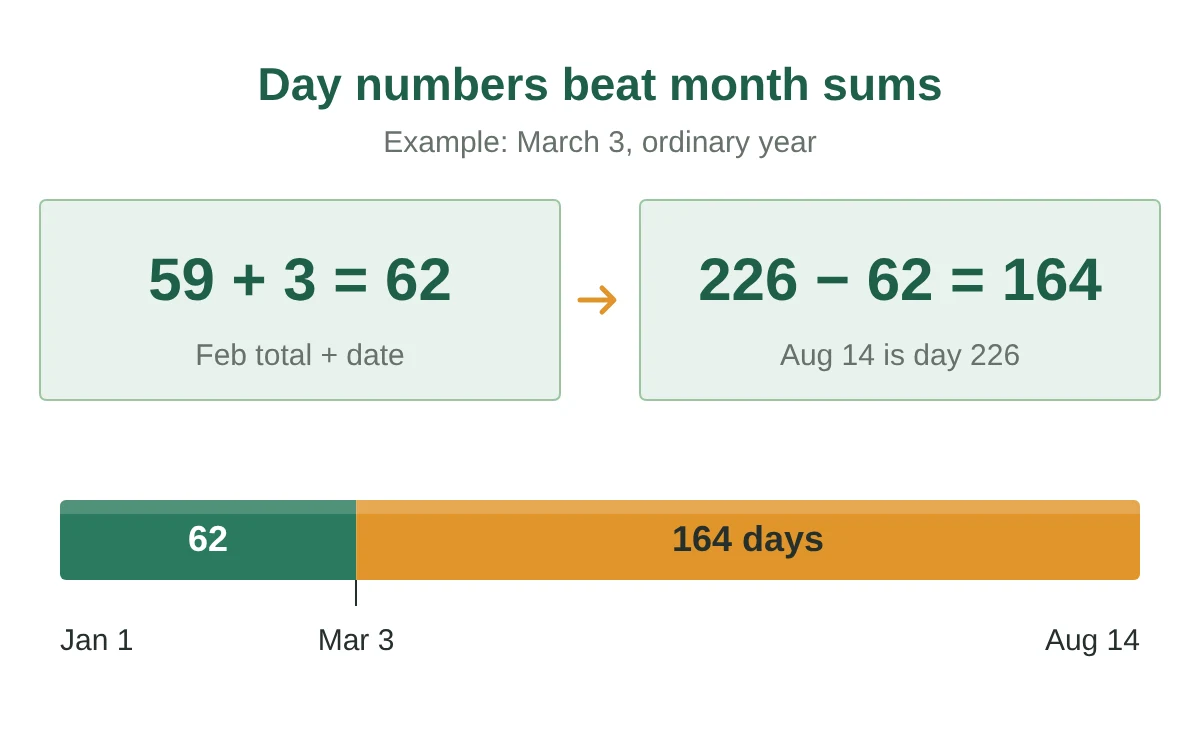
Skip the month-by-month addition. August 14 is day 226 of an ordinary year and day 227 in a leap year, because Jan through Jul add up to 212 days (213 in a leap year) and August 14 sits 14 days after that. Find the day number of your starting date and subtract it from 226.
Day numbers are easy to build from memory if you know the month-end totals: 31, 59, 90, 120, 151, 181, 212. Add the day of the month to the last total before it. March 3 is 59 + 3 = 62. That one subtraction replaces a column of month lengths and is much harder to get wrong.
If your start is already past August 14 this year, flip the logic: days left in the year (365 minus the day number, or 366 in a leap year) plus 226. Add 227 instead when the coming year is a leap year.
Worked example with a made-up start date
Take a hypothetical start of March 3 in a non-leap year. March 3 is day 62, so 226 minus 62 gives 164 days.
Check it the long way: 28 days left in March, then 30 for April, 31 for May, 30 for June, 31 for July and 14 for August. That is 28 + 30 + 31 + 30 + 31 + 14 = 164. Both methods agree, and agreement between two methods is the real test that you did not slip.
If you want to skip the arithmetic for other pairs of dates, the date calculator handles any start and end.
Try this: Pick any date in the next month, work out its day number from the month-end totals, and subtract it from 226 (or 227 in a leap year). Then compare with the live counter on the day you chose.
Weeks and weekdays to August 14
Divide the day count by 7. In the example, 164 days is 23 weeks and 3 days. The remainder matters more than the weeks, because it decides how many working days you get.
For weekdays, multiply the full weeks by 5 and then look at the leftover days one by one. Suppose the hypothetical March 3 is a Tuesday. The 3 leftover days are Wednesday, Thursday and Friday, so they all count: 23 × 5 + 3 = 118 weekdays. Aug 14 itself is a Friday in that example, because 164 days is 3 days past a whole number of weeks.
Public holidays are the one thing this ignores. Subtract any that fall on weekdays in your range, such as Memorial Day, Juneteenth or July 4 in the US. For a pure weeks conversion, 8 weeks in days shows the multiplication in the other direction.
Off-by-one and leap-year traps
The usual error is deciding whether to count the start day. The standard rule is that the start day is excluded and the end day is included, which is what subtraction gives you. If a form or contract says “within 30 days” or “inclusive”, read it, because the answer can shift by one.
Leap years only matter if February 29 sits inside your range. Starting in January or February of a leap year, you cross it and the count grows by one. Starting on March 1 or later in that year, it does not. A countdown that began last November and ends next August never crosses a leap day unless the following year is the leap year and you start before March.
Another quiet trap: the weekday of August 14 moves forward one day each year, and two days after a leap year. Last year’s weekday is a poor guide to the coming one.
Why the zero moment depends on your time zone
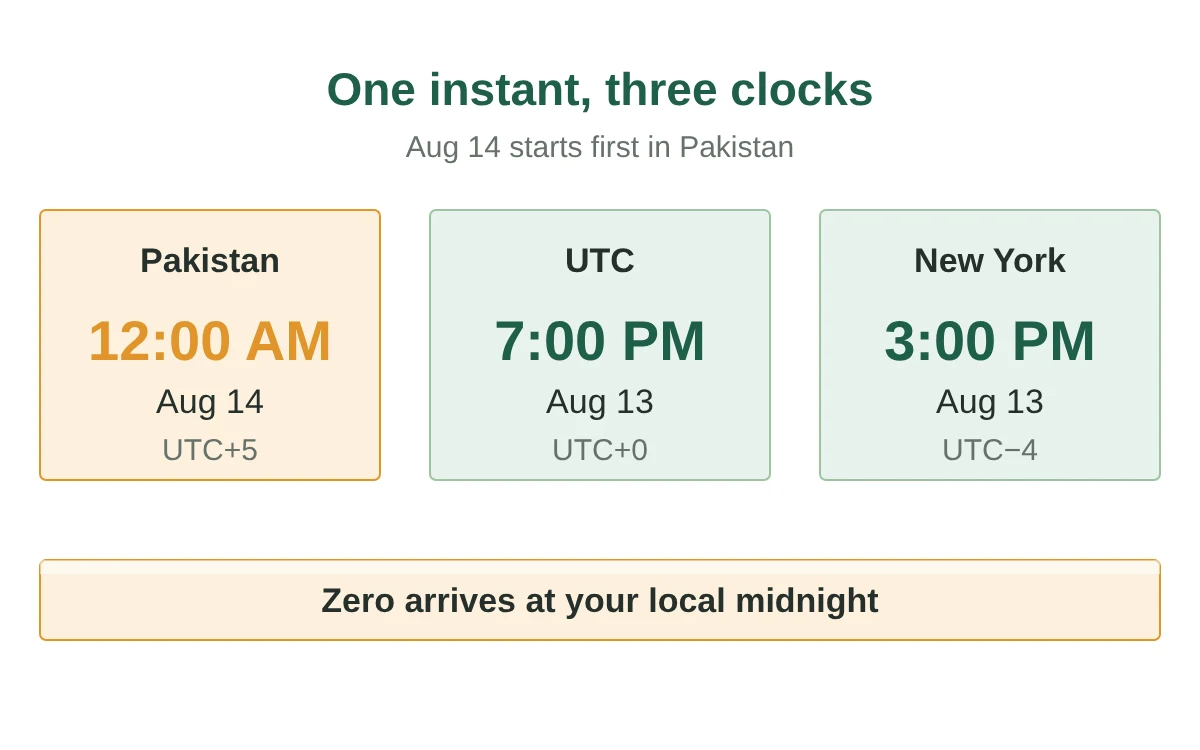
A date countdown reaches zero at local midnight, so the same August 14 arrives at different moments around the world. Pakistan Standard Time is UTC+5, which means August 14 begins there at 7 PM UTC on August 13. That is mid-afternoon on the US East Coast on the 13th.
Your live counter uses your device clock, so it shows your own midnight. If you are counting down to an event somewhere else, such as a broadcast from Islamabad, convert that location’s start time first. For a nearby deadline, how long until midnight gives the same local-clock logic for tonight.
What August 14 is known for
The best-known observance is Pakistan’s Independence Day (Youm-e-Azadi), a national holiday marking the end of British rule in 1947. It is marked with flag-raising ceremonies, parades and the national anthem.
There is a small wrinkle in the history. The Indian Independence Act of 1947 named August 15 for both new dominions, and Pakistan’s practice settled on the 14th. India marks its own day on August 15, so a trip or event spanning both is common in the region (see also August 15).
In US history, President Roosevelt signed the Social Security Act into law on August 14, 1935. The date also falls in the long Perseid meteor shower window, which typically runs from mid July to late August. The peak varies by year, so check a current forecast rather than assuming August 14.
Planning around the countdown
Work backward from the date rather than forward. A 90-day lead time suits bookings, travel and large purchases, and 90 days from now shows where that checkpoint lands today. Use your weekday count for work deadlines, and the week count for habits or savings plans, since it gives you whole units to schedule.
Mid-August is also the stretch before many schools and universities restart, so flights and accommodation tend to tighten in the weeks before. If your plans are really about the whole month, days until August is the better anchor, and August 13 is useful if you want to be ready the evening before.
Try this: Write three checkpoints on your calendar: 90 days out, 30 days out and the final weekend before. Use the live counter to confirm each one before you commit to it.
Spreadsheet formulas that never go stale
Typing a fixed year into a formula means it breaks after the date passes. This version always targets the next August 14 and returns 0 on the day itself:
=DATE(YEAR(TODAY())+(TODAY()>DATE(YEAR(TODAY()),8,14)),8,14)-TODAY()
For working days, wrap the same target date in NETWORKDAYS(TODAY(), target), and add a range of holiday dates as the third argument. Note that NETWORKDAYS counts both the start and end dates, so it can read one higher than simple subtraction when both are weekdays.
Frequently asked questions
How do I calculate the days until August 14 by hand?
Find the day number of your start date by adding its day of the month to the previous month-end total (31, 59, 90, 120, 151, 181, 212), then subtract it from 226. August 14 is day 226 of a normal year and day 227 in a leap year.
Does a leap year change how many days are left until August 14?
Only if February 29 falls between your start date and August 14. Starting in January or February of a leap year adds one day to the count, while starting on March 1 or later does not.
What time does August 14 start in Pakistan compared with the US East Coast?
Pakistan Standard Time is UTC+5, so August 14 begins at 7 PM UTC on August 13. That is 3 PM on August 13 in US Eastern Daylight Time.
What spreadsheet formula always counts down to the next August 14?
Use =DATE(YEAR(TODAY())+(TODAY()>DATE(YEAR(TODAY()),8,14)),8,14)-TODAY(), which rolls to next year once the date passes and returns 0 on the day itself. If you switch to NETWORKDAYS for working days, remember it counts both the start and end dates, so it can read one higher than simple subtraction.