
How Many Days Till August 19?
Calendar
Countdown chart
The live counter above gives the exact answer for your clock and time zone, down to the second. The date it points to is the next August 19, which is Thursday, August 19, 2027. The number changes every day, so this page explains how to verify it yourself and how to turn it into weeks, weekdays and planning checkpoints.
Most of the confusion around “days till” questions comes from three things: whether the end date is counted, which time zone is used, and whether a count means calendar days or working days. Each is easy to settle once you know where it bites.
Count it by hand in 30 seconds
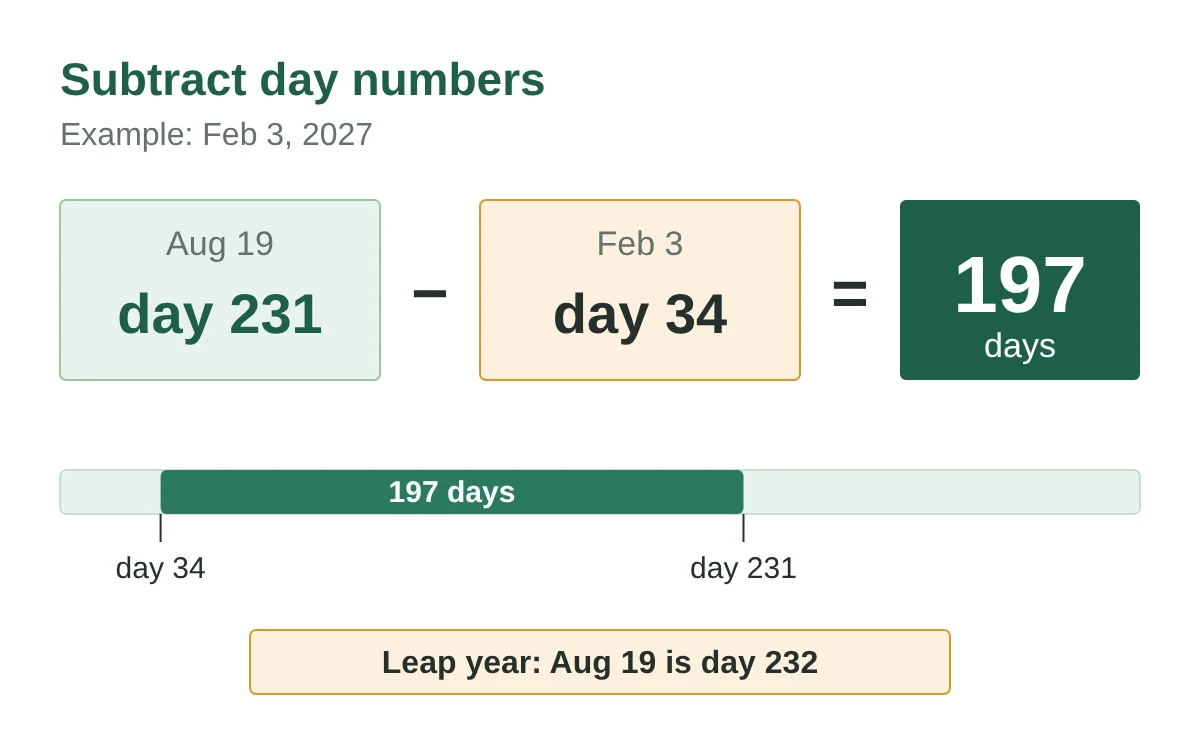
The reliable method is to subtract day-of-year numbers. August 19 is day 231 of any non-leap year (day 232 in a leap year). If you know today’s day-of-year, the answer is 231 minus that number. Day-of-year is simple to get: the cumulative totals at the end of each month are 31, 59, 90, 120, 151, 181, 212 (January to July), so August 19 is 212 plus 19.
The other route is to add up the remainder of the current month, every full month in between, and 19. That works, but it invites slips because months have different lengths. The day-of-year route needs only one subtraction.
A worked example with a made-up start date
Say the start date is February 3, 2027 (a hypothetical). February 3 is day 34 (31 plus 3). So 231 minus 34 gives 197 days. Check by the long route: 25 days left in February, then March (31), April (30), May (31), June (30) and July (31) add up to 153, then 19 more for August: 25 plus 153 plus 19 is 197. Both methods agree.
Try this: Pick any date in the next month. Work out the days to August 19 using the day-of-year method, then compare it with the live counter above. If you are off by one, the cause is almost always a month-end total.
Why two counters can disagree
Two sites can show different numbers on the same day and both be defensible. The first cause is inclusive versus exclusive counting. “Days until” normally excludes today and counts the target day’s arrival, but a project plan that treats August 19 as a working day may count it as well. The second is the clock: a counter set to a server’s time zone flips to the next day at a different moment than your phone does.
The third cause is cached pages. A static page can keep showing an old number for weeks. A count that updates on your own device cannot go stale this way, which is why the widget above runs on your local clock.
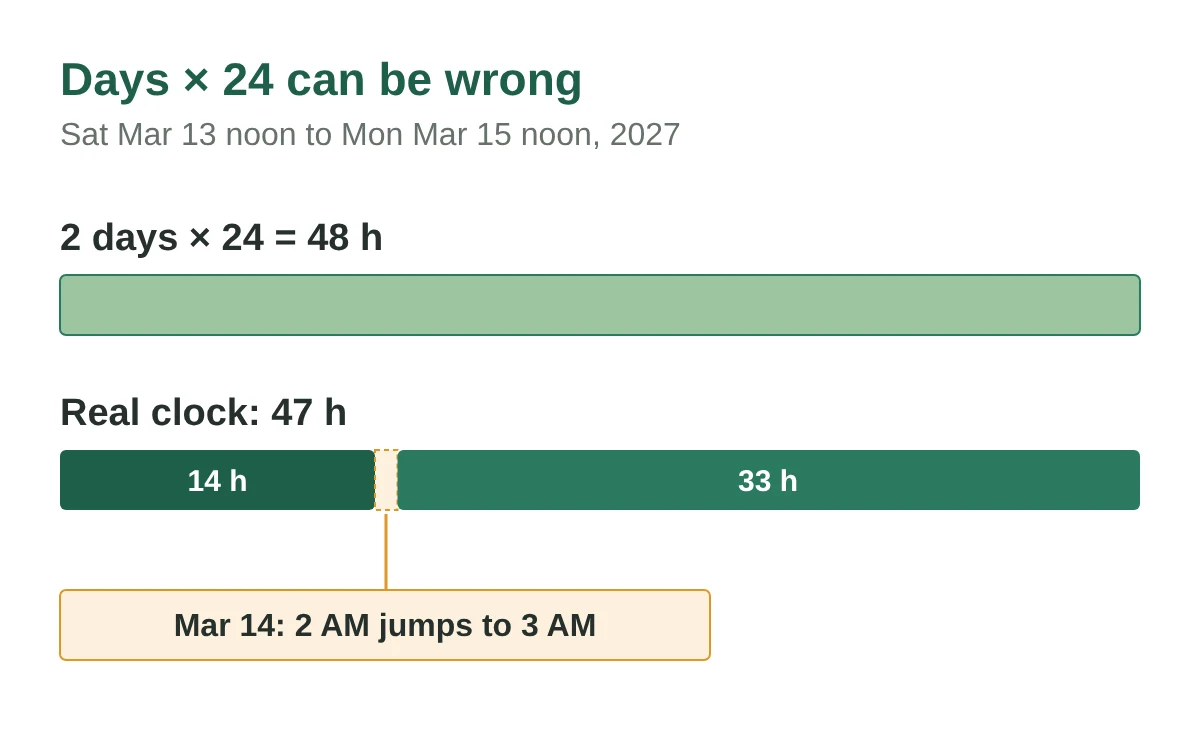
Hours need extra care. Multiplying days by 24 is wrong whenever a daylight saving change sits in between, because that day has 23 or 25 hours. Across the March clock change in the Northern Hemisphere, the true hour count is one less than days times 24.
Weeks and weekdays to August 19
Convert days to weeks by dividing by 7, then keep the remainder. The remainder tells you something useful: because August 19, 2027 is a Thursday, the start day of the week is fixed by the remainder. A remainder of 0 means you start on a Thursday, 1 means a Wednesday, 2 a Tuesday, and so on backwards. In the worked example, 197 divided by 7 is 28 weeks and 1 day, and February 3, 2027 is indeed a Wednesday.
For weekdays, count whole weeks first (5 working days each), then walk through the leftover days one by one. In the example, 28 weeks gives 140 weekdays, and the leftover day is the Thursday itself. That makes 141 if August 19 counts as a workday and 140 if it does not. Public holidays still have to be subtracted by hand, and they differ by country and region.
For anything contractual, the date calculator handles inclusive and exclusive counts side by side.
Where August 19 sits in the calendar
The weekday of August 19 moves on a steady pattern. It shifts forward by 1 day each year, or 2 days after a leap year. That gives Thursday in 2027, Saturday in 2028 and Sunday in 2029. A date that lands on a Saturday, as in 2028, is worth knowing in advance if you are booking an event or a deadline.
Another quirk is that the 2028 leap day (February 29) pushes August 19 to day 232, so day-of-year shortcuts need one extra day for any start date after February in a leap year. After August 19, 2027 there are 134 days left in the year, a handy number if you track year-end goals.
What August 19 is known for
August 19 carries several well-documented observances. In the United States, National Aviation Day was established in 1939 by President Franklin D. Roosevelt to mark the birthday of Orville Wright, who was born in 1871. It is a federal observance but not a public holiday. Nobody gets the day off, so a countdown to it is about interest rather than a day away from work.
Internationally, World Humanitarian Day falls on the same date. It marks the 2003 bombing of the UN headquarters in Baghdad that killed 22 humanitarian workers, and the UN General Assembly established it in 2008. The date is also World Photography Day, and Afghanistan marks its Independence Day on August 19.
In the Northern Hemisphere it is high summer, and the date often lands in the stretch when many schools and universities are getting ready to restart. Start dates vary by district and country, so check your own school calendar before building plans around it.
Milestones worth marking
Working backwards from a fixed date is more useful than watching a total fall. In 2027 the 90 day mark lands on May 21, the 100 day mark on May 11, and six weeks out is July 8. If you want to see how a quarter-length run-up looks, the 90 days from now page shows how to compute those checkpoints from any date, and the May 21 countdown is the matching start line for 2027.
For a recurring date like this one, mark the checkpoints on the calendar once and they repeat every year, shifting only by weekday. If the date is a personal one, such as a birthday, the same logic applies in the days until my birthday counter.
Spreadsheet formulas that avoid off-by-one errors
In a spreadsheet, subtracting dates returns whole days. Use =DATE(2027,8,19)-TODAY() for calendar days. TODAY() carries no time of day, so the result is a clean integer. NOW() would give a fraction, and rounding that fraction up or down is where most off-by-one errors come from.
For weekdays, NETWORKDAYS(TODAY(),DATE(2027,8,19)) counts both ends, so subtract 1 if you do not want the end date included. Add a range of holiday dates as a third argument if you need public holidays removed.
Try this: In a blank sheet, put today’s date in A1 and August 19, 2027 in A2. In A3 use =A2-A1 and in A4 use =NETWORKDAYS(A1,A2). Compare A4 with A3 times 5/7 to see how weekends and the inclusive count shift the result.
Nearby dates
If your plans sit close to August 19, a neighbouring countdown may suit them better: August 15, August 20 or the whole of August. For a broader list, the all date countdowns index covers every day of the year.
Frequently asked questions
What day of the year is August 19?
August 19 is day 231 in a non-leap year and day 232 in a leap year. Subtracting today's day-of-year number from 231 (or 232 in a leap year) gives the days remaining in the same year.
Why do two countdowns to August 19 show different numbers?
The usual causes are inclusive versus exclusive counting (whether August 19 itself is counted), counters using a server time zone that flips days at a different moment than your device, and cached pages showing an old number. A counter running on your own device's clock avoids the last two problems.
How do I count weekdays until August 19 in a spreadsheet?
Use =NETWORKDAYS(TODAY(),DATE(2027,8,19)), which counts both the start and end dates when they are weekdays, so subtract 1 if August 19 should not be included. Add a range of holiday dates as a third argument to exclude public holidays.
Is August 19 a public holiday?
Not in the United States, where National Aviation Day on August 19 is a federal observance but not a day off. Afghanistan marks Independence Day on August 19, and the date is also World Humanitarian Day and World Photography Day.