
How Many Days Until August 20th?
Calendar
Countdown chart
The live counter above gives the exact answer for your clock and time zone, down to the second. The target is always the next August 20 that has not started yet. Once the date arrives, the counter moves on to the following year, so the answer is never negative.
The rest of this page covers what the counter cannot show you: how to check the number yourself, why other sites sometimes differ by a day, how to convert the result into weeks and working days, and where this date sits in the calendar.
Count it by hand in under a minute
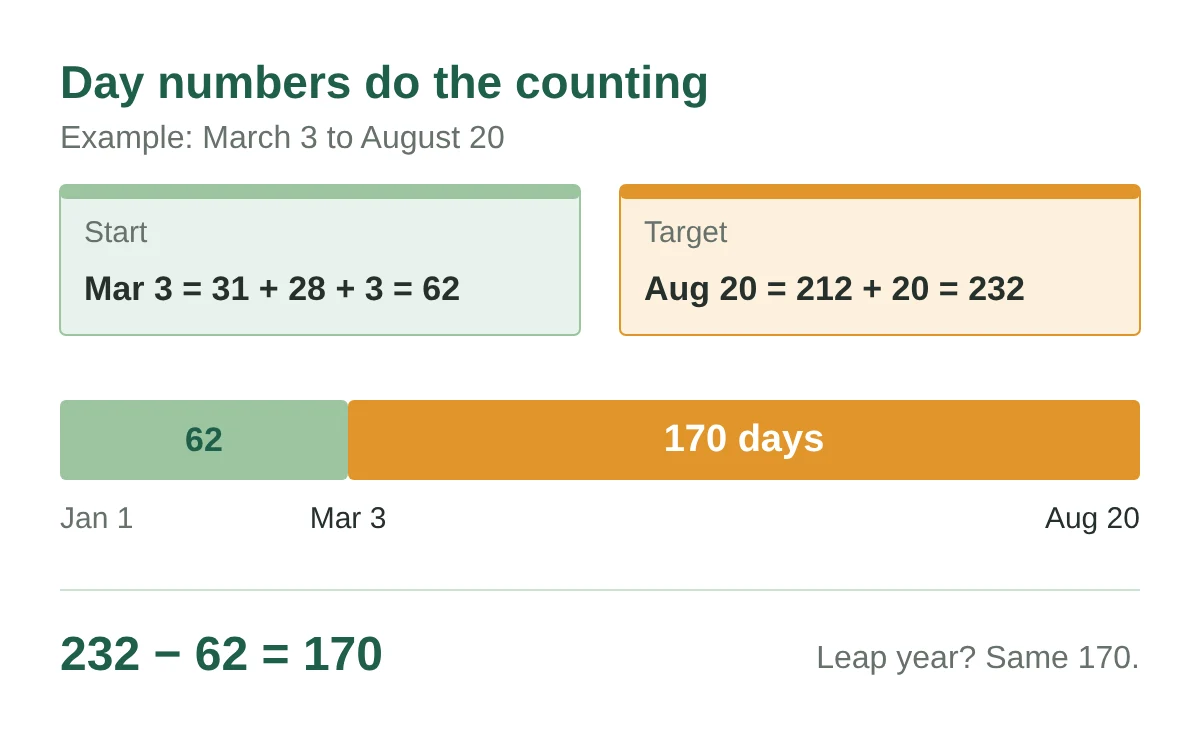
Every date has a day-of-year number, and August 20 is day 232 in a normal year and day 233 in a leap year. The easy way to remember it: July 31 is day 212, so August 20 is simply 212 + 20. Subtract the day-of-year of your starting date and you have the gap.
Take a hypothetical start of March 3 in a non-leap year. March 3 is day 62 (31 + 28 + 3). Then 232 minus 62 gives 170 days. The same answer comes out in a leap year, because both dates sit after February 29 and shift together.
If your start falls after August 20, count to the end of the year and then add the days from January 1. A hypothetical November 1 in a non-leap year is day 305, so 365 minus 305 leaves 60 days to December 31. Add 232 for the following August 20 and you get 292 days. This works the same way for any date, and the date calculator will confirm your result if you want a second opinion.
Try this: Pick any date six months from now and find its day-of-year number using the month-end cheat sheet: Jan 31, Feb 59, Mar 90, Apr 120, May 151, Jun 181, Jul 212. Subtract it from 232 (or add the year-end remainder) and compare with the widget.
Why two counters can disagree by one day
The most common source of a one-day gap is inclusive versus exclusive counting. The standard method treats the gap as the number of midnights you cross, so today and the target are not both counted. Some sites add one so that August 20 itself counts as a day, which gives a bigger number for the same moment.
The second cause is timing. A precise countdown runs to the first moment of August 20, which is midnight at the start of the day. On the evening of August 19 it already shows less than one day left, even though the date has not arrived. A counter that rounds up will show 1 at that point, and one that rounds down will show 0.
The third cause is the time zone. A counter that uses a server’s clock rather than yours can be a day off for several hours around midnight, especially if you are far from UTC. Your widget above uses your own device clock, so it reflects your local midnight.
Weeks and weekdays until August 20
Dividing the day count by 7 gives whole weeks plus leftover days. For the hypothetical March 3 start, 170 days is 24 weeks and 2 days. Weeks are the more useful unit when you are planning a deadline, because the leftover days tell you which weekday you land on.
Weekdays need one extra step. Every full week holds exactly 5 working days, so 24 weeks gives 120. Then look at only the leftover days and count how many fall on Monday to Friday. In the hypothetical case, a Wednesday start and a Friday target leave a Thursday and a Friday in the remainder, so the total is 122 weekdays including August 20 itself.
Public holidays are the hidden catch. Calendar-based weekday counts do not remove them, so subtract any that fall on weekdays in your window, such as Memorial Day, Juneteenth or July 4 in the US. A range that spans spring to August can easily lose three or four working days this way.
What day of the week August 20 falls on
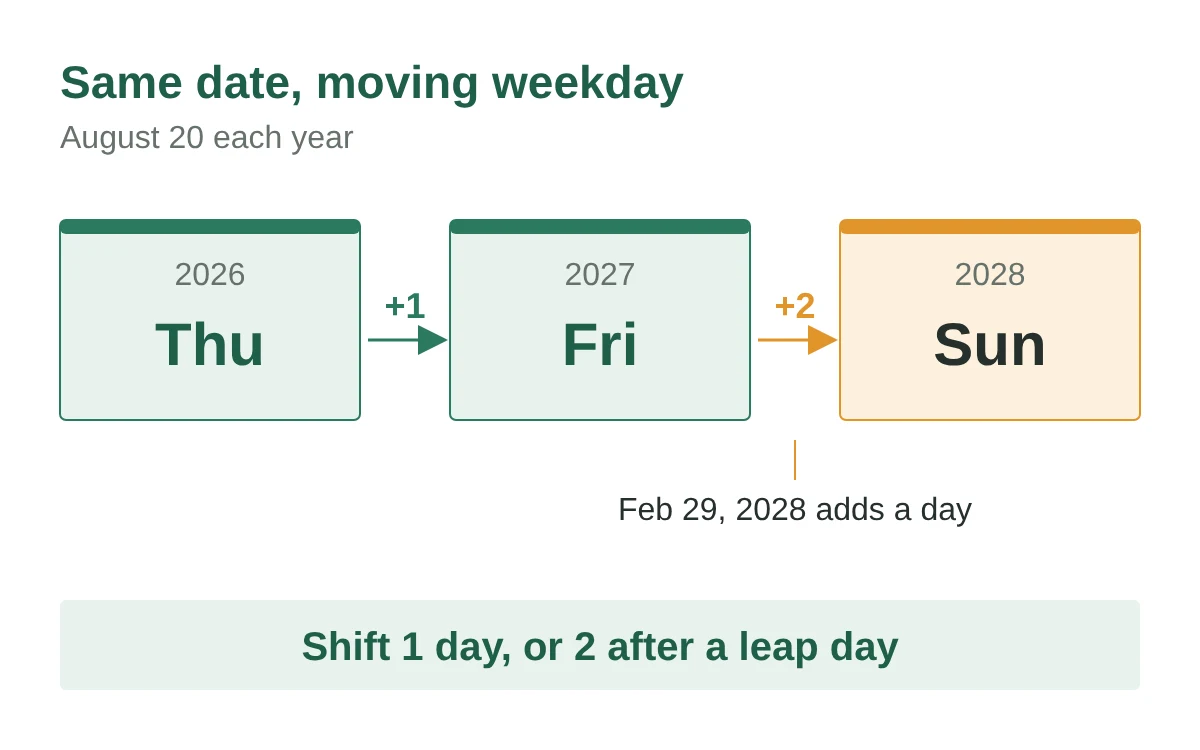
The weekday of any fixed date moves forward by one each year, and by two when a February 29 sits in between. It shifts forward by 1 day each year (or 2 days after a leap year). The sequence is predictable: August 20 is a Thursday in 2026, a Friday in 2027, a Sunday in 2028 (the leap day causes the double jump), then a Monday in 2029 and a Tuesday in 2030.
This matters for planning. In 2027 the date lands on a Friday, which makes it a natural start to a long weekend. In 2028 it lands on a Sunday, so anything due that day effectively moves to the Friday before or the Monday after.
The gap between two consecutive August 20ths is 365 days, except when February 29 falls between them. From August 20, 2027 to August 20, 2028 it is 366 days.
Try this: Work out the weekday of August 20 in a year ten years from now using the shift rule. Add 1 per year, plus 1 extra for each leap day in between, then take the total modulo 7.
What August 20 is known for
August 20 is not a US federal holiday, and it carries no tax deadline in the US. It is, however, a national day in a few countries. In Hungary it is St. Stephen’s Day, and the 20th of August is an official state holiday in memory of the state’s founding and its founder, King Saint Stephen. Stephen was canonized on that date in 1083, and the day is known for fireworks, parades and state awards.
Estonia marks the Day of Restoration of Independence on August 20, recalling the 1991 declaration that ended Soviet rule. Morocco observes the Revolution of the King and the People on the same date. If your countdown is for a trip, check which of these closes shops or changes transport timetables where you are going.
Globally, it is also World Mosquito Day. It commemorates the 1897 discovery by British physician Sir Ronald Ross that malaria is transmitted by mosquitoes. Many other “national days” attached to the date, such as food or radio days, are informal and vary by source.
In much of the Northern Hemisphere it is late summer. Many US school districts start around mid-August, but start dates differ by district, so confirm yours with the school calendar rather than assuming.
Planning milestones for the countdown
Working backwards from August 20 is often more useful than watching the total fall. The 100-day mark is May 12 and the 90-day mark is May 22, assuming the target is August 20 of the same year. For other offsets, the 90 days from now page lets you reverse the calculation from any start.
A good rule for projects is to split the time into four equal blocks and set a checkpoint at the end of each. For 170 days that means a checkpoint every 42 or 43 days. For bookings, many airlines and hotels open or change fares at set intervals before a date, so mark the 6-month, 3-month and 1-month points too.
If your event is flexible by a day either way, compare the neighbours: August 19 and August 21 have their own counters, and the weekday may suit your plans better.
Where August 20 starts first around the world
The date does not begin everywhere at once. It starts earliest in Kiribati’s Line Islands (UTC+14) and ends last in the zones at UTC-12. So for about 26 hours, somewhere on Earth is on August 20.
This has two practical effects. If you are counting to an event in another country, set the counter’s time zone to that location, not yours, or you will be off by up to a day. And if an online deadline says “by August 20” without stating a zone, the safest reading is the last moment in the latest time zone, though you should confirm that with the organiser.
Frequently asked questions
The questions below cover the quick answers most people look for after seeing the live count.
Frequently asked questions
Why does another countdown show a different number of days until August 20?
The usual causes are inclusive counting (adding one so August 20 itself counts), rounding up or down on the final day, and a counter that uses a server time zone instead of your local clock. The standard method counts midnights crossed and runs to the first moment of August 20.
How do you calculate the days until August 20 without a counter?
August 20 is day 232 of a normal year and day 233 in a leap year. Subtract the day-of-year number of your start date from that. If your start date is after August 20, add the days left in the year to 232 (or 233 if the next August 20 falls in a leap year).
What day of the week is August 20 in the next few years?
August 20 is a Thursday in 2026, a Friday in 2027, a Sunday in 2028, a Monday in 2029 and a Tuesday in 2030. The weekday moves forward one day each year and two days when a February 29 falls in between, which is why 2028 jumps from Friday to Sunday.
Which time zone sees August 20 first, and how long does the date last worldwide?
August 20 begins first in Kiribati's Line Islands (UTC+14) and ends last in the UTC-12 zone. That means the date is in progress somewhere on Earth for about 26 hours, so a countdown to an event abroad should use that location's time zone.