
How Many Days Until June 30th?
Calendar
Countdown chart
The live counter above gives the exact number of days to June 30 on your own clock and time zone. To check it by hand, remember that June 30 is day 181 of an ordinary year and day 182 in a leap year. Subtract today’s day-of-year number from that, and you have the answer.
The sections below cover the shortcut, the places where hand counts go wrong, and how to turn the total into weeks and working days. They also cover what the date is known for.
The one-subtraction shortcut
Counting month by month works, but it invites arithmetic slips. A cleaner way is to convert today’s date to a day-of-year number and subtract it from 181. For a hypothetical start of March 12 in a normal year, March 12 is day 71 (31 + 28 + 12). So 181 minus 71 gives 110 days.
You can confirm it the long way. March has 19 days left after the 12th, then April adds 30, May adds 31, and June adds 30. That is 19 + 30 + 31 + 30 = 110.
A leap year changes nothing for dates from March onward. Both numbers shift up by one (June 30 becomes day 182, March 12 becomes day 72), so the difference stays 110. Leap day only matters if your start date is in January or February.
Try this: Pick any date from March to June and work out its day-of-year number in your head. Subtract it from 181, then check the result against the live counter. Two or three rounds and the month lengths stick.
Counting from after June 30
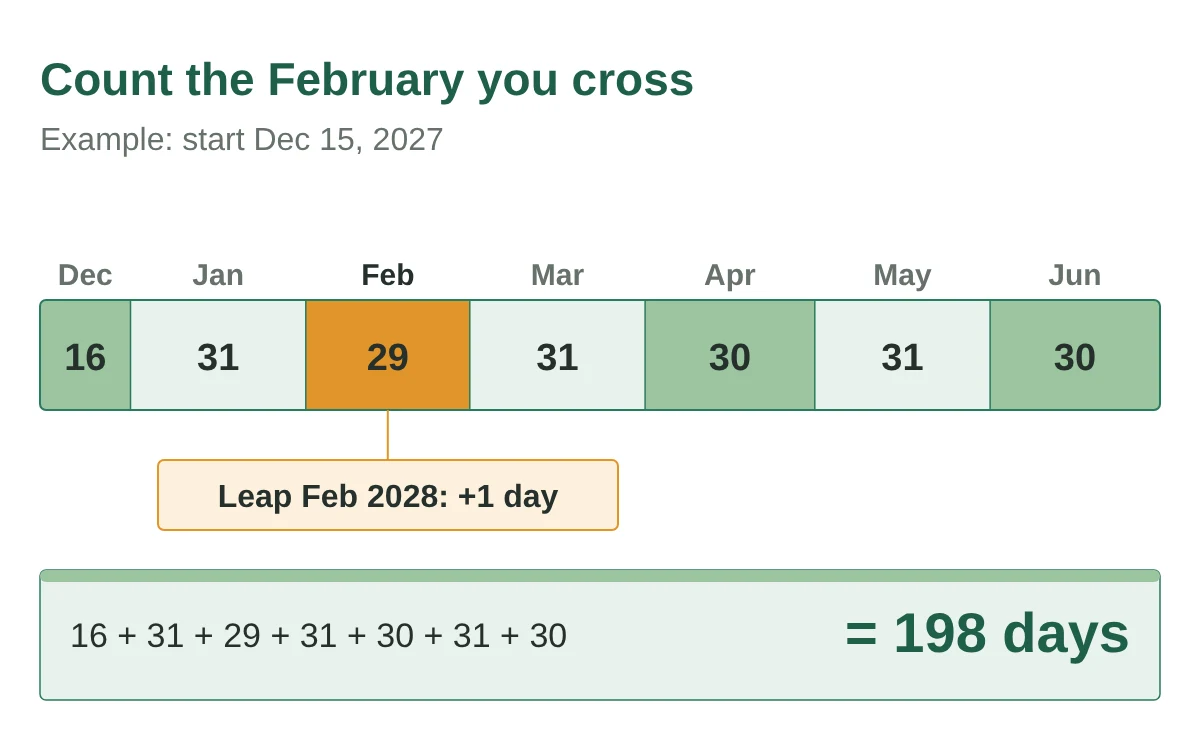
Once June 30 has passed, the target becomes next year’s date, and February decides the result. Take a hypothetical start of December 15. There are 16 days left in December, then 31 (January), 28 (February), 31 (March), 30 (April), 31 (May) and 30 (June). That totals 197 days. If the coming February has 29 days, the answer is 198.
The common mistake is to check whether the current year is a leap year. What matters is whether the February you cross is a leap February. A count that starts in December 2027 crosses February 2028, so it includes the extra day.
For a quick estimate from late in the year, use half a year as a anchor. June 30 sits 181 or 182 days after the new year begins, so a December start is a little under 200 days out. Months from June onward are the long way round.
Until June 30 or through June 30?
“Days until June 30” usually means the number of midnights between now and the start of June 30. That makes the live count reach zero as the date begins. If you are racing a deadline that runs through the end of June 30, such as a form, a fiscal-year close or a final payment, you effectively have one more day than the count suggests.
Time zones can move this by a full day. The widget uses your device clock, so someone in Sydney reaches June 30 many hours before someone in Los Angeles. For anything involving a counterparty abroad, find out whose midnight the deadline uses. If you only need the clock side of that question, how long until midnight covers the final stretch.
Weekdays and weeks to June 30
For the weeks, divide the day count by 7 and keep the remainder. The 110 days from the earlier example make 15 weeks and 5 days. Each whole week holds exactly five weekdays, so the work is in the leftover days.
The leftover days start on the weekday after your start date. Say you start on a Monday. The five extra days run Tuesday to Saturday, which includes four weekdays. That gives 15 × 5 + 4 = 79 weekdays, counting June 30 itself if it falls on one. This example would land on a Saturday, so it does not.
In a spreadsheet, NETWORKDAYS counts both the start day and the end day. Run it on a weekday and the total is one higher than the “days between” convention. Neither version removes public holidays unless you give it a list. In the US, Juneteenth (June 19) and July 4 are the ones most likely to sit near this date. If you need to compare two arbitrary dates, the date calculator does the subtraction for you.
A formula that rolls over by itself
A formula such as =DATE(2027,6,30)-TODAY() breaks the moment the year passes. This one picks the next June 30 automatically:
=DATE(YEAR(TODAY())+(TODAY()>DATE(YEAR(TODAY()),6,30)),6,30)-TODAY()
The comparison returns 1 once June 30 is behind you and 0 before then, which bumps the year only when needed. On June 30 itself the result is zero, and on July 1 it jumps to the following year. Paste it into a countdown cell once and it keeps working for years.
What June 30 is known for
Plenty of days on June 30 have lasting weight. The date is the halfway point of the calendar, closing the first half of the year and the second quarter. It falls in summer in the Northern Hemisphere and in winter in the Southern Hemisphere.
- International Asteroid Day marks the Tunguska event of June 30, 1908, when an object exploded over Siberia and flattened an enormous area of forest.
- Social Media Day was started by the tech outlet Mashable in 2010 and is now an unofficial marketing and community date.
- The Democratic Republic of the Congo celebrates its independence on June 30 (from 1960).
- Australia’s financial year ends on June 30, and many US states close their fiscal year on the same date.
June 30 is also a traditional slot for the leap second. Leap seconds were added at the end of June 30 or December 31, the most recent one on December 31, 2016. Metrologists voted in 2022 to phase the practice out by 2035.
The weekday drift and a hidden twin
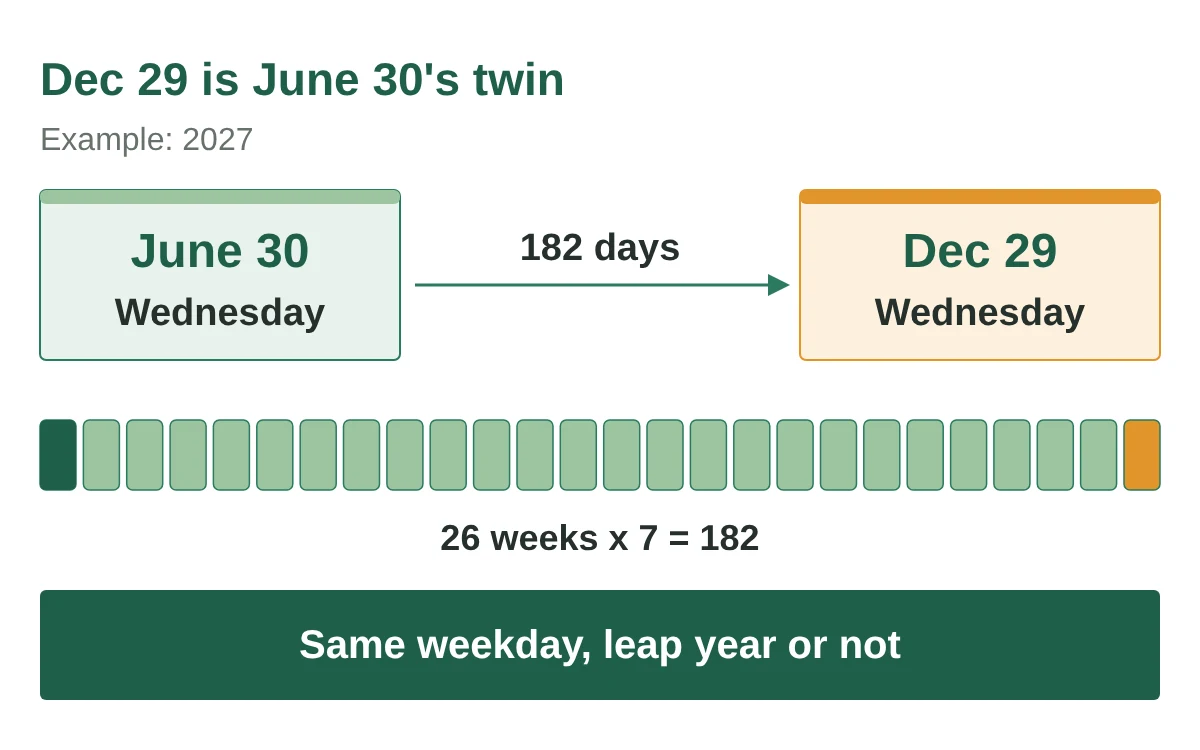
June 30 moves forward one weekday each year, and two after a leap year. It falls on a Wednesday in 2027, a Friday in 2028 and a Saturday in 2029. That is why a recurring plan tied to June 30, such as a half-year review, lands on different days and needs checking each time.
There is a neat pairing here. December 29 always shares a weekday with June 30, in leap and ordinary years alike, because the two dates sit exactly 182 days (26 weeks) apart. If you know one, you know the other.
Planning around the countdown
June 30 works well as a checkpoint because it splits the year into equal halves. A simple method is to plan backwards in fixed blocks. Use the 90 days from now page to mark the start of a quarter-length push, and 8 weeks to days to set a final sprint window.
For a longer run, count how many whole Fridays or month-ends remain and make each one a milestone. Because deadlines on June 30 often run to the end of the day, build in a buffer of one working day before it. If the date is only a stop on the way to something later, how many days until July 4th picks up where this one ends.
Try this: Write down your June 30 goal, then set three checkpoints at roughly 100, 50 and 14 days out. Use the live counter to find the exact dates and put them in your calendar today.
Frequently asked questions
What day of the year is June 30?
June 30 is day 181 in an ordinary year and day 182 in a leap year. To find the days remaining, convert today's date to its day-of-year number and subtract it from 181 (or 182 in a leap year).
Does a leap year change how many days are left until June 30?
Only if the start date falls in January or February, because the extra day on February 29 sits between the two dates. From March 1 onward, both the start date and June 30 shift up by one, so the difference stays the same.
How do I count days to June 30 when this year's June 30 has already passed?
Count to next year's June 30, and check whether the February you cross has 29 days, not whether the current year is a leap year. For example, a count from December 15 totals 197 days, or 198 if the coming February is a leap February.
If a deadline is June 30, does the countdown include that day?
A standard countdown reaches zero as June 30 begins, so a deadline that runs through the end of June 30 gives one more day than the count shows. Time zones can also shift this by a full day, so it is worth confirming whose midnight the deadline uses.