
How Many Days Until June 7th?
Calendar
Countdown chart
The exact answer is in the live countdown above this article, which reads your device’s clock and time zone. If you want to check it by hand, use one number: June 7 is the 158th day of the year, or the 159th in a leap year. Subtract the day-of-year of your starting date from that and you have the day count.
That one number also turns date math into simple subtraction, so the rest of this page covers the working method, the weekday and weekend counts, and what the date is known for.
The day-of-year shortcut
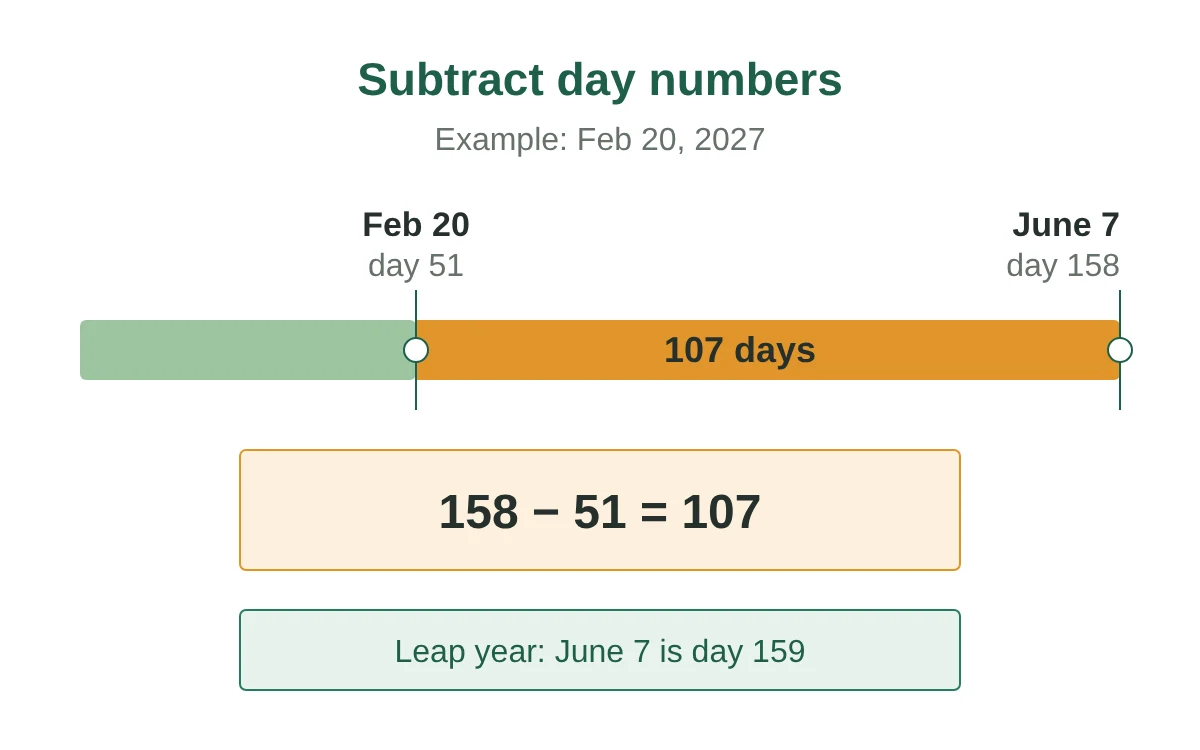
June 7 is the 158th day of the year in a normal year. The count runs 31 (January) + 28 + 31 + 30 + 31 = 151 days to the end of May, plus 7. In a leap year, February has 29 days, so every date from March 1 onward moves up by one and June 7 becomes day 159.
Most manual mistakes come from adding month lengths from memory. Counting forward through each month invites slips, since 30 and 31 are easy to swap. Day-of-year numbers avoid that, and you only need to know three anchors: March 1 is day 60 (61 in leap years), June 1 is day 152 (153), and June 7 is day 158 (159).
A worked example by hand
Take a hypothetical start date of February 20, 2029, which is not a leap year. February 20 is day 51 (31 days of January plus 20). Subtract: 158 minus 51 gives 107 days.
You can confirm it the long way. The rest of February after the 20th is 8 days, then March adds 31, April 30, May 31, and June adds 7. That totals 8 + 31 + 30 + 31 + 7 = 107. Two methods agreeing is the cheapest error check there is.
Try this: Pick today’s date, look up its day-of-year, and subtract it from 158 (159 in a leap year). Then compare your answer with the live countdown. If the two differ by one, you have probably hit the inclusive versus exclusive issue described below.
Counting weeks and weekdays
Divide the day count by 7 and keep the remainder. In the example above, 107 days is 15 weeks and 2 days. The remainder tells you something useful: the start date and June 7 are 2 weekdays apart. February 20, 2029 is a Tuesday, and June 7, 2029 is a Thursday, so the remainder matches.
For weekdays, multiply the full weeks by 5 and then count only the leftover days, looking at which weekdays they land on. Here that is 15 × 5 = 75, plus Wednesday and Thursday for the last two days, which gives 77 weekdays. The leftover days are always the last ones before the target, so you only need to know what weekday June 7 is. Public holidays in between are not removed by this method, so subtract them separately if you need working days. The date calculator handles days between two dates if you would rather skip the arithmetic.
Which weekday June 7 lands on
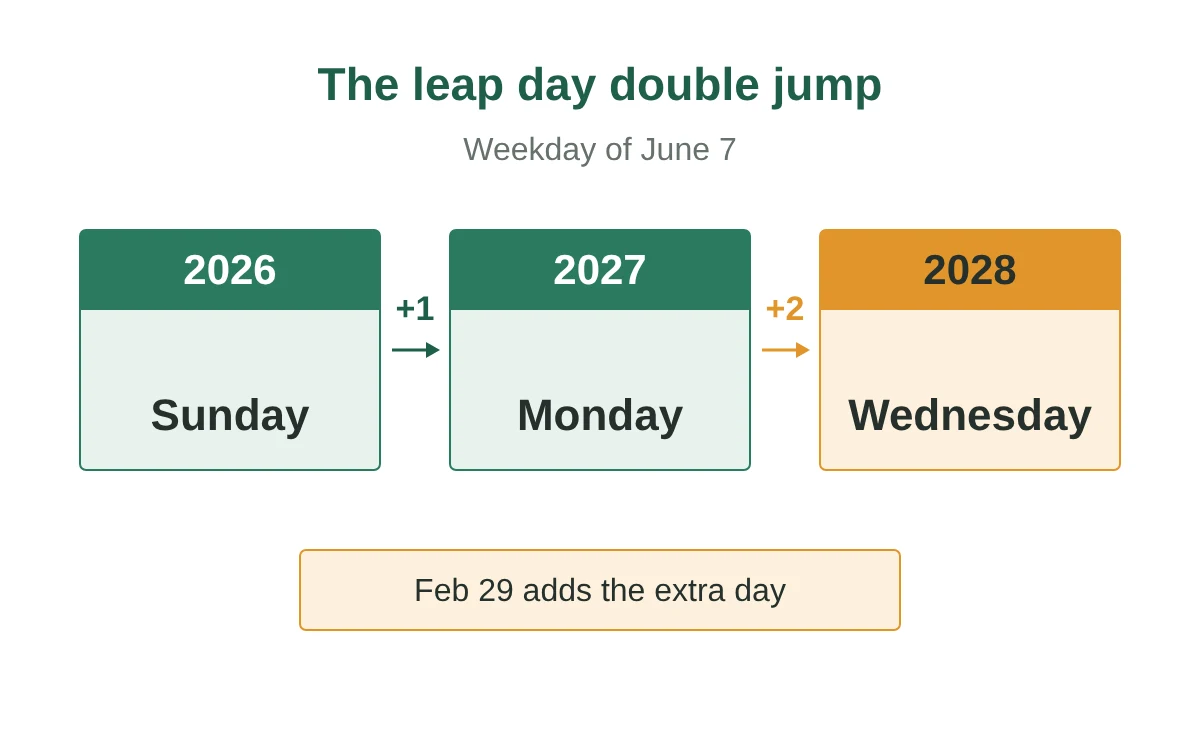
The weekday moves forward by one each year and by two after a leap day. The pattern: Monday in 2027, Wednesday in 2028 (the leap-year double jump), Thursday in 2029, Friday in 2030. A full cycle takes 28 years in the Gregorian calendar, with the exception of century years that are not leap years.
Weekday matters for planning. A Monday June 7 is a clean week start, whereas a Friday makes the whole following weekend part of the event. Check the weekday first, then decide whether the countdown should be measured in days or in working weeks.
Why the countdown hits zero at midnight
A countdown to a date ends at 00:00 at the start of June 7 in your time zone, not at the end of the day. When the widget shows 0 days, the whole day is still ahead. This is also why two sources can differ by one: some count today as day one (inclusive), and others count only the nights between (exclusive). Day-of-year subtraction gives the exclusive count, which matches how this page’s countdown works.
Time zones add another wrinkle. Someone in Sydney reaches June 7 many hours before someone in Los Angeles. If you are coordinating with people elsewhere, agree on whose midnight counts. The Central time page is handy for checking one common zone.
The hour count is not days times 24
Multiplying days by 24 to get hours works only if no clocks change in between. Daylight saving transitions create a 23-hour day in spring and a 25-hour day in autumn, so a countdown that crosses one of them is off by an hour if you use the shortcut. In the US and Europe, June sits inside daylight saving time, so any count that starts in winter crosses the spring change and holds a spare 23-hour day. The live widget accounts for this because it uses your local calendar rather than a flat 24-hour block.
Try this: Take a start date in January and work out the hours to June 7 by multiplying days by 24. Then subtract the day count’s equivalent in real elapsed hours from the widget. The one-hour gap is the spring clock change.
What June 7 is known for
June 7 is not a public holiday in the US or UK, but it carries a good many observances. World Food Safety Day is a UN observance on June 7, and National Boone Day marks Daniel Boone first exploring Kentucky’s Bluegrass region on June 7, 1769. National Chocolate Ice Cream Day is an unofficial US favourite.
Elsewhere it is more serious. Malta marks Sette Giugno, which commemorates the uprising against British colonial rule on June 7, 1919. Union Dissolution Day is an official flag-flying day in Norway, recalling 1905. Peru marks its flag day on the same date.
Some US observances shift. National Cancer Survivors Day sits on the first Sunday in June, which only lands on June 7 when June 7 is a Sunday, because the first Sunday can never fall later than the 7th. That was the case in 2026. Corpus Christi is also movable, so do not assume a fixed date for either.
Planning around the countdown
June 7 sits just after the start of meteorological summer on June 1 and roughly two weeks before the June solstice. In the Northern Hemisphere, that is peak garden season and the start of the Atlantic hurricane season (June 1), which matters if you are booking travel to the US Gulf or Caribbean.
A few ways to use the countdown well:
- Set checkpoints at the halfway point and at 30 days out, since most deadlines slip in the final month.
- Work backwards in whole weeks, so each milestone falls on the same weekday.
- Keep the fixed anniversaries separate from the movable ones, since the date repeats every year but the weekday does not.
Because June 7 recurs, the same logic applies to any yearly date, like a birthday. The birthday countdown works that way. For neighbouring dates, see June 6 and June 8, or take a broader view with the days until June page.
Frequently asked questions
How many days until June 7?
The live countdown above the article gives the exact figure for your own clock and time zone. To check it by hand, subtract the day-of-year of today's date from 158 (or 159 if the June 7 in question falls in a leap year).
What day of the week is June 7?
It changes each year. June 7 falls on a Monday in 2027, a Wednesday in 2028, a Thursday in 2029 and a Friday in 2030. The weekday moves forward by one each year, or by two when a leap day sits in between.
Is June 7 a public holiday?
Not in the United States or the United Kingdom. It is a national day in a few places, including Malta (Sette Giugno) and Norway (flag day for the 1905 union dissolution). Check your local calendar if work or school depends on it.
Does the countdown reach zero at midnight or at the end of June 7?
It reaches zero at 00:00 on the morning of June 7 in your time zone. The whole of June 7 still lies ahead at that moment, so the date is not over until the following midnight.