
How Many Months Until November?
Calendar
Countdown chart
The live counter above gives the exact answer on your own clock and time zone, shown as whole calendar months plus leftover days until November begins at 00:00 on November 1. That is the cleanest definition of “until November”, because a month starts at its first instant, not at some midpoint.
Counting it yourself takes about ten seconds once you know one rule, and a few traps are worth knowing, because many countdown sites quietly disagree with each other.
What “until November” actually measures
The target is the first moment of November in your time zone. A count of “11 months” therefore means 11 full calendar months have to pass, not 11 blocks of 30 days. Because the calendar months are uneven (28 to 31 days), the same month count can cover anywhere from about 335 to 365 days.
November is the 11th month today, but its name comes from the Latin for nine. It was originally the ninth of ten months on the Roman calendar, and kept its name when the year grew to twelve months. That is why the name looks off by two.
A by-hand shortcut that always works
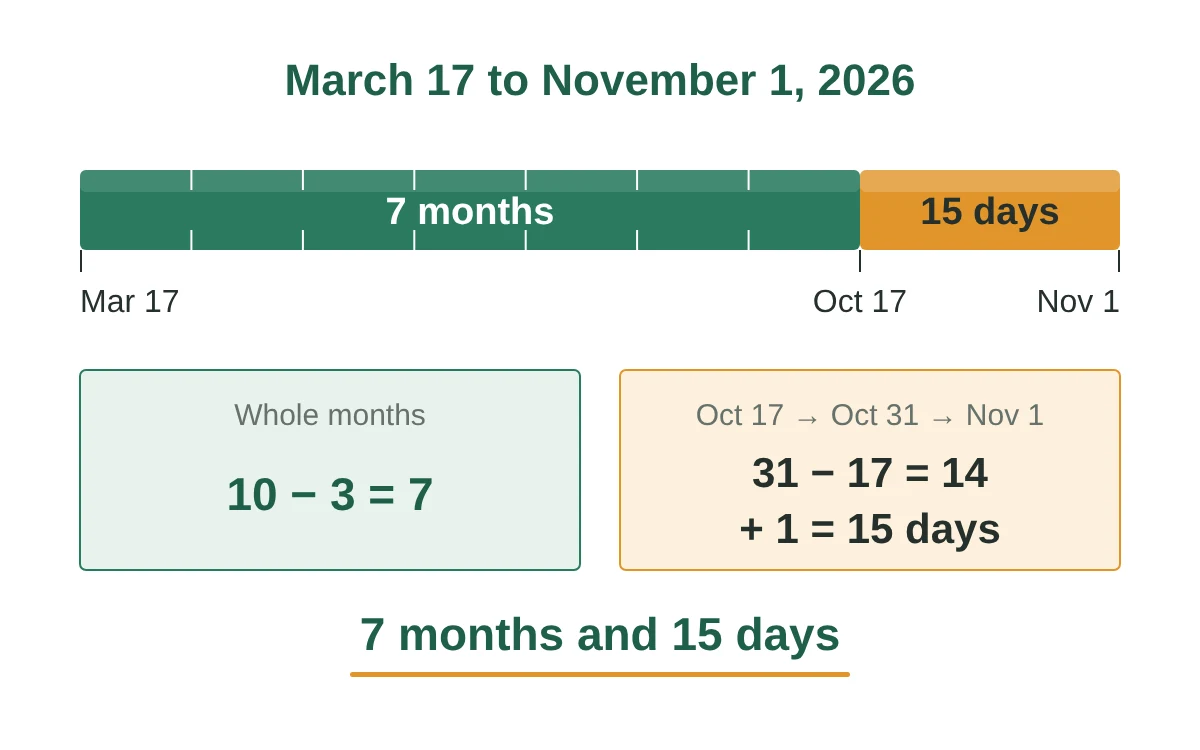
Take the month number of your starting date. If the day of the month is the 1st, the whole months to November 1 are 11 minus that number. If the day is the 2nd or later, subtract one more: 10 minus the month number. The leftover days are 32 minus the day of the month.
Worked example, using a hypothetical start of March 17: March is month 3, so 10 minus 3 gives 7 whole months, which lands on October 17. From October 17 to November 1 is 32 minus 17, so 15 days. The answer is 7 months and 15 days.
Try this: Pick any date at random, such as August 9. Predict the answer with the rule (10 minus 8 is 2 months, then 32 minus 9 is 23 days), then check it in the date calculator.
The rule is safe because the month just before November is October, which has 31 days. Whatever day you start on, October has a matching date, so nothing ever needs adjusting. Targets in other months do not always have that luxury.
Why days divided by 30 gives the wrong answer
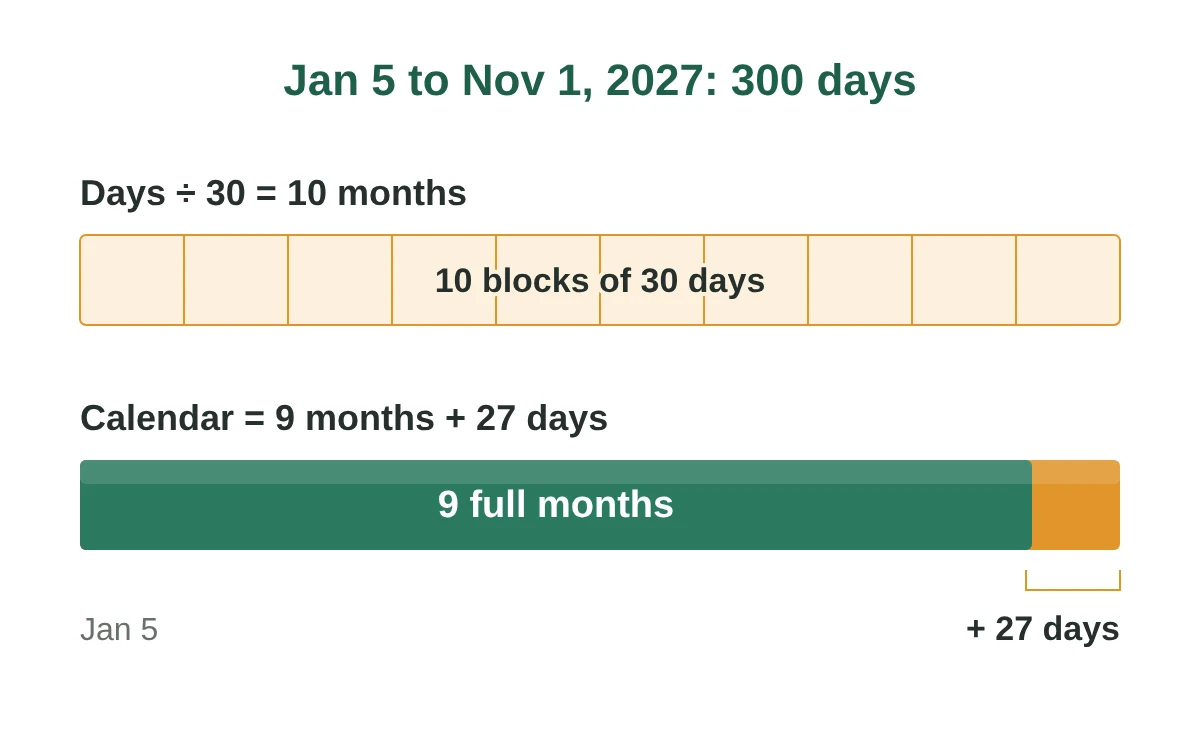
A common shortcut is to take the day total and divide by 30. It drifts, because the average month is closer to 30.44 days, and the error grows with distance. At 300 days the divide-by-30 method says 10 months, while the calendar may say 9 months and 27 days or 9 months and 30 days depending on where you start.
Rounding makes it worse. Some counters show “about 11 months” for a gap that is really 10 months and 20 days. That reads fine for casual planning but fails if a deadline, a lease or a payment schedule depends on whole months. If you only have a day total, the 120 days to months converter shows how much the answer moves depending on the method.
Months from the 1st of every month
From the first day of each month, the whole-month count to November 1 is a fixed number and never changes from year to year:
| Starting on the 1st of | Months to November 1 |
|---|---|
| January | 10 |
| February | 9 |
| March | 8 |
| April | 7 |
| May | 6 |
| June | 5 |
| July | 4 |
| August | 3 |
| September | 2 |
| October | 1 |
Anything after the 1st sits between two rows, with the leftover days filling the gap. On the 2nd of a month you are already 1 month and a few weeks short of the next row, which is why the second-day-onward rule subtracts an extra month.
When it is already November
During November itself, “until November” is ambiguous. It can mean the next November, which is nearly a year away, or the end of the current month. Counters that start a new target as soon as November 1 passes will show close to 12 months, and it will fall by one only after the same day of next month.
If you actually want the end of the current month, count to December 1 with how many days until December. If you want a specific day, such as the first, use how many days until November 1st.
Months, weeks or days: which unit to use
Months suit long-range planning where precision to the day is not needed, such as booking travel or setting a savings goal. Weeks suit anything with a weekly rhythm, like training plans or sprints, and weeks until November 1st gives the week count directly. Days are best for hard deadlines.
A useful check is to convert in both directions. If the counter says 7 months and 15 days, that is roughly 230 days, or 32 to 33 weeks. If the units do not agree within a few percent, one of them has been counted the wrong way.
Try this: Write down the months and days from the counter above, then convert the months to days using the real month lengths between now and November 1, not 30 each. Compare your total with the day count in the days countdown.
Time zones and clock changes
The counter uses your device clock, so two people looking at the same moment can see different results near a month boundary. Auckland reaches November 1 many hours before Los Angeles does. If you are scheduling something across zones, agree on whose midnight counts.
Clock changes matter only if you count in hours. Daylight saving shifts can make the exact hour total one more or one less than the day total times 24, depending on whether the span crosses a change. For month and day counts this never matters, since the calendar date is unaffected.
If the start date has a time of day, such as 3 PM, the count is to midnight, so the final partial day runs from 3 PM to 12 AM. That is a 9-hour stub that you can add to the month and day answer if you want exactness.
Planning around the month count
Month counts are most useful when converted into milestones. Splitting the remaining time into equal monthly checkpoints is easier than splitting it into days, and the calendar boundaries give natural review dates (the 1st of each month works well). For anything measured in longer blocks, 60 months to years helps you sort out multi-year plans.
For the nearer months along the way, you can compare against how many months until October, which lands exactly one month earlier on the calendar.
Frequently asked questions
How many months until November?
The live counter above gives the exact figure for your clock: whole months plus leftover days until November 1 begins. From the 1st of any month, the whole-month count is 11 minus that month's number, so it is 8 from March 1 and 3 from August 1.
Is it 11 months until November if I search in December?
From December 1 it is 11 months to the next November 1, since November 2027 is the next one after a December start. Starting mid-December it is 10 months plus the leftover days, because the 11th month is not yet complete.
Does the countdown end on November 1 or November 30?
It ends at the start of November 1, 00:00 on your clock, because that is when the month begins. If you need the end of the month, count to December 1 instead.
Why do two sites give different month counts for the same day?
Some divide the day total by 30 or 30.44 and round, while others count whole calendar months and show the remainder in days. The calendar method is the exact one.