
How Many Days Until November 7th?
Calendar
Countdown chart
The live counter above gives the exact answer, measured from your device’s clock to the first moment of November 7 in your time zone. To check it by hand, subtract today’s day-of-year number from 311, and add 365 if November 7 has already gone by this year.
The date recurs every year, so the counter always points at the next one. The sections below cover the shortcuts, the traps (leap days, clock changes, time zones) and the things worth knowing about the date itself.
What the countdown is really measuring
A countdown to a date ends at the start of that date, which is midnight at 00:00 local time. That has a side effect: November 7 begins in Kiribati (UTC+14) 26 hours before it begins in the far west of the Pacific (UTC-12). Across the planet the date is “live” somewhere for 50 hours.
So two people in different time zones can see different day counts at the same instant. The widget uses your own zone, which is what you want for a personal deadline. If you are counting toward something happening in another city, work out the target in that city’s zone first.
Whole days and calendar days also differ. If it is 6 pm today, the gap to midnight starting November 7 is a few hours short of a round number. Calendar-day tools round that up and count today as a full day, while elapsed-time tools do not. This is why two sites can disagree by one without either being wrong.
Count it by hand with day-of-year numbers
November 7 is the 311th day of the year in a common year. In a leap year it is day 312, because February 29 comes first. Subtracting day numbers is faster than adding up month lengths.
To get today’s day number, use the running totals at the end of each month: January 31, February 59, March 90, April 120, May 151, June 181, July 212, August 243, September 273, October 304. Add the day of the month to the total for the previous month. Then subtract from 311.
If the result is negative, November 7 has passed. Add 365 and you have the count to next year’s date. The leap-day rule trips people up here: add a day only if February 29 falls between your two dates, not simply because the current year is a leap year. A countdown that starts in November of a leap year and ends the following November never crosses a February 29 if the next year is a common year.
A worked example with a hypothetical date
Suppose you start counting on August 19 in a common year. The day number is 243 minus 31 plus 19, which is 231. Then 311 minus 231 gives 80 days.
Cross-check with the month method: 12 days left in August, 30 in September, 31 in October, and 7 in November. Added together, 12 + 30 + 31 + 7 is 80. Two routes that agree make an arithmetic slip very unlikely.
Eighty days is 11 weeks and 3 days, or 1,920 hours before any clock change is considered.
Try this: Work out today’s day-of-year number from the running totals, subtract it from 311 (or 312), and compare your answer with the live counter. If you are off by one, you counted today differently from the widget, not wrongly.
Weeks and weekdays to November 7
To turn days into weeks, divide by 7 and keep the remainder. In the example above, 80 days is 11 weeks and 3 days. The remainder is the useful part: it tells you which weekday you land on. Starting on a hypothetical Tuesday, 3 days past a whole number of weeks is a Friday.
Weekdays work the same way. Each full week holds 5 weekdays, so 11 weeks contribute 55. For the leftover 3 days, list the weekdays that follow your start day. After a Tuesday those are Wednesday, Thursday and Friday, which adds 3 more, for 58 weekdays including November 7 itself. Stopping at the day before gives 57.
Working days then lose any public holidays in the span. For a countdown that starts in late summer in the US, that usually means Labor Day and the second Monday of October. Veterans Day on November 11 comes after the target, so it never reduces the count. For arbitrary start dates, the date calculator handles both inclusive and exclusive counting.
Why the weekday keeps moving
A common year is 52 weeks plus one day, so November 7 lands one weekday later each year. It shifts forward by 1 day each year, or 2 days after a leap year. More exactly, the double step happens whenever a February 29 sits between two consecutive November 7s. 2028 is a leap year, so the jump into that November is two days.
That movement matters for planning. Month-and-day dates never get a reliable weekday, so a recurring event on November 7 will hit a weekend in some years and a Tuesday in others. The next one is shown in the counter above, and the weekday is worth checking before you book anything.
A detail for US readers: Election Day is the Tuesday after the first Monday in November, so it always falls between November 2 and 8. November 7 can be Election Day, and in 2028 it is a Tuesday, so the two coincide in that presidential election year.
Clock changes can shift an hours countdown
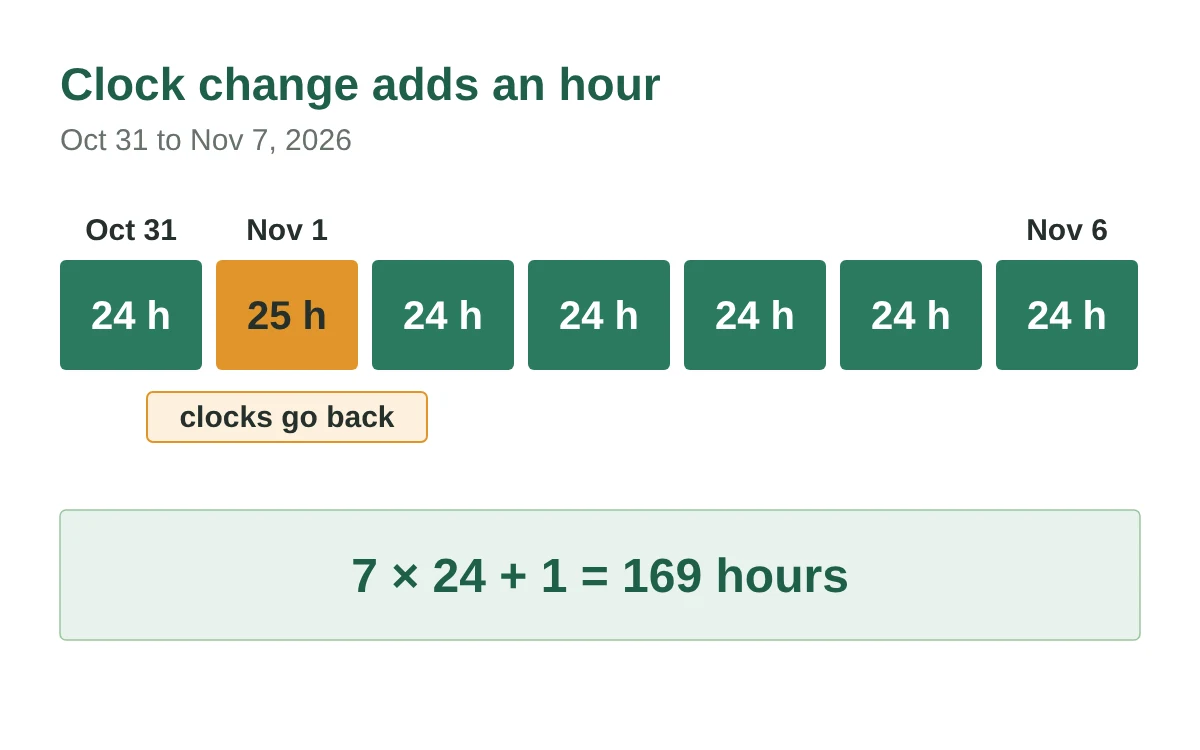
Days are immune to daylight saving time, but hours are not. In the US the clocks go back on the first Sunday in November, which means the change falls between November 1 and November 7. A countdown to midnight starting November 7 that crosses the change contains one more real hour than days times 24 suggests.
Europe changes in the last weekend of October, so the same effect appears there on a different date. If you are converting a count into hours or minutes for a schedule, use a tool that works from timestamps. Multiplying by 24 is only exact when no change lies in the span. The time conversions page covers the unit arithmetic.
What November 7 is known for
The date has no single global holiday, but several observances share it:
- International Inuit Day, celebrated annually on November 7.
- Bangladesh’s National Revolution and Solidarity Day, which commemorates the 7 November 1975 coup.
- October Revolution Day, marked in Belarus. The name comes from the Julian calendar date of 25 October for the 1917 events, which fall on November 7 in the Gregorian calendar.
It is also the birthday of Marie Curie (1867) and Albert Camus (1913). In the Northern Hemisphere it sits in late autumn, and it always falls at least 15 days before US Thanksgiving, which cannot come earlier than November 22.
If your target is a neighbouring date, November 11 is four days later and the month as a whole is on the months until November page.
Planning around the date
A countdown is most useful when it is cut into blocks. Fifty-six days is exactly 8 weeks (see 8 weeks in days), which is a good unit for a project with weekly reviews. Counting back from November 7 in 56-day steps gives you milestone dates that land on the same weekday as the target.
For a longer run, put a checkpoint at the 90 days out mark, then at 56, 28 and 7 days. Early checkpoints are the ones people skip, and they are the cheapest to keep.
Try this: Pick your target weekday, then subtract 56, 28 and 7 days from November 7. Because each step is a multiple of 7, all three milestones fall on the same weekday as the target. Put them in your calendar now.
If the date is a deadline rather than a celebration, aim to finish a weekday earlier. When November 7 falls on a weekend, the practical cutoff is usually the Friday before.
Frequently asked questions
How many days until November 7th?
The live counter above gives the exact figure from your own clock and time zone. To check it by hand, subtract today's day-of-year number from 311 (312 in a leap year), and add the length of a year if November 7 has already passed.
What day of the week is November 7th?
It changes every year. The weekday moves forward by one each year, or by two when a February 29 falls between one November 7 and the next. The counter above shows the weekday for the next occurrence.
Is November 7th a public holiday?
Not in the United States. It is an official observance in a few countries, including Bangladesh (National Revolution and Solidarity Day) and Belarus (October Revolution Day), and it is International Inuit Day.
How do I count only weekdays until November 7th?
Multiply the number of full weeks by 5, then add the weekdays among the leftover days, counted forward from the day after your start. Subtract any public holidays that fall in between.