
How Many Days Until October 28th?
Calendar
Countdown chart
The live countdown above gives the exact answer for your clock and time zone, down to the second. It always aims at the next October 28 that has not yet started, so once this year’s date passes, it switches to next year’s. The rest of this page explains how to get the same number by hand, and where the common mistakes hide.
October 28 sits late in the year, three days before Halloween, so the count is easy to get wrong across a year boundary or a leap day. A few short rules remove nearly all of that risk.
The day-of-year shortcut
Adding up month lengths is slow. A faster method is to use day-of-year numbers. October 28 is day 301 in a common year and day 302 in a leap year, because February 29 pushes everything after it back by one. Remember 301 and you can skip the month-by-month sums.
Find the day-of-year number for your starting date, then subtract it from 301. If you are not sure of the start date’s number, add up the whole months before it and then add the day of the month. This works only when both dates fall in the same calendar year, which is the case for any start date before October 28.
For a start date after October 28, flip the approach: take the days left in the start year (365 or 366 minus the day-of-year), then add 301 or 302 depending on whether the target year is common or leap.
A worked example
Take a hypothetical start date of March 15, 2027, which is not a real “today”, just a test case. January has 31 days and February has 28 in 2027, so March 15 is day 74 (31 + 28 + 15). Then 301 minus 74 gives 227 days.
You can verify it the slow way. March 16 to 31 is 16 days, then April 30, May 31, June 30, July 31, August 31 and September 30 add up to 199 in total. Adding the 28 days of October gives 227. Both routes agree, which is the point: always run one check by a second method.
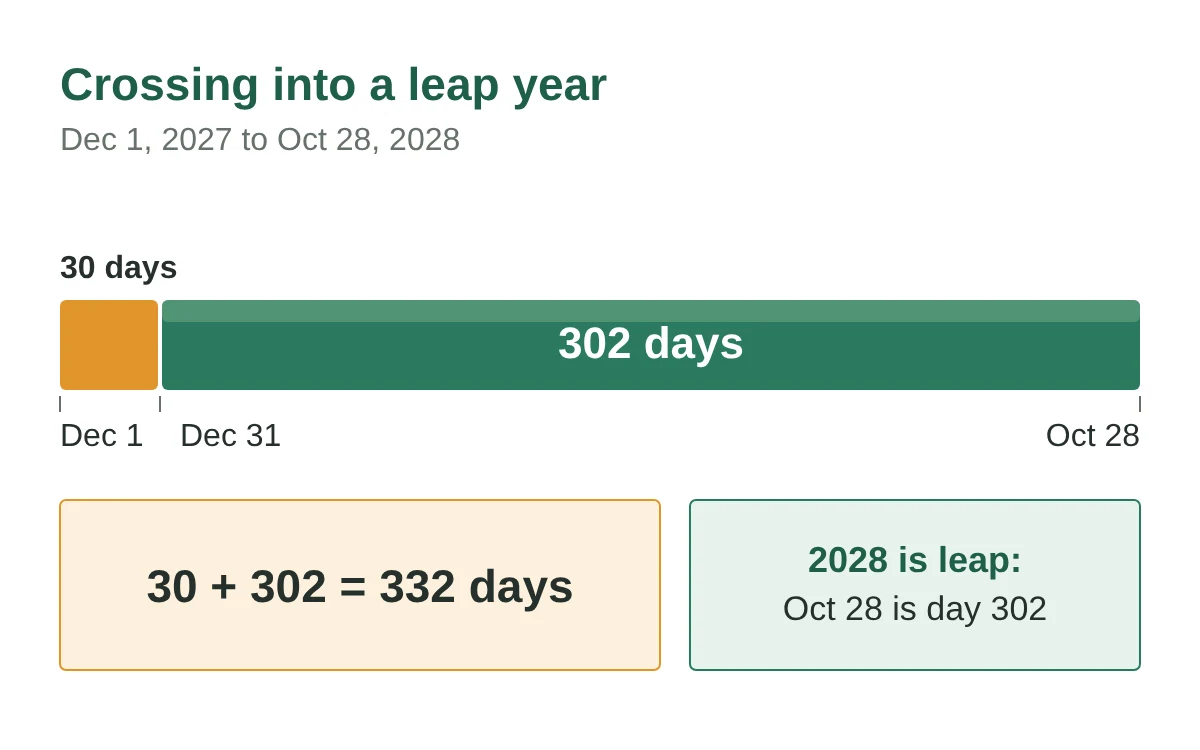
Now a leap-year case. Starting on December 1, 2027 and aiming for October 28, 2028: December 1 is day 335 of 2027, so 30 days remain in that year. The target year, 2028, is a leap year, so October 28 is day 302. The total is 30 + 302 = 332 days. Someone using 301 here would be off by one.
Try this: Pick any date from last month and compute its distance to October 28 with the 301 shortcut. Then paste the same two dates into the date calculator and see whether you match. If you are off by one, you have almost certainly mixed up leap years.
Inclusive or exclusive: the off-by-one trap
Date subtraction counts the nights between two dates, not the days you touch. From a Monday to the following Monday the answer is 7 even though 8 calendar squares are involved. The countdown widget follows the same rule: it measures to the start of October 28, so the target day itself is not counted.
A second trap appears on the final day. At 3 PM on October 27, a date-only subtraction says 1 day remains, while a clock-based count says about 9 hours. If you are timing something that starts at midnight, the midnight countdown is the more honest tool. If a deadline falls at 5 PM on October 28, count to that moment instead of the date.
Counting weeks and weekdays
Divide your day count by 7. The quotient is full weeks and the remainder is the extra days. In the example above, 227 days is 32 weeks and 3 days. For working days, multiply the full weeks by 5 and then count only the weekdays in the leftover stretch.
That leftover stretch depends on the start weekday, which is where people slip. March 15, 2027 falls on a Monday, so the 3 leftover days are Monday, Tuesday and Wednesday, all weekdays. The total is 32 × 5 + 3 = 163 weekdays, counting the start day and stopping before October 28. Public holidays still need to be subtracted by hand, since they differ by country and employer.
A useful consequence: a count of exactly 7, 14 or 28 days always lands on the same weekday you started on. If you want a countdown that ends on a weekday of your choice, pick a start date whose distance to October 28 gives the right remainder. For longer spans, the 8 weeks to days page shows how week blocks convert.
Why the weekday keeps shifting
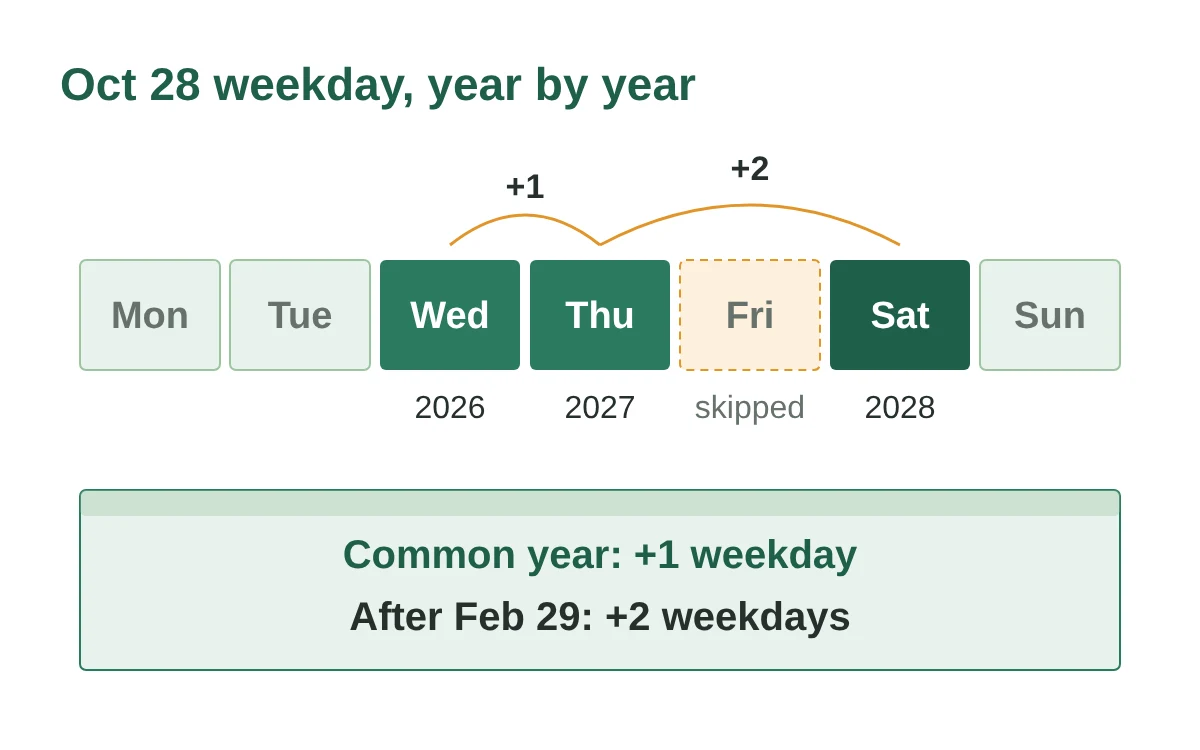
October 28 moves forward one weekday each year, and two weekdays after a leap year. The pattern follows from 365 days being 52 weeks plus one day. It shifts forward by 1 day each year (or 2 days after a leap year). For instance, the date lands on a Thursday in 2027 and then jumps to a Saturday in 2028, skipping Friday.
This matters for planning anything tied to the date, such as a recurring event or a fixed-date holiday. A fixed date will not stay on a weekend, or on a weekday, for long. Every 28 years the calendar mostly repeats, although century years that are not leap years can break that cycle.
What October 28 is known for
The date carries two national days. In the Czech Republic it is Independence Day, and it celebrates the day in 1918 when independence was declared from the Austro-Hungarian Empire. Over time the date also took on other associations, and it has developed into a day of general Czech patriotism. As a practical detail for travellers, shops with a floor area of more than 200 square metres are closed on the holiday.
In Greece and Cyprus it is Ohi Day. It marks October 28, 1940, when Greek Prime Minister Ioannis Metaxas replied “Ohi” (“No”) to Mussolini’s ultimatum. Many Greek communities mark it with parades and school ceremonies.
Smaller observances also attach to the date, including National Chocolate Day in the United States, which is an informal awareness day and not an official holiday. In the Western Christian calendar, October 28 is also the feast of Saints Simon and Jude. No widely observed fixed tax or school deadline sits on this date, so check your own institution before assuming one.
Clock changes near the date
October 28 sits right in the clock-change zone. In the United States, daylight saving time ends on the first Sunday of November, so October 28 is always still on daylight time. In Europe, the change happens on the last Sunday of October, which falls between October 25 and 31. Depending on the year, October 28 can come before or after that change.
For a countdown, this means an hour-based count can come out 1 hour different from a plain multiple of 24 if the span crosses a clock change in your region. A day count between dates is not affected, which is why date subtraction is safer than multiplying by 24. If your target involves another region, remember that the countdown follows your device’s time zone, not theirs.
Planning milestones before the date
Working backward from a fixed date is easier than waiting for it. Marking the 90-day point gives a quarterly checkpoint, and for October 28 that point falls in late July. The 90 days from now page helps you place that checkpoint from any starting date.
Because the date sits just before Halloween, it often serves as a soft deadline for costumes, decorations and event bookings. If you are counting toward it from the other direction, the October countdown shows the whole month, and the November 1st countdown covers the date right after the holiday weekend.
Try this: Choose three checkpoints before October 28 (for example 100, 50 and 10 days out). Work out each date using the 301 shortcut in reverse, then put them in your calendar with a reminder. Doing this once takes less time than rechecking the countdown every week.
Frequently asked questions
What is the fastest way to work out how many days are left until October 28?
October 28 is day 301 of a common year and day 302 of a leap year. Subtract the start date's day-of-year number from that figure, as long as both dates fall in the same calendar year. For a start date after October 28, add the days remaining in the start year to 301 or 302, depending on whether the target year is common or leap.
Does the days-until-October-28 count include October 28 itself?
No. Date subtraction counts the nights between the two dates, so the count runs to the start of October 28 and the target day is not included. This is the same reason Monday to the following Monday is 7 days, not 8.
Why does October 28 fall on a different weekday each year?
A common year is 52 weeks plus 1 day, so the date moves forward one weekday each year. It moves two weekdays when the new year is a leap year, because February 29 comes before October 28. For example, it falls on Thursday in 2027 and Saturday in 2028.
Which countries mark a national day on October 28?
The Czech Republic marks Independence Day, recalling the 1918 declaration of independence from Austria-Hungary. Greece and Cyprus observe Ohi Day, commemorating the 1940 "No" to Mussolini's ultimatum. National Chocolate Day in the United States is an informal awareness day, not an official holiday.