
How Many Days Until September 20th?
Calendar
Countdown chart
The live countdown above gives the exact answer for your own clock and time zone, in days, hours, minutes and seconds. It always aims at the next September 20, so once the date passes it rolls over to the following year without any input from you.
Most pages on this topic give a single number and stop. The more useful skill is knowing what that number means: whether it includes today, which midnight it targets, and how it changes if you want weekdays or weeks instead. The sections below cover those details.
Why two counters can disagree
Search for this question and you will find sites that differ by a day, or by several weekdays, on the same afternoon. The causes are boring but predictable. One counter may count today as day one, another may not. One may aim at the start of September 20 and another at the end of it. And a server in another time zone may think it is already tomorrow.
The fix is to decide what you mean before you compare. If you want the number of midnights between now and the morning of September 20, use the exclusive count, which is what the widget does. If you are booking something that includes both today and the date itself, add one. A day-long event on September 20 also ends a full 24 hours after the countdown hits zero, which matters if your deadline is “by the end of the day”.
Time zone is the quiet culprit. Someone in Sydney is already in September 20 while someone in Los Angeles is still in September 19. If you are coordinating across regions, check the date in the zone where the event happens, not where you happen to be sitting.
Counting by hand with day-of-year numbers
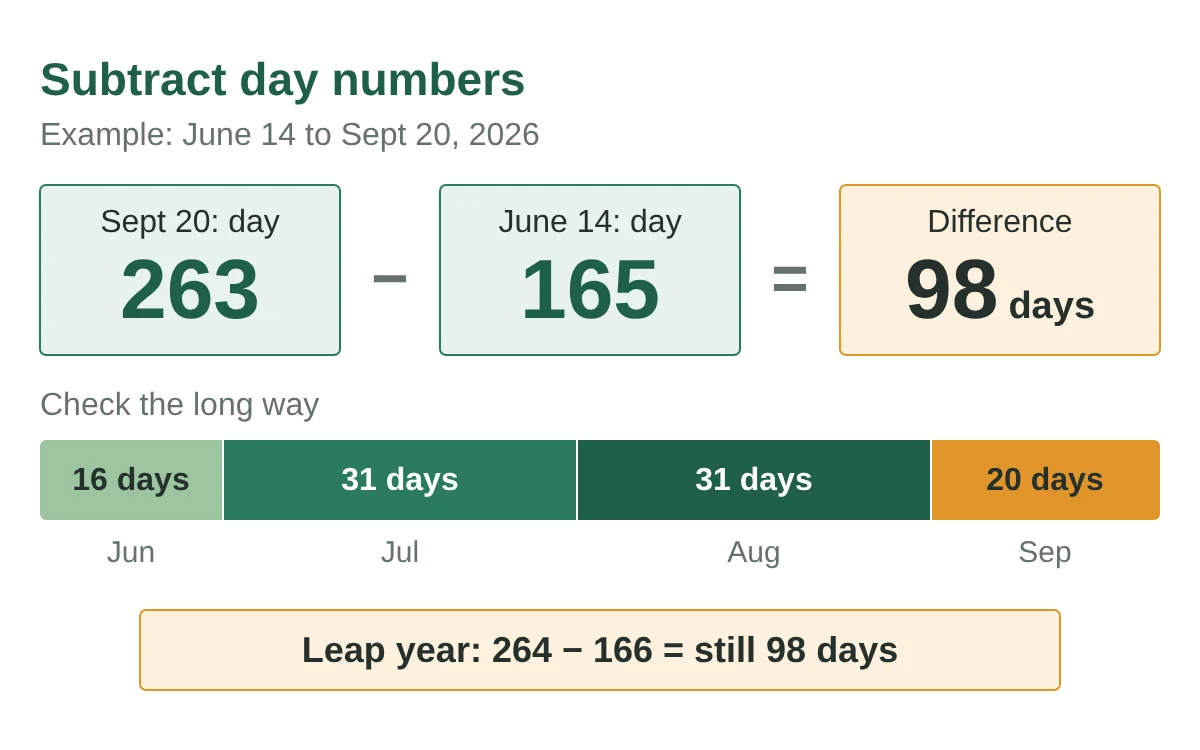
The cleanest manual method is to subtract day-of-year numbers. In a common year, September 20 is day 263. In a leap year it is day 264, because February 29 pushes everything one place later. Memorising that one figure lets you do the whole sum in a single subtraction.
Here is a worked example with a hypothetical start date of June 14. June 14 is day 165 (151 days through May, plus 14). Subtract: 263 minus 165 gives 98 days. Check it the long way: 16 days left in June, 31 in July, 31 in August, and 20 in September gives the same 98.
The same logic works in a spreadsheet. This formula always points at the next September 20 and handles the year rollover for you:
=DATE(YEAR(TODAY())+(TODAY()>DATE(YEAR(TODAY()),9,20)),9,20)-TODAY()
If you need the gap between any two dates that are not today, the date calculator handles both ends and the inclusive option.
Try this: Pick any date in the past year, subtract its day-of-year number from 263, and then check the result against the date calculator. Do it twice and the number will stick.
Counting weeks and weekdays to September 20
Weekdays are where hand counting goes wrong most often. The shortcut: every full block of 7 days contains exactly 5 weekdays, whatever day you start on. So split your total into weeks and leftover days, multiply the weeks by 5, then look at the leftovers individually.
Using the hypothetical June 14 example, 98 days is exactly 14 weeks, so the answer is exactly 70 weekdays with no leftovers to inspect. That only works when the total divides evenly by 7. With 100 days instead, you would have 70 weekdays plus the weekday status of the two days after your start date.
Remember that a weekday count is not a working-day count. Public holidays are not removed, and in many countries and regions there are holidays between summer and late September. If you need working days, subtract them yourself. For a rough conversion of a whole-week total, the 8 weeks to days page shows the multiplication pattern.
What September 20 is known for
September 20 is not a public holiday in the United States, the UK or most other countries, so there is no calendar rule to account for. What it does have is a place in the season. It falls just before the September equinox, which usually lands on September 22 or 23. That makes September 20 the last stretch of astronomical summer in the Northern Hemisphere and the last of astronomical winter in the Southern Hemisphere, even though meteorological autumn began on September 1.
A few well-documented events fall on this date. The first Cannes Film Festival opened on September 20, 1946. Billie Jean King beat Bobby Riggs in the “Battle of the Sexes” tennis match on September 20, 1973. And the US repeal of “Don’t Ask, Don’t Tell” took effect on September 20, 2011.
For deadlines, the date sits between two notable US markers. The third-quarter estimated tax payment is due on September 15, and the federal fiscal year ends on September 30. Neither lands on September 20, so do not assume a tax deadline falls here. Confirm any local school, tax or contract date with its source.
How the weekday shifts from year to year
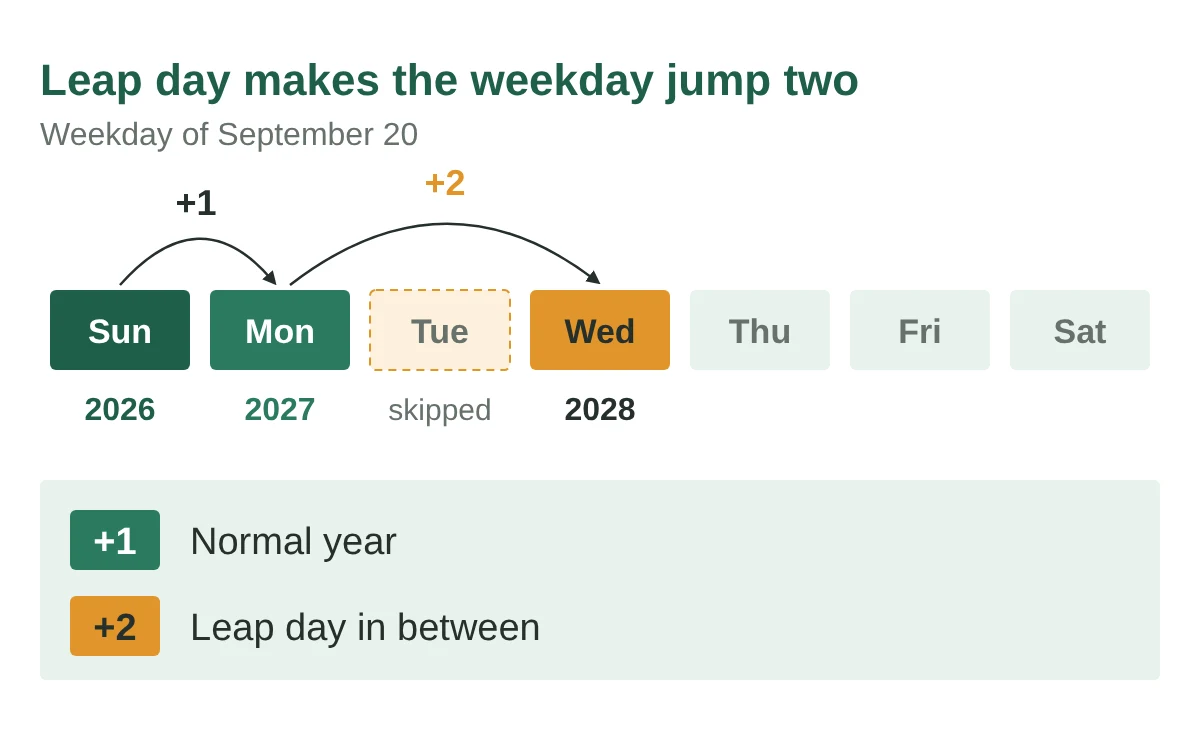
September 20 moves forward one weekday each year, or two after a leap day falls in between. That gives a Sunday in 2026, a Monday in 2027, a Wednesday in 2028 (the jump of two comes from the 2028 leap day), then Thursday and Friday in the two years after.
This is useful for long-range planning. If you are scheduling something in a few years and want it on a weekend, you can see that you will need to move to the nearest Saturday or Sunday instead. The neighbouring dates behave the same way, so a quick look at September 19 or September 24 is often enough to find a better fit.
Hours, minutes and the daylight saving trap
Converting a day count to hours by multiplying by 24 is correct only if no clock change sits in between. In the US and Europe, clocks spring forward in March, so any start date between the autumn change and that March will contain one 23-hour day. A raw multiplication then overshoots by one hour. The live widget accounts for this because it uses your device’s real clock rules.
By September 20 you are still on summer time in the Northern Hemisphere, and the autumn change is weeks away. In the Southern Hemisphere, many regions that observe daylight saving switch in early October, so the date still sits before it. If you want the final hours counted on the day itself, the how long until midnight page gives a clean read for the last stretch.
Planning around the countdown
A countdown is most useful when you attach milestones to it. Dividing the remaining time into checkpoints works better than watching the total shrink. Common choices are the halfway point, the last 30 days, and the last 7 days.
- Halfway point: take the day total and halve it, then put that date in your calendar.
- Last 30 days: a good time to confirm bookings or deliveries.
- Last 7 days: reserve it for checks only, with no new decisions.
For a nearby anchor, the October 1 countdown shows how much room you have after September 20 before the month closes. If you want the month as a whole, the September countdown gives that view.
Try this: Set three reminders now: one at the halfway date, one 30 days out, and one 7 days out. Name each with what must be finished by then.
FAQ
Answers to the most common questions are in the FAQ section below.
Frequently asked questions
Why do different countdowns to September 20 show different numbers?
Counters differ on whether today counts as day one, whether they aim at the start or end of September 20, and which time zone they use. The exclusive count (midnights until the morning of September 20) is the standard one, and adding one gives the inclusive count if today and the date itself both count.
How can I work out the days until September 20 by hand?
Subtract the start date's day-of-year number from 263, or from 264 in a leap year, since September 20 is day 263 in a common year. For example, June 14 is day 165 in a common year, so 263 minus 165 gives 98 days.
How many weekdays are there between today and September 20?
Every full block of 7 days holds exactly 5 weekdays, so multiply the number of whole weeks by 5 and then check any leftover days one by one. This counts Monday to Friday only, so public holidays in that stretch must be subtracted separately to get working days.
Is September 20 a public holiday?
It is not a public holiday in the United States, the UK or most other countries. It usually falls two or three days before the September equinox, which typically lands on September 22 or 23.