
How Many Days Until September 24th?
Calendar
Countdown chart
The live widget above gives the exact answer for your clock and time zone, down to the second. If you want to check it or work it out without a calculator, the quickest route is to compare day-of-year numbers: September 24 is day 267 in a common year and day 268 in a leap year, so you subtract today’s day number from that.
The rest of this page covers the cases where a hand count goes wrong, how to count weekdays and weeks, and what the date means in places where it is more than a square on the calendar.
The day-of-year shortcut
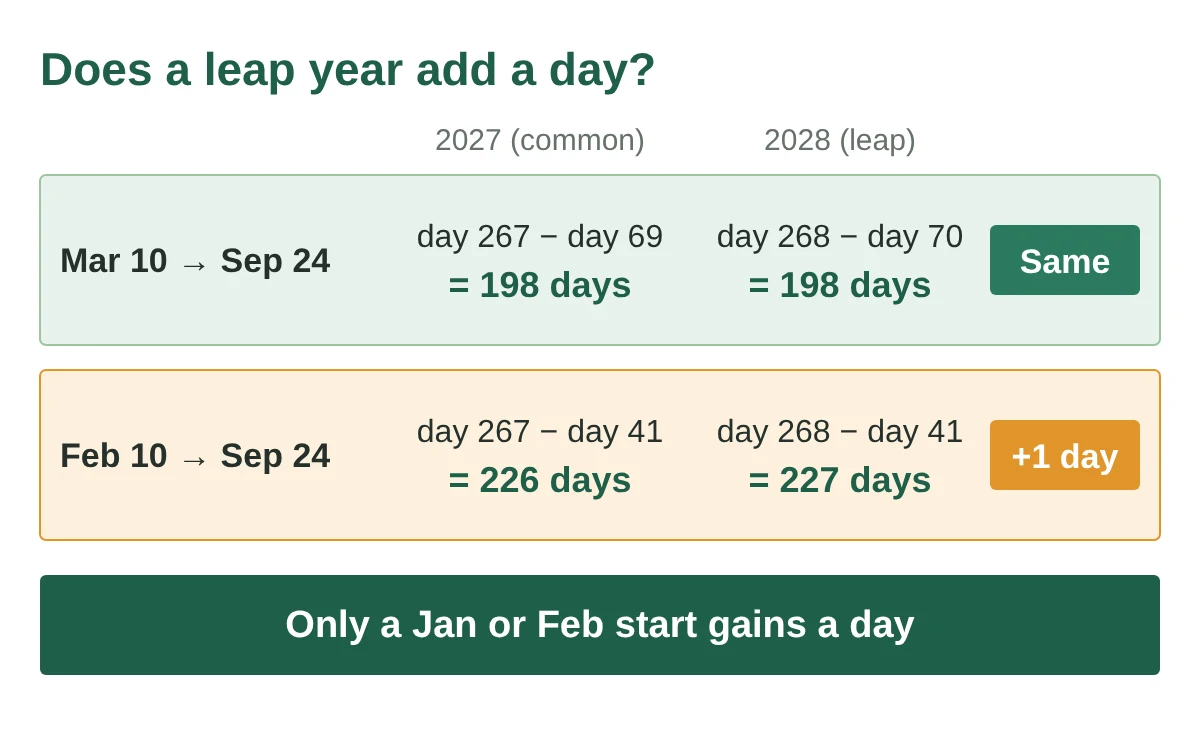
Adding up the days left in each month is slow and invites slips. A cleaner method is to give every date a day-of-year number and subtract. September 24 is day 267 in a common year (the months before it total 243 days, plus 24). Any date earlier in the same year is a smaller number, and the difference is your answer.
Here is a worked example with a hypothetical starting date, March 10, 2031 (a common year). March 10 is day 69 (31 + 28 + 10). Then 267 minus 69 gives 198 days. A check by months agrees: 21 days left in March, then 30, 31, 30, 31 and 31 for April through August, then 24, which also totals 198.
Leap years need one adjustment. If the year has a February 29 and your start date is on or after March 1, September 24 is day 268, and so is your start date’s number, so the difference is unchanged. The gap only grows by one when your start date is in January or February of a leap year.
Try this: Pick any date a few months out and work it out by day-of-year, then check it against the date calculator. If the two disagree by one, you have found your own habit of counting inclusively or exclusively.
Counting weekdays and weeks
Weeks are easier than they look. Divide the day count by 7: the whole number is the weeks, and the remainder is the leftover days. In the example above, 198 days is 28 weeks and 2 days. The leftover matters because it tells you which weekday you start on relative to the target. The 2-day remainder means the start date falls 2 weekdays before the weekday of the 24th, so a start on a Monday leads to a Wednesday target.
For working days, multiply the whole weeks by 5 and then count the weekdays in the leftover stretch. That gives 28 × 5 = 140, plus the 2 weekdays in the leftover days, so 142 weekdays in the example (counting the 24th, not the start date). This ignores public holidays, which differ by country and employer.
The number you see depends on whether both end dates are counted. “Days until” normally excludes the start day and includes the target day. Work-day functions in spreadsheets often include both ends, which produces a figure one higher whenever both are weekdays.
What September 24 is known for
The date’s best-known role is in South Africa, where it is Heritage Day. It is a fixed public holiday on 24 September every year, not a floating date, so it falls on a different day of the week annually. It was first observed as a public holiday in 1995, the year after the country’s first democratic election.
The date has a second history. In KwaZulu-Natal, 24 September was observed as Shaka’s Day before it became a national holiday, marking the presumed anniversary of King Shaka’s death in 1828. It became Heritage Day after the Inkatha Freedom Party objected to its exclusion from the new Public Holidays Bill, and a compromise broadened it into a day for all South Africans.
Many people also know it as Braai Day. National Braai Day is a grassroots initiative launched in 2005 that encourages South Africans to celebrate their heritage around a braai. It is an informal campaign, not the legal name of the holiday. Elsewhere, the date carries only informal food and novelty days, such as National Cherries Jubilee Day and Bluebird of Happiness Day in the U.S., none of which give you a day off.
When the holiday lands on a weekend
Because the date is fixed, the weekday cycles. When a South African public holiday falls on a Sunday, the following Monday is observed as a public holiday. In 2028, September 24 is a Sunday, so the day off moves to Monday, September 25.
That makes the weekday a planning detail worth checking early. In 2027 the date is a Friday, which gives a long weekend. In 2028 it is a Sunday, but the substitute Monday still gives a three-day stretch. The weekday moves forward one step a year, or two after a February 29, so the pattern rarely repeats in consecutive years.
Using the countdown for planning
A countdown works better as checkpoints than as one long number. Backward planning is the practical use: choose the milestones relative to the target and place them on the calendar.
- 100 days out: book anything with limited availability.
- 60 days out: confirm travel, guests or deliverables.
- 30 days out: finalise details and set a hard stop for changes.
- 7 days out: only logistics remain.
If your plan hinges on the days around the date, the neighbouring countdowns for September 23 and September 25 are handy for building a three-day window.
Spreadsheet formulas that roll over by themselves
A fixed formula such as =DATE(2027,9,24)-TODAY() works for one year, then returns a negative number once the date passes. A self-correcting version moves to the following year automatically:
=DATE(YEAR(TODAY())+(TODAY()>DATE(YEAR(TODAY()),9,24)),9,24)-TODAY()
The comparison inside the formula evaluates to 1 after September 24 and 0 before it, which pushes the target year forward when needed. On the day itself the result is 0, not 365.
For weekdays, NETWORKDAYS counts both end dates, so subtract 1 if you want to leave today out. If you work a non-standard week, NETWORKDAYS.INTL lets you define which days are weekends.
Try this: Paste the rolling formula into a spreadsheet cell and set your computer’s date to a day after September 24 (or just test it with a different month and day). It should point to next year without edits.
Where the countdown flips
The widget counts to the first instant of September 24 on your clock. On September 23 it will read less than one full day, and a lazy mental count that rounds down would say “0 days” even though the date has not arrived. Think of it as a count to midnight, which the how long until midnight page covers in hours.
Time zones add one more wrinkle. South Africa runs on a single offset and does not use daylight saving time, so Heritage Day begins there before it begins in the Americas. Someone in New York and someone in Johannesburg will both see the same calendar date, but they reach zero hours apart. For a shared event, agree on one time zone and a specific hour, not just a date.
Last, if your target is the whole month rather than one day, the days until September page gives that count, and October 1 is the usual next anchor after the 24th.
Frequently asked questions
What day of the week is September 24?
It moves every year. It falls on a Friday in 2027, a Sunday in 2028, a Monday in 2029 and a Tuesday in 2030. The weekday shifts forward by one each year, or by two when a leap day sits in between.
Is September 24 a public holiday?
In South Africa, yes: it is Heritage Day, a fixed-date public holiday. In most other countries, including the United States, it is an ordinary working day.
What is the day number of September 24 in the year?
It is day 267 in a common year and day 268 in a leap year. That number is the base of the fastest hand calculation.
Does the countdown reach zero at midnight or at a set hour?
The live widget counts to the start of September 24 on your own clock, so it reaches zero at your local midnight. A friend in another time zone reaches zero at a different real moment.