
How Many Days Until September 23rd?
Calendar
Countdown chart
The live countdown above gives the exact number of days, hours and minutes to the next September 23 on your own clock and in your own time zone. It always aims at the next occurrence of the date, so once September 23 has passed it rolls over to the following year. The rest of this page covers how to get the same answer by hand and a few traps that quietly change the result.
September 23 is a fixed date, but its weekday, its astronomy and its meaning for different countries all vary. That is why a countdown to it is more useful when you know what you are counting toward.
Count it by hand with day numbers
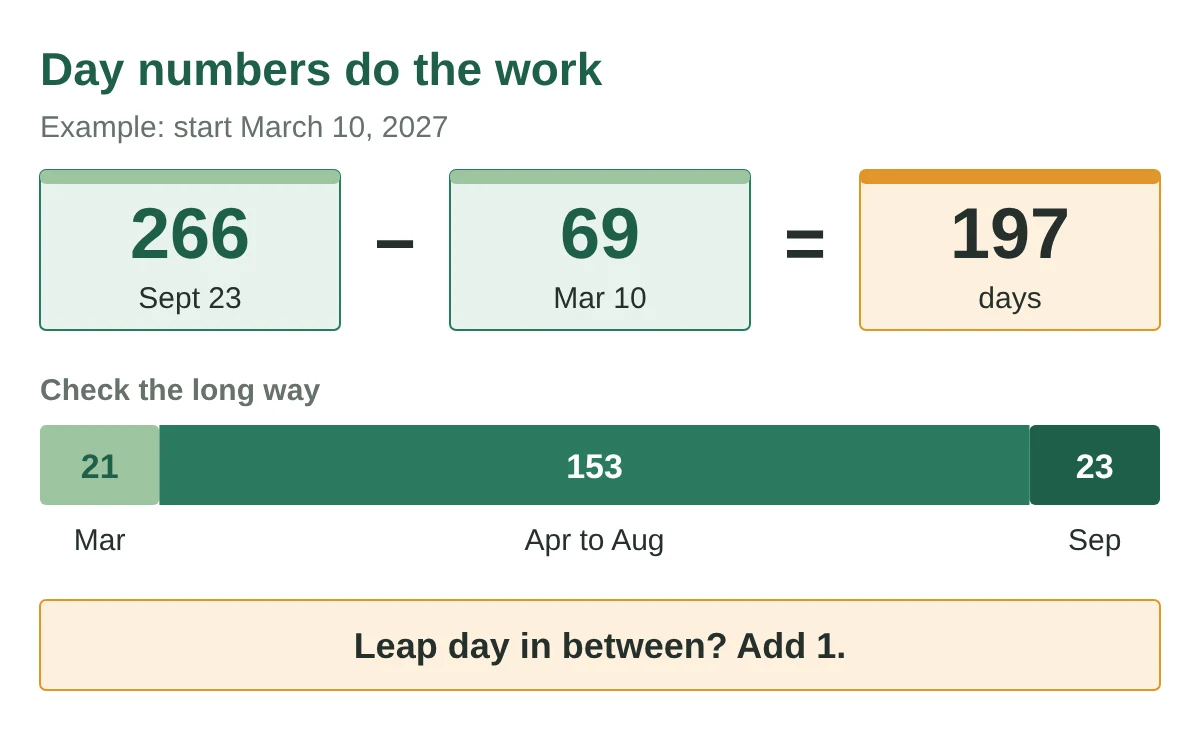
The fastest manual method is to subtract day-of-year numbers. September 23 is day 266 of a normal year and day 267 in a leap year. Find the day number of your start date, subtract it from 266, and you have the answer.
Here is a worked example with a hypothetical start of March 10, 2027. March 10 is day 69 (31 days of January, 28 of February, plus 10). Then 266 minus 69 gives 197 days. You can verify it the long way: 21 days left in March, then 30, 31, 30, 31 and 31 for April through August (153 in total), then 23 for September. That is 21 + 153 + 23 = 197.
The common mistake is using 266 across a February 29. If a leap day sits between your start date and the target, add one day. In a leap year itself, the target becomes 267.
Weeks and weekdays to September 23
Divide the day count by 7 for weeks, and keep the remainder. In the example, 197 days is 28 weeks and 1 day. The remainder is the useful part: it tells you the start date’s weekday is one step behind the target’s weekday. Since September 23, 2027 is a Thursday, March 10, 2027 was a Wednesday.
For working days, multiply the full weeks by 5, then count only the weekdays in the leftover days. Those leftover days are the final ones before the target, so they take the target’s weekday and the ones just before it. In the example, 28 weeks gives 140 weekdays, and the single leftover day is the Thursday itself, so you get 140 if you stop the day before, or 141 if you count the 23rd. Public holidays are not removed by this method.
Try this: Pick any date within the next few months. Subtract its day-of-year number from 266, divide by 7, and write down the weeks and the remainder. Then check the result against the live widget.
Which September 23 is the countdown aiming at?
Three edge cases cause most disagreements. On the day itself, a countdown reads zero days but still shows hours until the date has fully passed, so “today” counts as zero, not one. The day after, the target jumps forward a full year.
The second is inclusive counting. Counting from a Monday to the following Monday is 7 days if you subtract and 8 if you tick off both ends. Event planners often want the inclusive version, such as a conference running over several days. Date subtraction gives the exclusive one.
The third is the time zone. The 23rd begins at different moments around the world, so someone in Sydney reaches it many hours before someone in Los Angeles. If you are counting to an event in another city, check what the widget’s clock is set to and convert the start time instead of guessing.
The spreadsheet formula that never goes negative
The usual formula, =DATE(2027,9,23)-TODAY(), works until the date passes, then returns a negative number. A version that always picks the next one is:
=DATE(YEAR(TODAY())+(TODAY()>DATE(YEAR(TODAY()),9,23)),9,23)-TODAY()
The comparison inside returns 1 when this year’s date has already gone by, which pushes the year forward. It works in both Excel and Google Sheets. If you want to compare any two dates without building formulas, the date calculator does it directly.
Why the weekday keeps changing
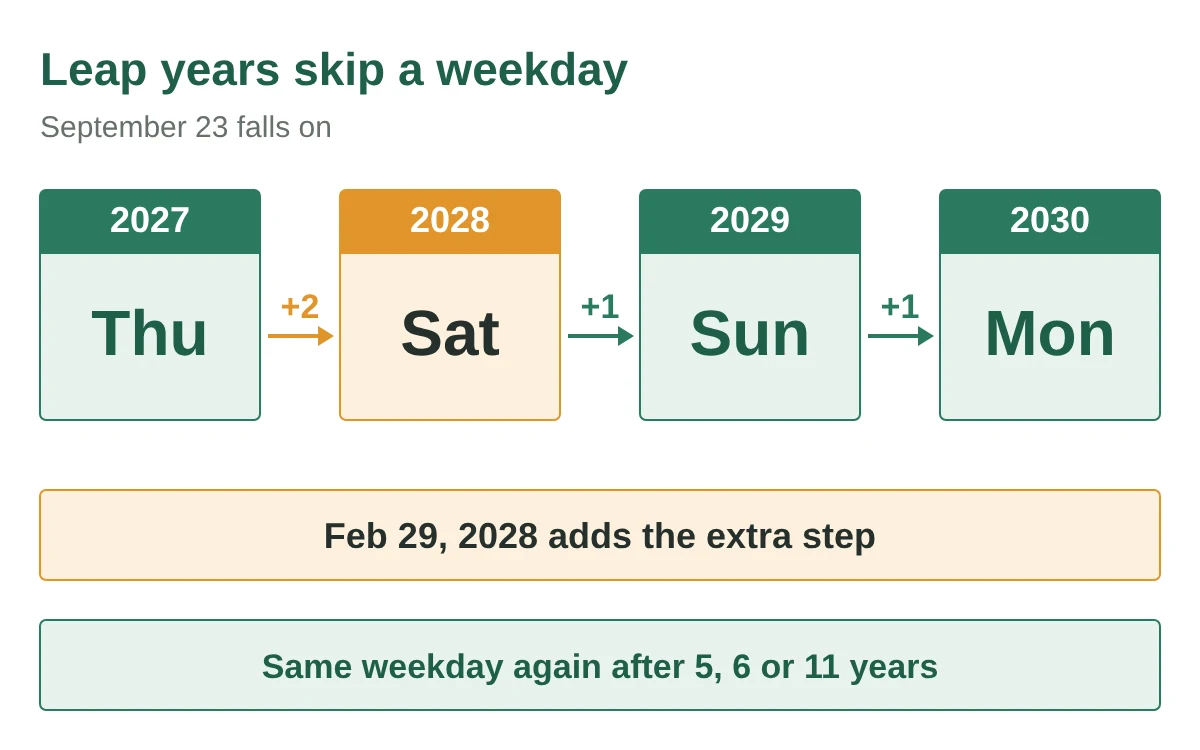
A 365-day year is exactly 52 weeks plus one day, so a fixed date moves forward one weekday each year. A leap year adds a second step. September 23 is a Thursday in 2027, then Saturday in 2028 because February 29, 2028 falls before it, then Sunday in 2029 and Monday in 2030.
This matters for planning. A recurring event pinned to September 23 will not land on a weekend predictably, and the date only returns to the same weekday after 5, 6 or 11 years, with gaps depending on where the leap years fall. If you need a Saturday, check the calendar rather than assuming.
The equinox that moves between the 22nd and 23rd
The September equinox is a single instant worldwide, and it often falls on September 22 or 23 depending on the year and where you are. In 2026 it arrived at 00:05 UTC on September 23, which was still the evening of September 22 across North America. In 2027 it is due around 06:02 UTC on September 23, which is about 2 a.m. on the US East Coast.
The date drifts because the calendar year does not match the astronomical year exactly, and leap years pull it back. Day and night are also not exactly equal on the equinox. Equal daylight and darkness, called the equilux, arrives a few days later at mid-latitudes, which is why some sources list a date after the 23rd.
In the Southern Hemisphere the same moment marks the start of spring, so a countdown to September 23 can mean the end of summer or the first day of spring, depending on where you live.
What else September 23 is known for
Saudi Arabia marks its National Day on September 23, commemorating the 1932 unification of the kingdom, and it is a public holiday there. Japan observes Autumnal Equinox Day as a national holiday, and because it follows the astronomical event, its date moves between September 22 and 23 from year to year. Many Western astrology charts treat September 23 as the point where Libra begins, though that boundary also shifts by a day. September 23 is also widely observed as Bi Visibility Day.
There is no federal US holiday, and no standard tax or school deadline, tied to this date, so any deadline you are counting toward is likely to be personal or set by your employer or institution. For nearby dates, the countdowns for September 24 and October 1 cover the days either side.
Planning checkpoints for the countdown
Working backward from a fixed date is easier than working forward. September 23 is 100 days after June 15 and 90 days after June 25, which gives you natural checkpoints if you are building a three-month plan. For a shorter run, the 90 days from now page shows where a 90-day window lands from today.
Weeks are a better planning unit than days for anything that needs steady effort, such as training, saving or studying. The weeks until October 1 page is a handy reference for that rhythm, and the days until September page helps if you want the month boundary first.
Try this: Choose three milestones before September 23, such as 100 days out, 50 days out and 10 days out. Subtract each from the target date using the day-of-year method and add them to your calendar now.
Frequently asked questions
What day of the week is September 23?
In 2027 it is a Thursday. After that it moves to Saturday in 2028 (a leap year), Sunday in 2029 and Monday in 2030. The weekday shifts forward by one each year, and by two after a February 29.
Is September 23 the first day of fall?
Often, but not always. The astronomical start of autumn is the September equinox, which lands on September 22 or 23 depending on the year and your time zone. Meteorological autumn starts on September 1 regardless.
What day of the year is September 23?
It is day 266 in a normal year and day 267 in a leap year. That is the same number whenever you count from January 1, which makes it handy for quick date subtraction.
Why does the countdown show a different number than my friend's?
Usually one of you is counting from a different time zone, or one count includes the target day and the other does not. The live widget uses your own device clock, so it follows your local midnight.