
How Long Until 1:30 PM?
Around the world
The live countdown above gives the exact hours, minutes and seconds until the next 1:30 PM (13:30) on your own clock and in your own time zone. If you want to check it by hand, the fastest method is to convert both times to minutes after midnight: 1:30 PM is 810, so the wait is 810 minus the current minute count.
The rest of this page covers the parts a plain countdown does not explain: why the hand method sometimes goes negative, how time zones and clock changes bend the answer, and how to avoid the common slips.
The 810-minute shortcut
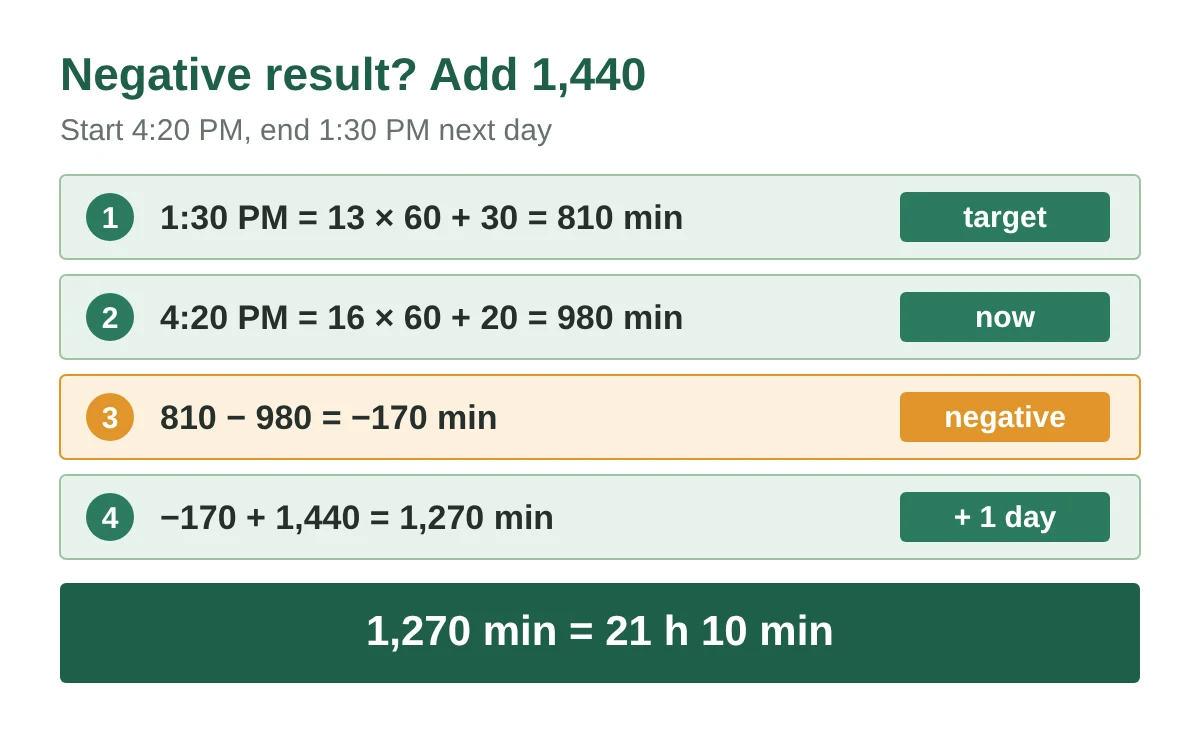
1:30 PM is 13 hours and 30 minutes after midnight, which is 13 × 60 + 30 = 810 minutes. Turn the current time into minutes the same way (hours × 60 plus minutes), subtract it from 810, and convert back to hours and minutes. This one number replaces all the borrowing and carrying that makes clock subtraction error-prone.
If the current time is after 1:30 PM, the subtraction comes out negative. That is a signal, not a mistake: add 1,440 (the minutes in a day) and you have the wait until tomorrow’s 1:30 PM. Equivalently, subtract the current minute count from 2,250.
A worked example by hand
Take a hypothetical moment of 9:47 AM. That is 9 × 60 + 47 = 587 minutes. Then 810 − 587 = 223 minutes, which is 3 hours and 43 minutes.
Now a hypothetical 4:20 PM. That is 980 minutes, and 810 − 980 = −170. Add 1,440 and you get 1,270 minutes, which is 21 hours and 10 minutes until 1:30 PM tomorrow. You can sanity check it without any formula: 4:20 PM to midnight is 7 hours 40 minutes, and midnight to 1:30 PM is 13 hours 30 minutes. Together that is 21 hours 10 minutes.
Try this: Pick the current time, convert it to minutes after midnight, and work out the wait to 1:30 PM before you look at the widget. Match the result to the widget to the minute, and the method will stick.
Why the wait is never more than 24 hours
A countdown to a time of day always points to the next occurrence, so the longest possible wait is just under 24 hours. The longest wait comes one minute after 1:30 PM. At exactly 13:30:00 the answer is zero, and a tick later it jumps to roughly a full day.
If you only type “1:30” without AM or PM, the maximum shrinks to 12 hours, because a 1:30 of one kind or the other arrives at least every 12 hours. The counts differ by exactly 12 hours between the two readings, which is a quick way to spot whether a figure you were given used the wrong half of the day. For a similar half hour target one hour earlier, see how long until 12:30 PM.
Time zones and 1:30 PM
A countdown is only meaningful relative to the zone the event is set in. “1:30 PM” in a meeting invite means 1:30 PM where the host is, and your device clock may disagree by hours. When 1:30 PM Eastern arrives, it is 12:30 PM Central, 11:30 AM Mountain and 10:30 AM Pacific, so the same event is a very different wait depending on where you sit. If you need to check what time it is in a particular zone, the Central time page shows it live.
Half hour zones catch people out. India is 5 hours 30 minutes ahead of UTC, so 1:30 PM in New York (winter) lands at midnight in India, while in summer it lands at 11:00 PM. Nepal adds a 45 minute offset on top, and the result is a time that looks nothing like 1:30. When converting, change to UTC first, then to the target zone, rather than guessing a straight difference. The time conversions section covers the unit side of this.
Daylight saving and the hour that goes missing
Hand maths assumes every day is 24 hours long. On the day clocks change, that is false. If a clock change falls between now and the next 1:30 PM, the real elapsed time is an hour longer or shorter than the subtraction says. A wait you calculate as 12 hours may be 11 or 13 on a changeover night.
This is the reason the widget uses your device’s own clock rather than a fixed offset. It also explains a quirk with 1:30 AM: in many places, 1:30 AM does not exist on the spring changeover night and happens twice on the autumn one. 1:30 PM sits safely away from the changeover, but the wait to it can still be affected if you are counting overnight.
Why people check, and what the number is really for
The most common reasons are practical. Many lunch breaks, school periods and appointment slots end or start near 1:30 PM, and “how long until” is faster than doing the maths mid-task. For US markets, 1:30 PM Eastern is two and a half hours before the 4:00 PM close, so the time left helps you plan late-session orders. Workers on a half-day finish often count to 1:30 PM too.
For short waits, think in anchor points rather than precise numbers. Noon is 90 minutes away, 1:00 PM is 30, and 12:30 PM is exactly an hour. For a count from the current time to something slightly later, how long until 2 PM shows the next anchor. If you only need a short offset, such as the time after a 30 minute wait, 30 minutes from now does that directly.
Try this: Next time a meeting is at 1:30 PM, count back from the start in blocks you can remember: 90 minutes is noon, 30 minutes is 1:00 PM. Set a reminder at the anchor time instead of the exact one.
Mistakes worth avoiding
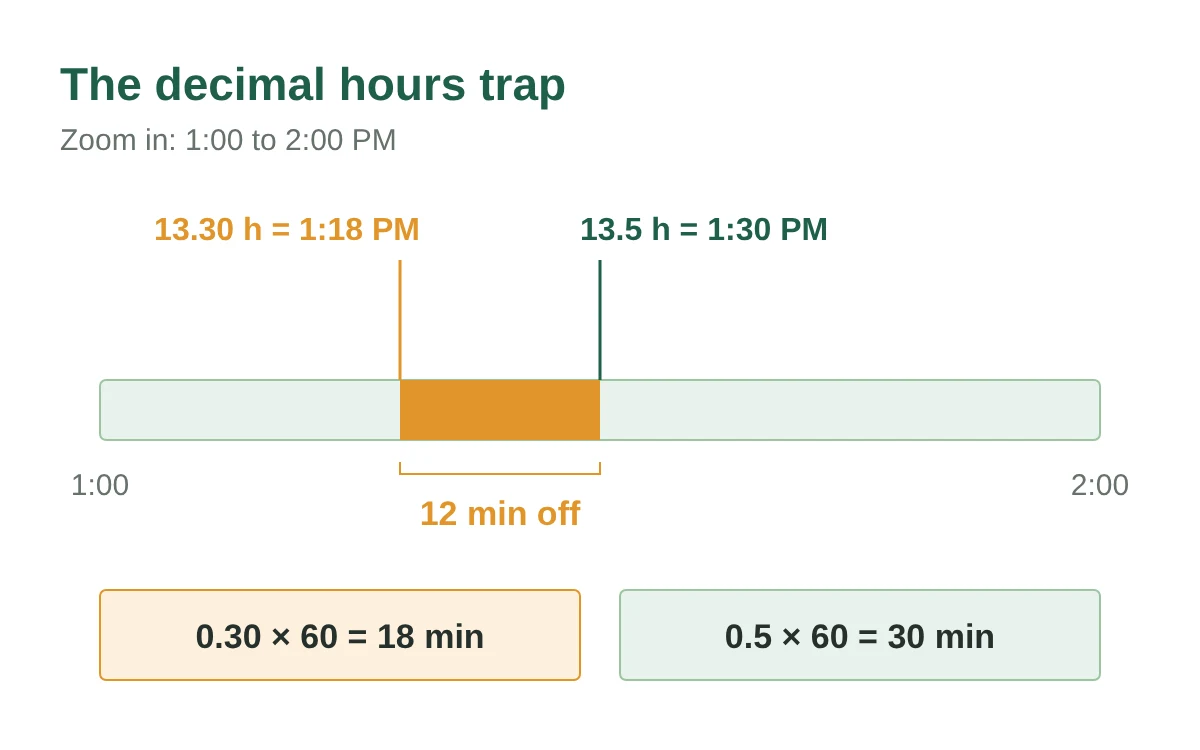
The classic mistake is treating the minutes as decimals. 1:30 PM is 13.5 hours after midnight, not 13.30, and mixing the two is the main source of errors in timesheets and payroll sums. Half an hour is 0.5, not 0.30.
Another common slip is subtracting across noon without converting to the 24-hour clock. Going from 10:45 AM to 1:30 PM is 2 hours 45 minutes, but doing it as 1:30 minus 10:45 on a 12-hour scale produces nonsense. Converting to 24-hour first (13:30 minus 10:45) removes the problem. Finally, remember that the countdown to 1:30 PM and the countdown to the end of the day are linked: 1:30 PM is exactly 10 hours 30 minutes before midnight, and how long until midnight works from the same minute-count approach.
Frequently asked questions
What is 1:30 PM in 24-hour time?
It is 13:30, written 1330 in military style. That is 810 minutes after midnight, or 13.5 hours in decimal form.
How many minutes are there from 1 PM to 1:30 PM?
There are 30 minutes. From noon it is 90 minutes, and from 12:30 PM it is exactly 60.
How long until 1:30 if I do not say AM or PM?
Whichever 1:30 comes next, so the wait is never more than 12 hours. If you meant a specific one, the widget's 1:30 PM figure is the right one for afternoon events.
Does the countdown change when clocks change for daylight saving?
Yes, on the changeover day the real elapsed time can be an hour more or less than the clock difference. The live widget uses your device clock, so it accounts for this automatically.