
How Long Until 12:30 PM?
Around the world
The time left until 12:30 PM is the gap between your current clock time and the next 12:30 in the afternoon. The live countdown above reads your device’s clock and time zone, so it gives the exact hours, minutes and seconds without any conversion on your part. The rest of this page covers doing it by hand, and the places where the result can quietly go wrong.
Most mistakes with this target come from three sources: the AM/PM label, a clock change in between, and checking for a place in a different time zone. Each is easy to spot once you know what it looks like.
The fastest way to do the sum by hand
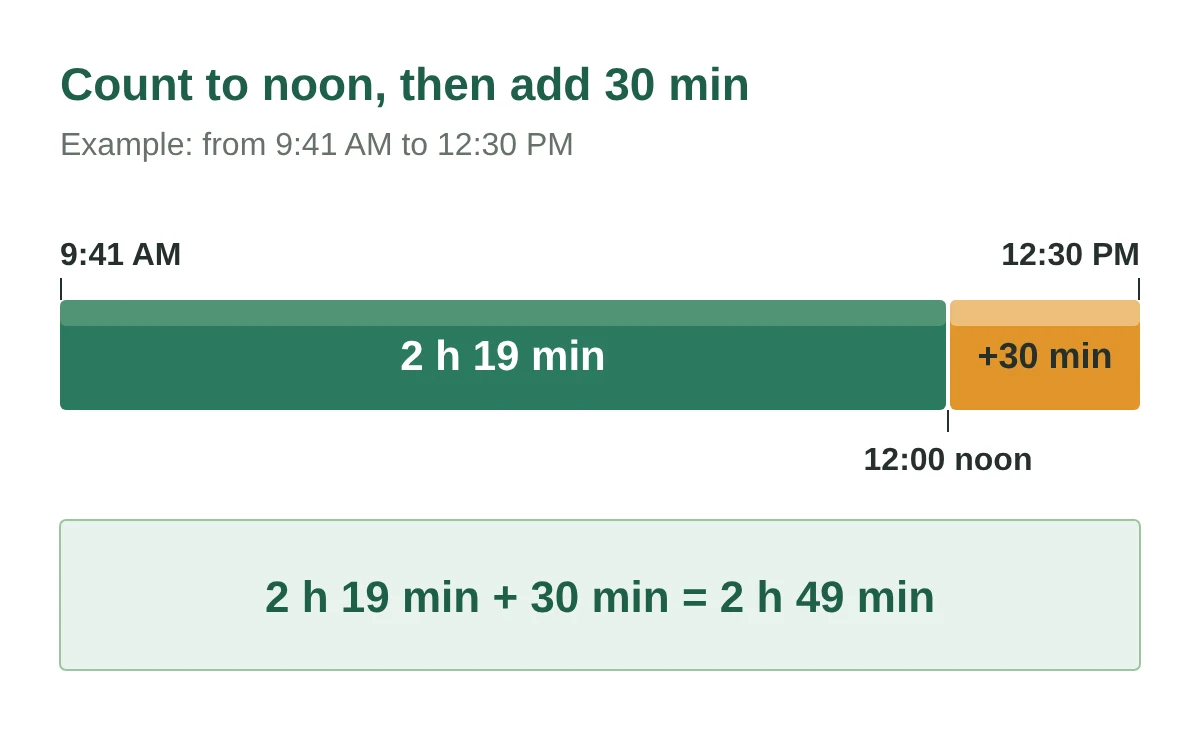
Most people subtract directly and get tangled when the minutes need borrowing. A cleaner method is to count to noon first, then add 30. Noon is a round anchor, so the hours part is trivial, and the extra half hour never causes borrowing.
The same trick works in reverse for later times. After noon, subtract: at 12:10 PM you are 20 minutes away, because 30 minus 10 is the whole sum. Between 12:00 and 12:30 you only ever need the minutes figure.
If you want one number to work with, use minutes since midnight. 12:30 PM is 750. Convert your current time the same way (hours times 60, plus minutes) and subtract. It is slower for a single check, but it is the method that scales to any target time.
A worked example with a made-up start time
Suppose a clock reads 10:47 AM. Using the noon method, 10:47 to 11:00 is 13 minutes, 11:00 to 12:00 is 60 minutes, and noon to 12:30 is 30 more. That is 103 minutes, or 1 hour 43 minutes.
Check it with the midnight method. 10:47 is 10 times 60 plus 47, which is 647 minutes. 750 minus 647 is 103. Both methods agree, and running both is a good habit when the answer matters, such as catching a train or joining a call.
Try this: Glance at any clock and give the minutes to 12:30 PM using the noon method, then check it against the widget. Do this three times at different hours and the method becomes automatic.
12:30 AM or 12:30 PM? The label trap
Both labels exist, and they sit 12 hours apart. 12:30 AM is half an hour after midnight, while 12:30 PM is half an hour after noon. The oddity is that 12 behaves like zero in 12-hour time, which is why 12:30 comes right after 12:00 rather than after 11:59.
If someone writes “12:30” with no label, the context decides. A lunch meeting means PM. A message sent at 11 PM saying “see you at 12:30” probably means the coming half hour after midnight. When in doubt, ask or convert to 24-hour time: 00:30 versus 12:30 leaves no room for confusion.
A related slip is adding 12 to convert to 24-hour time. That rule works from 1 PM onward, but 12:30 PM stays 12:30. It never becomes 24:30.
When 12:30 has already passed today
Once the clock is past 12:30 PM, the next one is tomorrow. The wait is 24 hours minus the time elapsed since 12:30 PM. At 1:00 PM, for example, that is 23 hours 30 minutes.
This is where a naive subtraction gives a negative result. If you get one, add 24 hours (1,440 minutes) and it corrects itself. If you are asking about the half hour after midnight instead, the hours page for how long until midnight is the useful starting point, since 12:30 AM is simply that plus 30 minutes.
Why people check 12:30
The most common reasons are practical ones:
- A morning shift or half-day that ends at 12:30
- A school or exam slot, since many schools release pupils around midday
- Appointments and lunch bookings, where 12:30 is a popular start
- Market hours, where 12:30 PM Eastern is 9:30 AM Pacific
For nearby targets, the neighbouring pages are handy: 12 PM, 12:15 PM and 1:30 PM. If you are timing something short, such as a task that must be done before then, 30 minutes from now shows the clock time directly.
Time zones and half-hour offsets
The widget uses your device’s time zone, so it answers “how long until 12:30 where I am.” That is not the same as 12:30 in the place you are calling. To find the wait for another city, convert their 12:30 into your clock time first, then count to that.
Half-hour zones can surprise you. India runs UTC+5:30, so its 12:30 PM is 07:00 UTC, which lands on a round hour for anyone on a whole-hour offset. Going the other way, 12:30 PM in a whole-hour zone falls on :00 or :30 in most places but on :15 or :45 in a few, such as Nepal at UTC+5:45.
A handy fixed point: US economic releases at 8:30 AM Eastern happen at 12:30 UTC when daylight saving is in force, and at 13:30 UTC in winter. For a live view of a specific zone, see Central Time now.
Try this: Pick one person you regularly call in another zone. Write down what 12:30 PM for them is on your clock, once for summer and once for winter. The two answers often differ by an hour.
Clock changes can move the answer by an hour
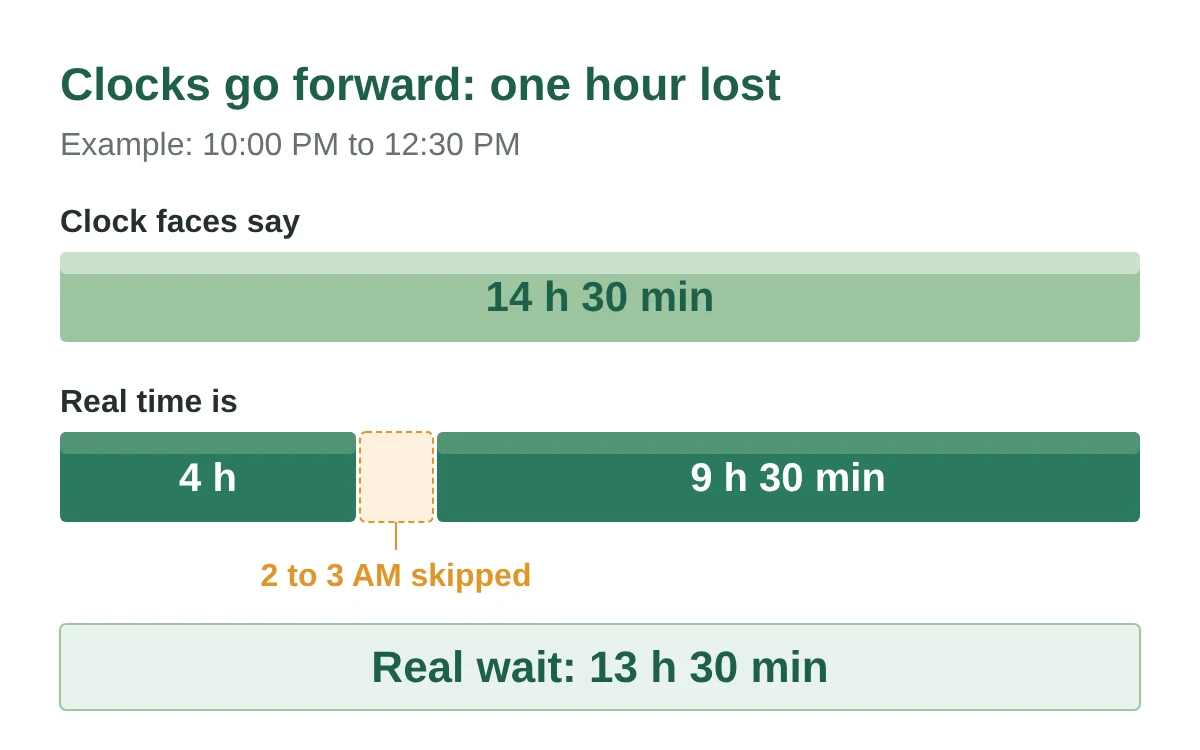
If a daylight saving change falls between now and 12:30 PM, the real time remaining differs from the difference you read off the clock face. In the US and Europe, the change happens in the small hours, so a countdown started the evening before is the one most likely to be affected.
On the night clocks go forward, an overnight countdown to 12:30 PM is one hour shorter than the faces suggest. When they go back, it is one hour longer. A countdown started the same morning is not affected, since the change has already happened.
Live widgets handle this correctly because they count real elapsed time. A hand calculation does not, so add or subtract the hour yourself if the night in question involves a change. For longer spans, the time conversions tools help you turn minutes into hours cleanly, and the time-of-day countdowns hub lists the other targets you may want.
Frequently asked questions
How many minutes is 12:30 PM after midnight?
It is 750 minutes after midnight (12 hours times 60, plus 30). Subtract the minutes-since-midnight of your current time from 750 and you have the answer in minutes.
What is 12:30 PM in 24-hour time?
It is 12:30, also written 1230 in military style. The hour stays 12 because noon is where the PM half begins, so nothing is added.
Is 12:30 PM the middle of the day?
It is half an hour past the midpoint. Noon splits the 24 hours of the day exactly in half, so 12:30 PM sits just after it, at about 52% of the day.
What if it is already past 12:30 PM?
The countdown rolls to tomorrow's 12:30 PM, which is always under 24 hours away. The live widget does this automatically, so you never see a negative number.