
How Long Until 12:15 PM?
Around the world
The time left until 12:15 PM is 12:15 minus the current time on your clock. The live countdown above does that subtraction using your own device clock and time zone, so it is correct for wherever you are, to the second. If today’s 12:15 PM has already gone by, it counts to tomorrow’s instead.
The rest of this page covers what the widget cannot show you: how to check the answer in your head, where manual counts go wrong, and why the same 12:15 means different things in different places.
Which 12:15 the countdown means
12:15 PM is 15 minutes after noon. 12:15 AM is 15 minutes after midnight. The 12-hour clock starts each half-day at 12 rather than 0, which is the root of most mistakes. A search for “12:15” with no suffix is ambiguous, but this page counts to the PM one, the quarter past noon.
Counting minutes since midnight removes the ambiguity. 12:15 PM is minute 735 of the day, and 12:15 AM is minute 15. In 24-hour notation they are 12:15 and 00:15, which cannot be confused.
How to work it out by hand
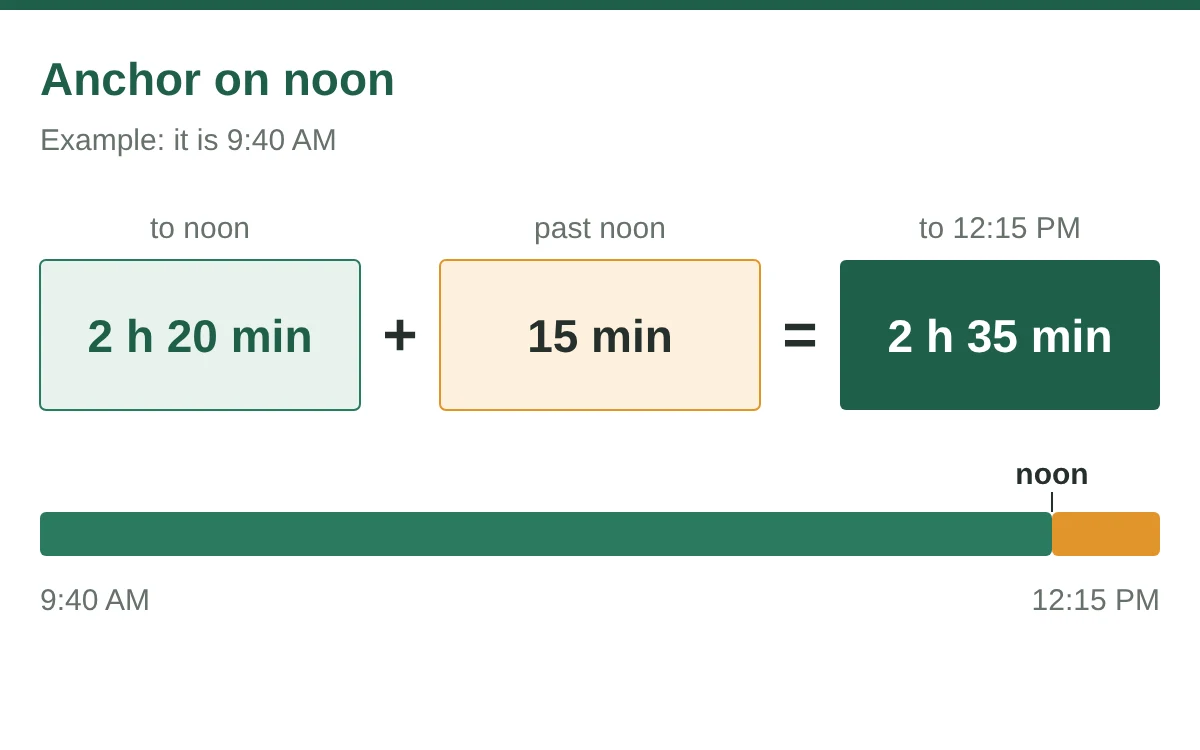
Convert both times to minutes since midnight and subtract. Take a hypothetical start of 9:40 AM. That is (9 x 60) + 40 = 580 minutes. The target is 735, so 735 minus 580 leaves 155 minutes, which is 2 hours 35 minutes.
There is a faster mental route that skips the conversion: count to the next landmark, then add the remainder. From 9:40 to noon is 2 hours 20 minutes, and 15 more minutes after noon makes 2 hours 35 minutes. Anchoring on noon works well because it is the one time everybody can find quickly.
Try this: Pick any start time and find the gap to 12:15 PM twice, once with the minutes method and once by counting to noon first. If the two answers match, your subtraction is sound. Check it against the live widget when the real time comes.
The count never passes 24 hours
A countdown to a time of day has a ceiling. Right after 12:15 PM the next target is almost exactly 24 hours away, and the number only falls from there. For a start that is already past 12:15, use this formula: 1,440 minus (current minutes minus 735).
With a hypothetical 2:00 PM start, that is 840 minutes. You are 105 minutes past 12:15, so 1,440 minus 105 gives 1,335 minutes, or 22 hours 15 minutes, until tomorrow’s 12:15 PM. A related fixed point: from 12:15 PM to the next 12:15 AM is always exactly 12 hours, which makes a handy sanity check.
If you want the neighbouring targets, how long until 12 PM covers noon itself and how long until 12:30 PM covers the half hour.
Daylight saving can change the answer
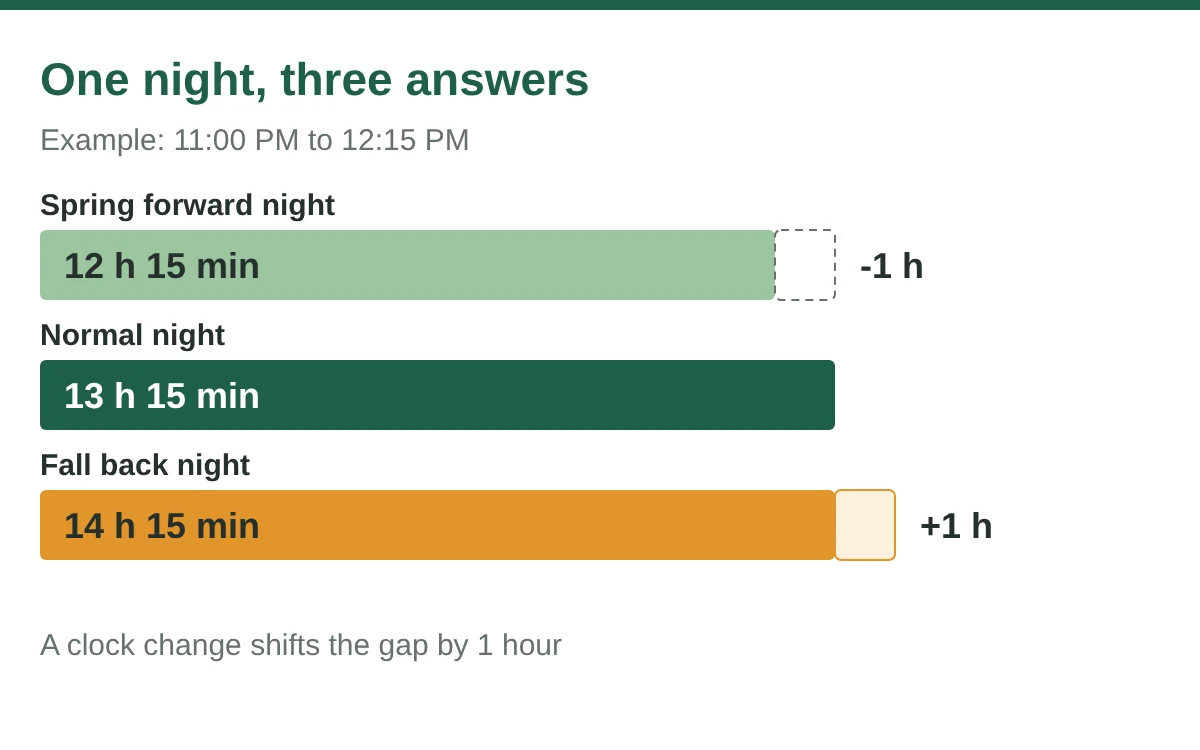
Hand subtraction assumes every day has 24 hours. On the two clock-change days a year, in places that use daylight saving, it does not. Say you count from 11:00 PM the night before to 12:15 PM. That is 13 hours 15 minutes on a normal night. On a spring-forward night it is 12 hours 15 minutes, and on a fall-back night it is 14 hours 15 minutes.
The clock change usually happens in the small hours, so any countdown that crosses it is off by exactly one hour if you do it on paper. The live widget uses your device’s real calendar rules, so it stays right. Do your own maths only for a start and end on the same side of the change.
Time zones and shared 12:15 plans
A 12:15 PM call is a different moment in each zone. Noon-quarter in New York is 9:15 AM in Los Angeles, and late afternoon in London. The widget counts to 12:15 on your clock, so if the 12:15 belongs to someone else’s zone, convert their time to yours first and then judge the gap.
Two traps catch people. The first is that US and European clock changes happen on different dates, so for a few weeks each spring and autumn the usual gap between, say, New York and London shrinks or grows by an hour. The second is that a zone name like “CST” is ambiguous, because it is used for more than one region. When a plan crosses regions, write the city, not the abbreviation. For a live reading of one specific zone, what time is it in Central Time now shows it directly.
Try this: For your next cross-zone 12:15, write the time as a city (“12:15 PM New York”) in the invite, then check what it is on your own clock before replying.
Why people check for 12:15
12:15 is a common slot for a few reasons. It is a typical second lunch period in schools and the start of the midday break for many offices, so it marks “how long until I can stop”. It is a favourite appointment time because it sits just after the noon rush, and a 12:15 start leaves a clean buffer if the previous visit runs over.
For traders, 12:15 PM Eastern falls mid-session in the US stock market, which runs from 9:30 AM to 4:00 PM Eastern. Many people there track it as part of the midday lull, so they time breaks around it. Remember that 12:15 PM Eastern is 9:15 AM Pacific, which is before a Pacific trader’s own lunch.
If you are planning around other times, how long until 3 PM and how long until midnight work the same way, and the full set is on countdowns to a time of day.
Rounding and the exact second
The target is 12:15:00 exactly, so a 12:15 countdown ends at the start of that minute, not the end of it. If the widget shows 14 minutes at 12:00:30, a whole-minute reading rounds down, and the true gap is 14 minutes 30 seconds. People who plan to the minute often arrive early by one minute without noticing.
To turn a spare number of minutes into hours and minutes, divide by 60 and keep the remainder: 155 minutes is 2 remainder 35. The time conversions page has more of these. Also, if a countdown shows hours as a decimal, such as 2.58 hours, multiply the decimal by 60 to get minutes. Here 0.58 x 60 is about 35.
Frequently asked questions
How many minutes is 12:15 PM after midnight?
12:15 PM is 735 minutes after midnight (12 hours x 60, plus 15). 12:15 AM is only 15 minutes after midnight. Subtracting your current minute count from 735 gives the minutes left.
Is 12:15 PM noon?
No. Noon is exactly 12:00 PM, so 12:15 PM is 15 minutes after noon. It is still the afternoon, and it is the first quarter hour of the PM half of the day.
What is 12:15 PM in 24-hour time?
It is 12:15, often written 1215 in military style. 12:15 AM becomes 00:15, which is why 24-hour notation avoids the AM and PM mix-up.
Why does the countdown jump to nearly 24 hours after 12:15?
Once today's 12:15 PM has passed, the next one is tomorrow's. The widget switches target automatically, so the time left restarts near 24 hours and shrinks from there.