
How Long Until 7 PM?
Around the world
The live countdown above gives the exact time left until 19:00 on your own device clock, down to the second. If 7 PM has already gone today, it counts toward tomorrow’s 7 PM instead. The rest of this page covers how to check the answer by hand, and where the easy mental sums go wrong.
Most people checking this are timing a shift end, an evening class, a dinner booking or a store closing. The calculation is the same each time, so a few reliable methods are worth having.
Doing the sum by hand
Convert 7 PM to 19:00 and subtract the current time written the same way. Say a hypothetical reading of 2:47 PM, which is 14:47. Then 19:00 minus 14:47 leaves 4 hours 13 minutes.
Subtracting minutes is where mistakes happen, because you cannot take 47 from 00. Borrow an hour: treat 19:00 as 18:60, then 18:60 minus 14:47 gives 4:13. Writing the borrow down explicitly stops most slips.
The 24-hour form matters most for afternoon times. Subtracting 2:47 from 7:00 on the face of the clock gives nonsense unless you remember both are PM, and the 24-hour form removes that risk.
The round-up shortcut
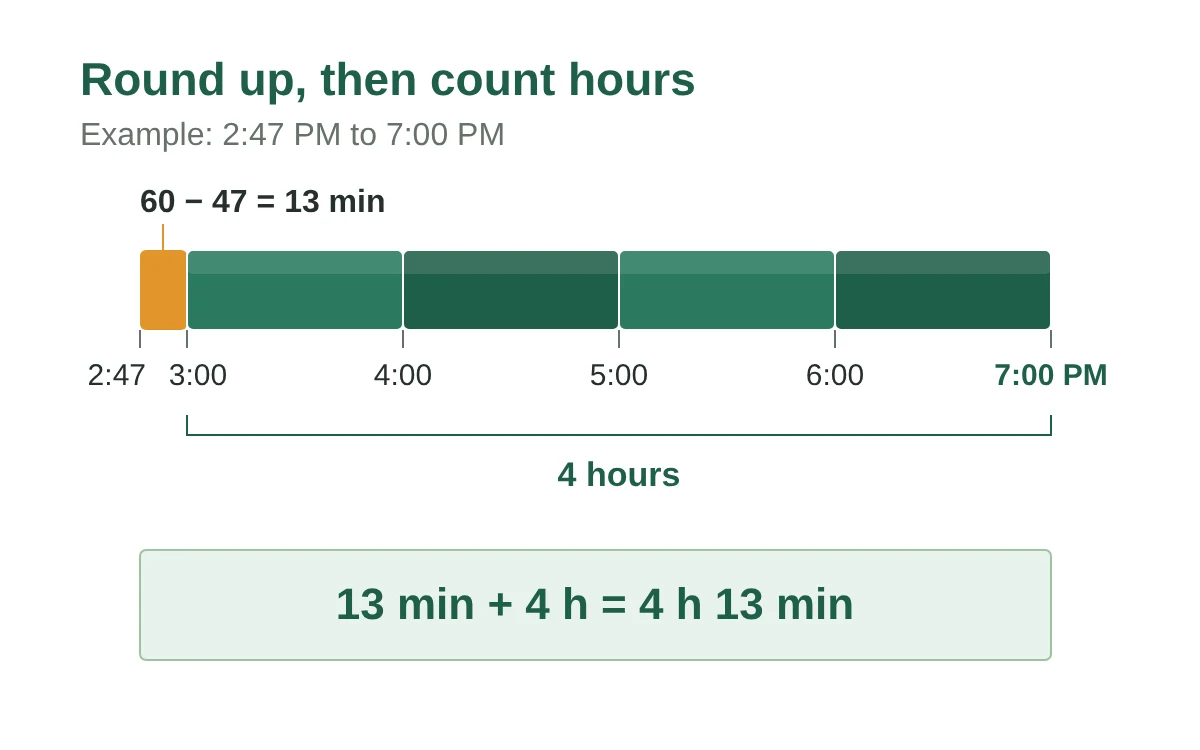
Skip the borrowing and count in two hops. First get to the next whole hour, then count whole hours to 7. From 2:47 PM, the next hour is 3:00, which is 13 minutes away. From 3:00 to 7:00 is 4 hours. The total is 4 hours 13 minutes.
The 13 comes from a pattern: the minutes to the next hour are always 60 minus the current minutes. Anyone who knows their complements of 60 (47 and 13, 38 and 22, 52 and 8) can do this instantly.
Try this: Glance at any clock and give the time to 7 PM in under five seconds using only the round-up method. Check it against the live widget. Do it five times and the complements of 60 will stick.
Minutes from midnight
7 PM is 1,140 minutes after midnight (19 times 60). That makes a clean formula: minutes left equals 1,140 minus the minutes already elapsed today. For 14:47 the elapsed figure is 14 times 60 plus 47, which is 887, so 253 minutes remain.
This is the better route when you want a minute total rather than hours and minutes, for example when setting a timer. If you only need to convert a minute figure back, the minutes to hours converter pattern applies: divide by 60 and keep the remainder as minutes. 253 minutes is 4 hours with 13 left over.
When 7 PM has already passed
After 7:00 PM, the answer is tomorrow’s 7 PM. The quick way is to work out how long ago 7 PM was and subtract that from 24 hours. At a hypothetical 9:15 PM, 7 PM was 2 hours 15 minutes ago, so tomorrow’s 7 PM is 21 hours 45 minutes away.
The formula version adds a day: 19:00 plus 24:00 is 43:00, and 43:00 minus 21:15 is 21:45. Both routes agree, and the complement route involves smaller numbers.
There is also a boundary case. At exactly 7:00:00 PM the count reads zero for a moment, then resets to a full 24 hours. A page that shows a very large number right after 7 is not broken. If you wanted the evening that just started, the answer is zero.
Clock changes can shift the answer
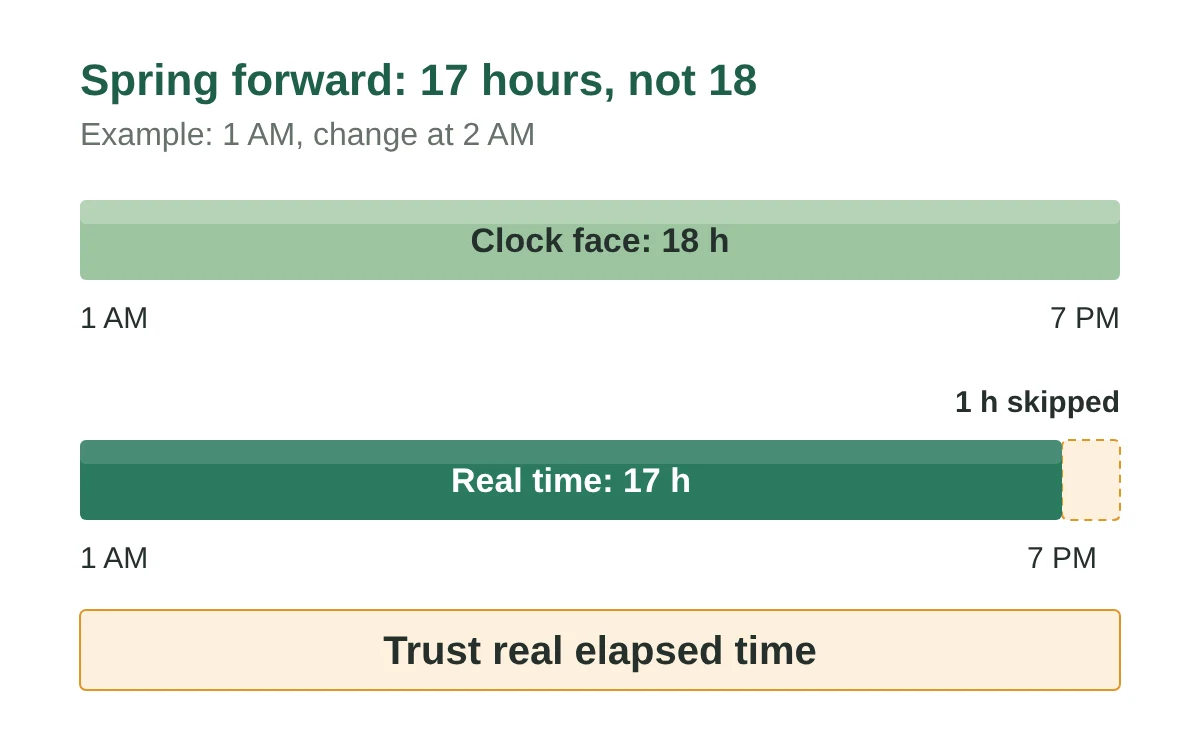
On the night clocks change, subtracting the two clock readings can be off by exactly one hour. Take a spring-forward night in a region where the change happens at 2 AM. At 1 AM, the clock face suggests 18 hours until 7 PM, but only 17 real hours will pass because one hour is skipped. In autumn it runs the other way, with an extra hour.
The mismatch only affects starting points before the changeover. From mid-morning on that day, both methods agree. If you plan something important that spans a clock change, trust a count based on real elapsed time and treat your hand sum as a rough check.
Time zones and other people’s 7 PM
The widget uses your device’s clock and zone, so it answers “when is 7 PM for me.” If you are waiting on someone elsewhere, such as a call or a livestream, work out their 7 PM in your own time first. 7 PM Eastern is 6 PM Central, 5 PM Mountain and 4 PM Pacific, and for other zones it is simpler to first convert their 19:00 to your local time and then count.
One trap is seasonal. “7 PM UK time” is 18:00 UTC in summer and 19:00 UTC in winter, because the UK switches between BST and GMT. A time written as “7 PM GMT” can therefore differ from “7 PM London” by an hour for half the year. When an event notice gives a zone abbreviation, check which one it names.
If you are travelling, your device may keep the old zone until it updates. Check that the phone clock matches the wall clock before trusting any countdown.
Work backwards to a leave-by time
A 7 PM deadline is rarely about 7 PM itself. For a dinner booking, subtract the journey and a buffer: a 25-minute drive plus 10 minutes to park gives 35 minutes, so leave at 6:25 PM. A quick way to do it is to take off the round part first (30 minutes to 6:30), then take off the remainder (5 more minutes to 6:25).
You can lean on the neighbouring countdowns for rolling targets. How long until 6 PM suits a pre-event cutoff, how long until 8 PM suits a late sitting, and how long until midnight covers whatever follows. For a fixed gap, the 45 minutes from now page gives the clock time at the end of a set wait.
Try this: Pick tonight’s real 7 PM plan. Write down the travel time, add a 10 minute buffer, and subtract the total from 19:00. Set an alarm for that leave-by time rather than for 7 PM.
Other times of day
For morning plans, how long until 7 AM uses the same method, with the twist that the target is usually tomorrow. For any other clock time, the time until countdowns collect the same live calculators in one place, and the same hand methods work for all of them.
Frequently asked questions
How many minutes are there until 7 PM?
Convert now to minutes after midnight and subtract it from 1,140, because 7 PM is 19 hours times 60 minutes. At 2:47 PM that is 1,140 minus 887, or 253 minutes. The live widget shows the exact figure for your clock.
What does the countdown show once it passes 7 PM?
It switches to the next 7 PM, which is tomorrow's. From the moment after 7:00 PM the remaining time is just under 24 hours, so a count that jumps from near zero to a big number is working as intended.
Is 7 PM the same as 19:00?
Yes. Add 12 to any PM hour from 1 to 11 to get the 24-hour form, so 7 PM is 19:00, written 1900 in military style. Midnight and noon are the two special cases.
Why is my hand calculation an hour off on some days?
The clocks probably changed overnight where you live. Subtracting clock times ignores the missing or repeated hour, while the true time left counts real elapsed time. The error only affects calculations that start before the changeover.