
How Many Days Until July 11th?
Calendar
Countdown chart
The live counter above gives the exact answer for your clock and time zone, down to the second. It always targets the next July 11, so on July 11 itself it shows the day and then rolls forward to the following year.
If you want to check it, or work it out with no tool at all, July 11 has a few properties that make the arithmetic quick. They also explain why two people can count to the same date and get different numbers.
The day-of-year shortcut
July 11 is day 192 of a normal year and day 193 in a leap year. Every other method is slower than this one: find the day-of-year number for your start date, then subtract. Day numbers for the first of each month in a normal year run 1, 32, 60, 91, 121, 152, 182, so you can add the day of the month to the nearest one.
This works because month lengths are fixed apart from February. Learn 192 once and you can count to July 11 from any date in the same year with a single subtraction.
A worked example with a hypothetical start date
Take a made-up start date of March 3 in a normal year. March 3 is day 62 (31 for January, 28 for February, plus 3). Subtract: 192 minus 62 is 130 days.
Check it the long way: 28 days left in March, 30 in April, 31 in May, 30 in June, then 11 into July. That adds to 28 + 30 + 31 + 30 + 11 = 130. Both routes agree, which is the quickest sanity test you can run.
To start from a date in a different year, add the days left in the starting year (365 or 366 minus its day number) to 192 or 193, depending on whether the July 11 you are targeting falls in a leap year.
Two traps that shift the answer by one
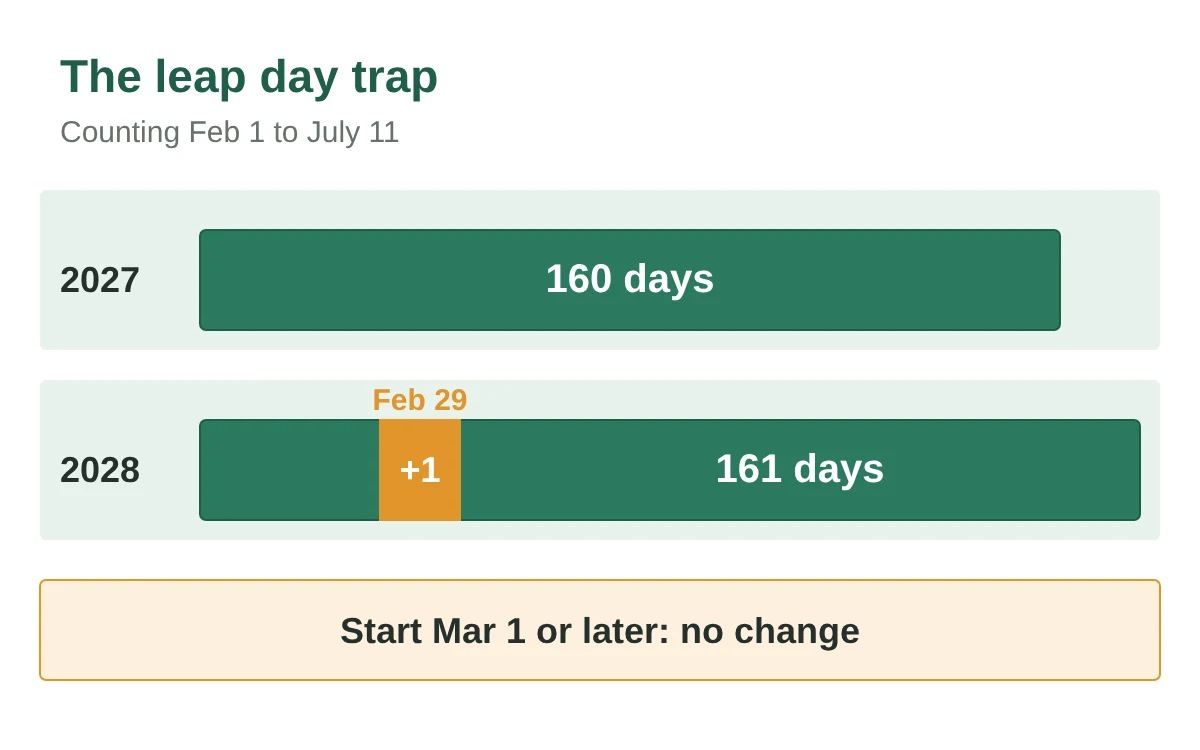
The leap-year trap only bites if your start date is on or before February 28 and the target July 11 is in a leap year. The extra day, February 29, sits between you and the target, so the count is one higher than the normal-year arithmetic says. Start on March 1 or later and the leap day has no effect.
The second trap is inclusive versus exclusive counting. “Days until” normally means the gap between two dates, so counting from March 3 to July 11 gives 130, not 131. If you are counting event days (say, a 3-day trip ending on July 11), you count both ends and add one.
Try this: Pick any date from last month. Compute its day-of-year number in your head, subtract it from 192, then check the result with the date calculator. If you are off by one, you counted inclusively.
Counting weeks and weekdays to July 11
Divide the day count by 7 and keep the remainder. In the example above, 130 days is 18 weeks and 4 days. The remainder matters more than the weeks, because it decides how many working days you get.
Each full week contributes exactly 5 weekdays. For the leftover days, count forward from your start date one day at a time. The example start was a Wednesday, so the 4 leftover days are Thursday, Friday, Saturday, Sunday, which gives 2 weekdays. Total: 18 × 5 + 2 = 92 weekdays.
Public holidays are not subtracted in that figure. In the US, July 4 falls just a week before, so work-day estimates for the weeks leading up to July 11 should account for it. If your countdown crosses it, the July 4th page shows how that date sits in the same stretch.
A weekday pattern that never changes
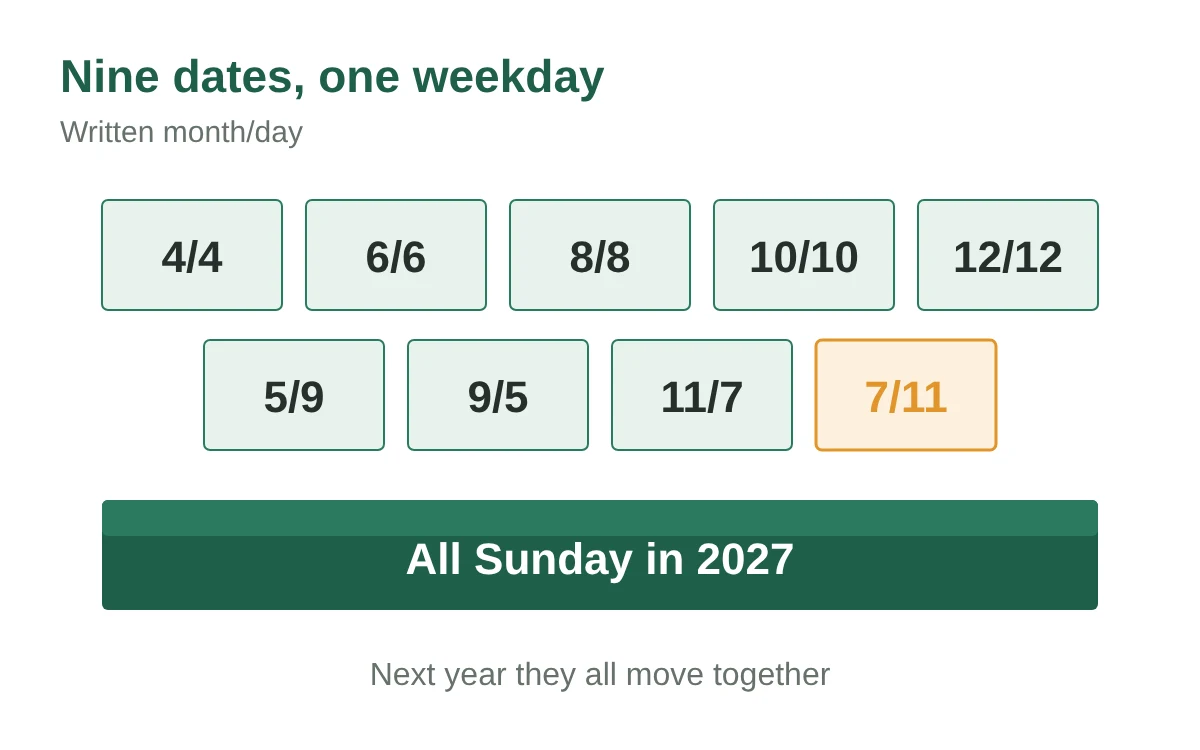
July 11 always falls on the same weekday as July 4, July 18 and July 25. It also shares its weekday with several other dates that follow a well-known mental calendar trick: 4/4, 6/6, 8/8, 10/10, 12/12, 5/9, 9/5, 7/11 and 11/7 all land on the same weekday in any given year.
Year to year, July 11 moves forward one weekday, or two after a leap day. The sequence runs Sunday in 2027, Tuesday in 2028, Wednesday in 2029, Thursday in 2030. That is useful for long-range planning, such as booking a venue years ahead.
What July 11 is known for
World Population Day is the formal one. It was inspired by public interest in Five Billion Day on July 11, 1987, the approximate date when the world population reached five billion, and the United Nations has marked it since. The date also gives its name to 7-Eleven’s annual Free Slurpee Day, though the details of the offer vary by country and year, so check your local store.
Elsewhere, July 11 is the Day of the Flemish Community in Belgium, commemorating the 1302 Battle of the Golden Spurs. In Mongolia, the Naadam festival begins on this date. In Northern Ireland the night of July 11 is traditionally marked by bonfires ahead of the Twelfth. None of these is a global public holiday, and July 11 is not a tax or school deadline in the US.
In the Northern Hemisphere it is mid-summer. In the Southern Hemisphere it is mid-winter.
Why your count might not match someone else’s
Time zone is the main cause. A countdown to July 11 targets midnight at the start of the day in the viewer’s own zone, so someone in Sydney reaches it many hours before someone in Los Angeles. The live counter above uses your own device clock, so it will differ from a friend’s in another zone.
The other cause is date format. Written as 7/11, the date is July 11 in the US but 7 November in much of the world, where 11/7 means July 11. If you are coordinating with people abroad, write “11 July” in full.
Planning ideas for the countdown
Work backwards in fixed milestones. 90 days before July 11 is always April 12, in leap years and normal years alike, and 70 days (ten weeks) before is always May 2. That makes them reliable checkpoints for a project or event. For other milestones, the 90 days from now page shows how a 90-day window works.
If July 11 is your birthday, the countdown is also a personal one, and the birthday countdown handles that. To compare with nearby dates, see July 18 or the month-level days until July page.
Try this: Write down April 12 and May 2 on your calendar now. They are the 90-day and 70-day marks before July 11, whichever year you are counting toward.
FAQ
Is the answer the same everywhere in the world? Not quite. The day count depends on the time zone of whoever is counting, because each zone reaches July 11 at a different moment. The live counter uses your device’s own clock.
How do I count the weekdays until July 11? Multiply the full weeks by 5, then add the weekdays among the leftover days counted forward from your start date. Public holidays are not subtracted unless you do it yourself.
Does a leap year change the number of days until July 11? Only if February 29 falls between your start date and July 11. Starting on March 1 or later, the leap day is already behind you, so it makes no difference.
What day of the week will July 11 be in the coming years? It lands on Sunday in 2027, Tuesday in 2028, Wednesday in 2029 and Thursday in 2030. It advances one weekday per year, or two after a leap year.
Frequently asked questions
What day of the year is July 11?
July 11 is day 192 in a normal year and day 193 in a leap year. Subtracting the day-of-year number of your start date from 192 (or 193) gives the days remaining, as long as both dates fall in the same year.
What date is 90 days before July 11?
April 12, in both leap and normal years, because February 29 is not in that stretch. The 70-day (ten-week) mark is always May 2.
Why does 7/11 mean different dates in different countries?
In the US, 7/11 is July 11. In much of the world the day comes first, so 7/11 reads as 7 November and 11/7 is July 11. Writing "11 July" in full avoids the mix-up.
Should the countdown to July 11 include both the start day and July 11?
For a plain "days until" figure, no. It is the gap between the two dates, so March 3 to July 11 is 130 days in a normal year. Add one only when counting event days where both ends are included.