
How Many Days Until July 9th?
Calendar
Countdown chart
The number of days until July 9 depends on today’s date and your time zone, so the live widget above is the reliable answer. It counts to the start of July 9 on your own clock and updates itself. If you want to check it or work it out offline, the fastest method is day-of-year arithmetic: July 9 is day 190 of a normal year, so subtract today’s day number from 190.
The rest of this page covers the parts a plain number can’t: where counts go wrong, how to turn days into weekdays and weeks, and what makes this date worth planning around.
Calculate it by hand in under a minute
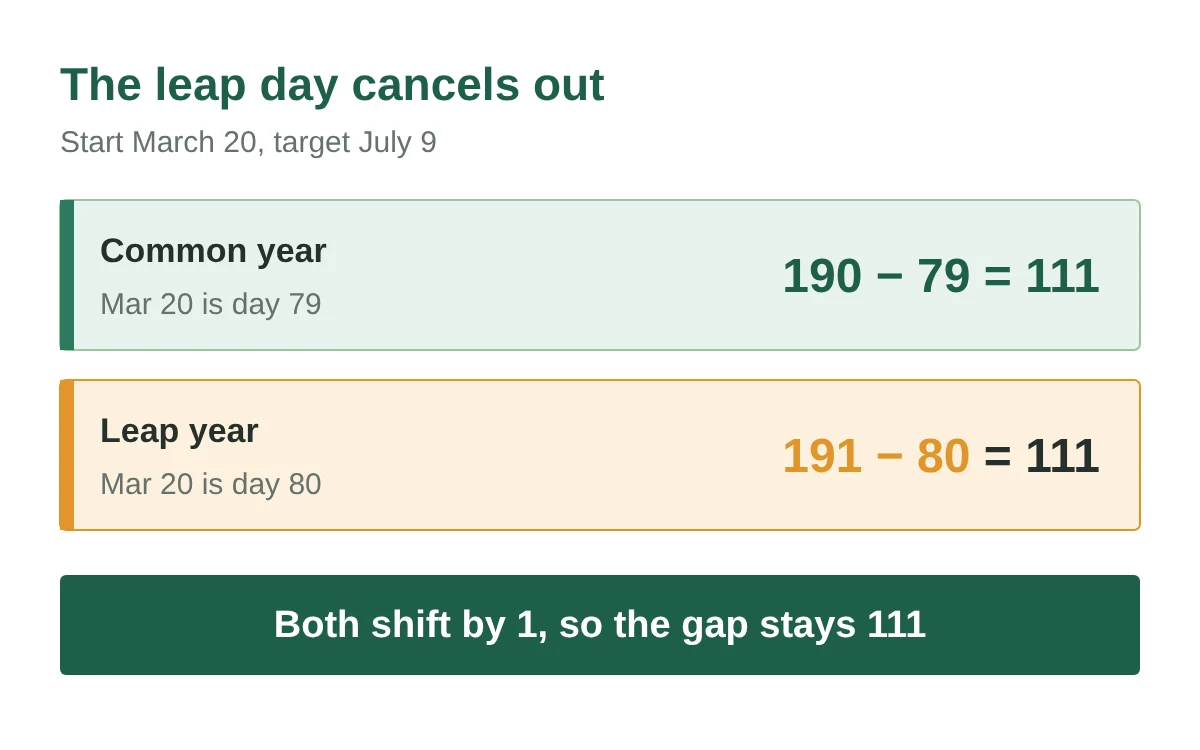
Day-of-year arithmetic beats counting month by month. July 9 is day 190 in a common year and day 191 in a leap year, because February 29 pushes everything after it back by one. Find the day-of-year number for your start date, then subtract it from 190.
Here is a worked example with a hypothetical start of March 20 in a non-leap year. March 20 is day 79 (31 for January, 28 for February, plus 20). Then 190 minus 79 gives 111 days. The month-by-month route agrees: 11 days left in March, 30 in April, 31 in May, 30 in June, then 9 more in July, which also makes 111.
The leap-day rule has a useful edge: February 29 only changes the answer if it sits between your start and July 9. A start date from March 1 onward in a leap year gives the same difference as in a common year, because both day numbers shift by one and cancel.
Try this: Pick any date three or four months from now, look up its day-of-year number, and subtract it from 190. Then check your answer against the widget.
Why two countdowns can disagree
Countdown pages often differ by exactly one day, and the cause is almost always the counting convention. Counting from today’s date to July 9’s date, with neither end included, is the standard for “how many days until”. Some tools include both ends and report one more. Others round a partial day up, so a countdown that has 12 hours left on the final day still shows “1 day”.
The time zone matters as well. A page that runs on server time or UTC flips to the next day at a different moment than your phone does. In the evening in the Americas, UTC may already be on tomorrow’s date, so a UTC-based counter can show one day fewer than your local calendar. This site’s widget uses your own clock, which is the right basis for planning an event in your own city.
For a more detailed comparison between any two dates, the date calculator lets you choose whether to include the end day.
Counting weekdays and weeks to July 9
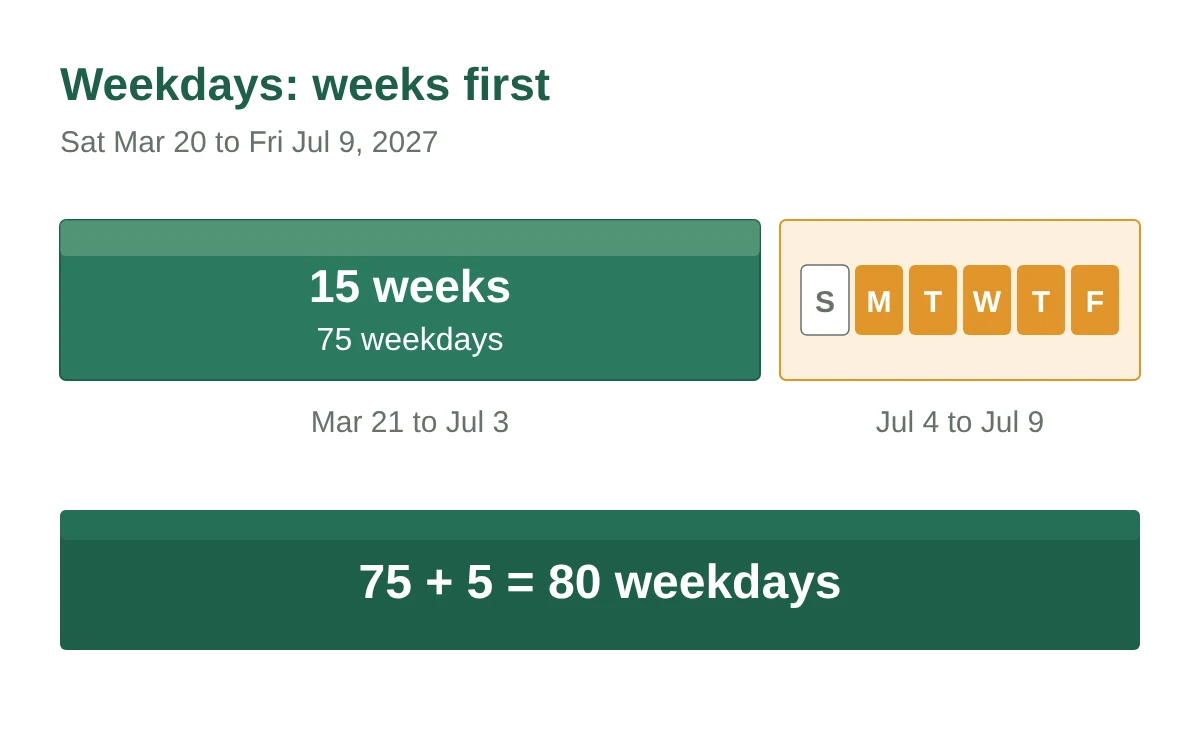
Weekdays are not simply total days times 5/7, because the remainder depends on which weekday you start on. The reliable method is to divide the total by 7, take 5 weekdays per full week, then count only the leftover days one by one.
Using the hypothetical 111 days from a Saturday, March 20: 111 is 15 full weeks (75 weekdays) plus 6 leftover days. Those 6 days run Sunday to Friday and contain 5 weekdays, so the total is 80 weekdays, counting July 9 itself. In 2027 that works neatly because July 9 is a Friday, so the final day is a working day.
Public holidays are not subtracted from a weekday count unless you do it yourself. In the United States, Independence Day on July 4 falls inside almost every countdown to July 9, so remove that one date if you need working days. If July 4 falls on a weekend, the federal holiday is observed on the nearest Friday or Monday, which can change the count. The July 4 countdown shows how far away it is from you.
For weeks, remember that 111 days is “15 weeks and 6 days”, not 16 weeks. Rounding up overstates the wait by most of a week.
What July 9 is known for
July 9 is the national day of two countries on different continents. Argentina marks its 1816 declaration of independence from Spain, signed by the Congress of Tucumán, and South Sudan marks its independence from Sudan in 2011, when it became the world’s newest country. Palau also observes Constitution Day on this date, and Nunavut Day is a territorial holiday in northern Canada.
The date has a Brazilian connection too: July 9 is a state holiday in São Paulo, commemorating the 1932 Constitutionalist Revolution. In the United States it has no federal status, though the 14th Amendment was ratified on July 9, 1868.
Time zones put the two independence days five hours apart. South Sudan is on UTC+2 and Argentina on UTC-3, so July 9 starts in Juba five hours before it starts in Buenos Aires. If you are timing a call or a livestream across the two, that gap decides whose July 9 you are counting to.
Which weekday July 9 lands on
A fixed date moves forward one weekday each year, or two after a leap year. July 9 is a Thursday in 2026, a Friday in 2027, a Sunday in 2028, a Monday in 2029 and a Tuesday in 2030. The jump from Friday to Sunday in 2028 is the leap day at work.
This matters for planning. A Friday July 9 produces a three-day weekend for anyone who takes Monday or has Friday as a holiday, as in Argentina. In 2028 it lands on a Sunday, and Argentina’s calendar rules for moving holidays are worth checking with official sources because they change by decree.
The same shifting weekday explains why a “9/7” written by someone in Buenos Aires or London means July 9, while in the United States 9/7 is September 7. Write the month out in any message about a deadline and the confusion disappears.
Planning around a July 9 countdown
July 9 sits nine days into the third quarter and in the middle of the northern summer, which makes it a deadline with a built-in buffer. The closest anchor is the start of the month, so the days until July page works well as a first milestone. If your plan runs to July 9 or to the weekend after, compare with the countdown to July 11.
Split a long countdown into checkpoints that use whole weeks instead of days. A target that is 15 weeks and 6 days away is easier to schedule as “15 weeks, then a final sprint”. Travel, school and event bookings tend to be tied to weeks and weekends rather than raw day counts.
Try this: Take the weeks remaining, divide them into four equal checkpoints, and put each one in your calendar as a Friday. A final checkpoint exactly one week before July 9 leaves room for slips.
If July 9 is a personal date, like a birthday or anniversary, the birthday countdown handles the leap-year edge cases for February 29 birthdays.
Frequently asked questions
How many days until July 9?
The live widget at the top of this page gives the exact figure for your own clock and time zone. By hand, subtract today's day-of-year number from 190 (191 if the July 9 you are counting to falls in a leap year).
What day of the week is July 9 in the next few years?
July 9 is a Friday in 2027, a Sunday in 2028 (the weekday jumps two places after a leap year), a Monday in 2029 and a Tuesday in 2030.
Is July 9 a public holiday?
It is a national holiday in Argentina and South Sudan, both for independence, and also in Palau. It is not a federal holiday in the United States or a public holiday in the UK.
Does the countdown include July 9 itself?
The usual convention counts the days between today and the start of July 9, so the target day is not counted as a full day remaining. Some sites count both ends, which makes their number one higher.