
How Many Days Until July 13th?
Calendar
Countdown chart
The number of days until July 13 is shown in the live countdown above, and it is calculated from your own device clock and time zone. The next July 13 is Tuesday, July 13, 2027. Once that day passes, the counter rolls over to the following year automatically.
Reading the number is easy. Checking it, and knowing what it really measures, takes a few tricks. The sections below cover a one-subtraction shortcut, a full worked example, weekday counting, and the small mistakes that cause off-by-one errors.
What the countdown actually measures
A countdown to a date is really a countdown to a moment: midnight at the very start of July 13 in your time zone. That has two consequences. On the morning of July 12 the count reads 1 day, and “tomorrow” is the target day. Also, someone in Tokyo and someone in Los Angeles reach July 13 at moments many hours apart, so their counts roll over at different times.
The way the date is written is never a problem for this one. In “7/13” or “13/7” the 13 can only be a day, so US and international formats agree on it. Dates like 7/12 do not have that luxury.
The day-of-year shortcut
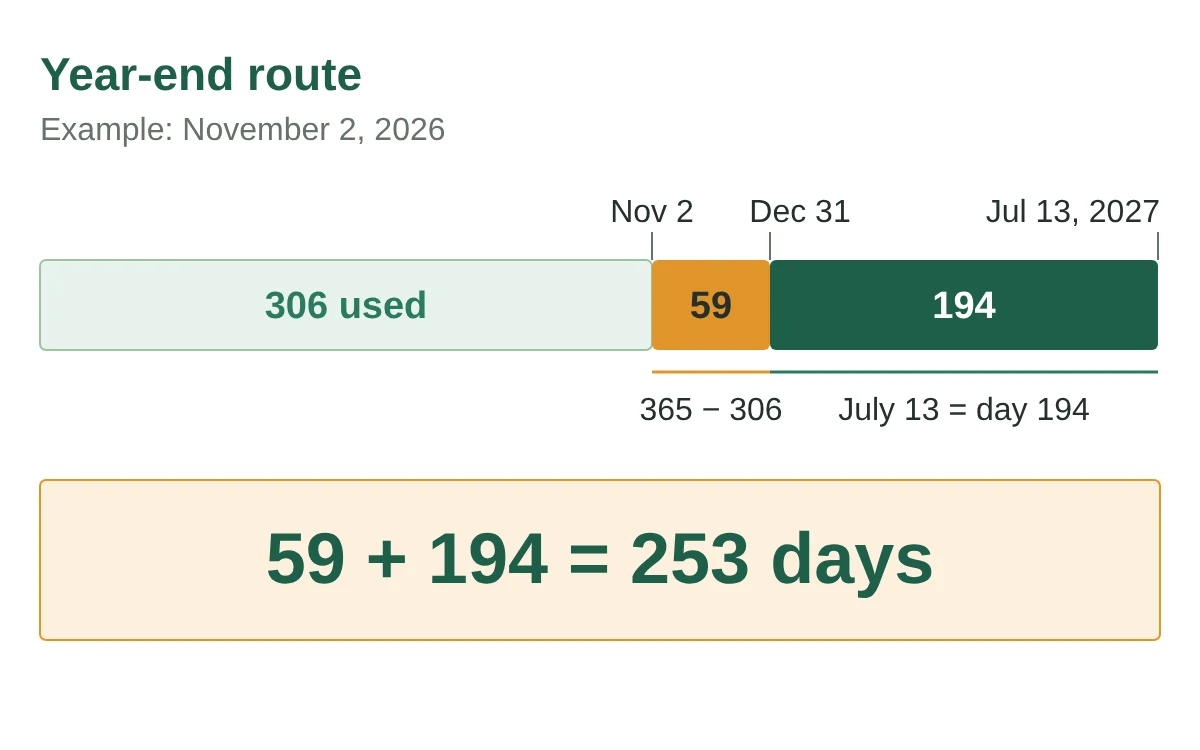
Every date has a position in the year, and July 13 is the 194th day of the year (195th in leap years). That gives a one-step method. Take 194, subtract today’s day-of-year number, and you have the days remaining if July 13 is still ahead this year.
If July 13 has already passed, use the year-end route: 365 minus today’s day number, plus 194. For a window that includes February 29, such as one running from late 2027 to July 13, 2028, use 366 and 195 instead.
Try this: Find today’s day-of-year number (the date field in a spreadsheet and the DAYOFYEAR function both give it) and subtract it from 194. Then compare the result with the live widget.
A worked example by hand
Take a hypothetical starting date of November 2, 2026. Count the days left in each month, then add 13 for July:
- Rest of November: 28
- December: 31
- January: 31
- February: 28 (2027 is not a leap year)
- March: 31, April: 30, May: 31, June: 30
- Then 13 more days into July
The total is 253 days. As a check, November 2 is day 306 of 2026, which leaves 59 days in the year, and 59 plus 194 is also 253. Two independent routes giving the same number is the best proof you have not slipped.
In a spreadsheet the same answer is one formula: subtract the start date from DATE(2027,7,13). The date-difference tools on the date calculator page do this for any two dates.
Counting weeks and weekdays
Divide the day count by 7 for weeks and keep the remainder. In the example, 253 days is 36 weeks and 1 day. The remainder also gives you the weekday for free: November 2, 2026 is a Monday, so 36 weeks later is another Monday, and one extra day lands on Tuesday. That matches July 13, 2027.
For weekdays, multiply the full weeks by 5, then walk the leftover days one at a time and count only Monday to Friday. The example gives 36 × 5 = 180, plus the final Tuesday, so 181 if July 13 counts and 180 if it does not. Different counters disagree by one for exactly this reason, so check which rule yours uses. Public holidays are a separate subtraction: a plain weekday count does not remove them.
Where July 13 lands in coming years
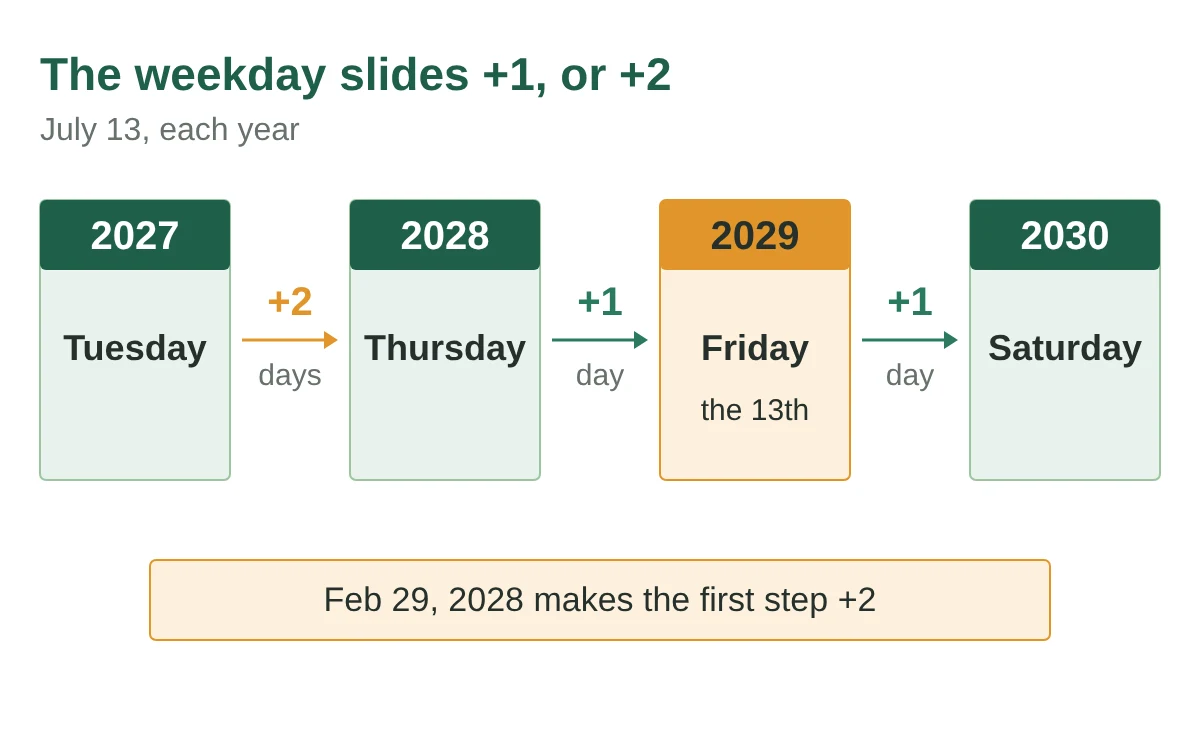
The weekday of a fixed date moves forward by one each year and by two after a leap year. It shifts forward by 1 day each year (or 2 days after a leap year). The sequence runs Tuesday in 2027, Thursday in 2028, Friday in 2029 and Saturday in 2030, as published observance tables confirm.
The Friday in 2029 is notable: July 13, 2029 is a Friday the 13th. If your target date is a deadline rather than a celebration, 2030 is the awkward one, since it lands on a Saturday and the working deadline effectively moves back to Friday, July 12.
What July 13 is known for
July 13 is not a public holiday in the United States, so schools and offices keep their usual schedules around it. It is mostly a fun-calendar date. Embrace Your Geekness Day is the most widely recognized pop culture observance on it, and the day is also linked with Fool’s Paradise Day, National Barbershop Music Appreciation Day and Gruntled Workers Day.
A few historical anchors are worth knowing. The Northwest Ordinance was passed on July 13, 1787, and Live Aid ran at Wembley and Philadelphia on July 13, 1985. The date also usually falls inside the Pamplona San Fermín festival and during the Tour de France in many years. Seasonally, it sits in the middle of summer in the Northern Hemisphere and midwinter in the Southern, so it is a poor guess for a school-term date in either half.
Planning backward from July 13
A countdown is more useful when it is split into checkpoints. Subtracting from the target is easier than adding from today. In a non-leap year, 90 days before July 13 is April 14, which makes the 90 days from now page a handy cross-check for quarter-length projects. Eight weeks before July 13, 2027 is May 18, 2027, also a Tuesday.
The same-weekday property is the hidden benefit of working in whole weeks: every checkpoint lands on the same day of the week as the target, so recurring meetings or training sessions line up without adjustment. Conveniently, June 13 to July 13 is exactly 30 days, so the June 13 countdown works as a one-month marker.
Try this: Write down July 13 minus 12 weeks, minus 8 weeks and minus 4 weeks. Put those three dates in your calendar as review points, all on the same weekday as the target.
Counting mistakes to avoid
The most common error is inclusive versus exclusive counting. “Days until” excludes the target day and usually excludes today, so a hand count that tallies both ends will be one too high.
Hour-based counting is the second trap. If you convert hours to days by dividing by 24, a daylight saving change inside the window leaves you an hour out, because one day in spring has 23 hours and one in autumn has 25. Counting calendar dates avoids this, and it is what the widget does.
The third is the leap year. Any span that crosses February 29 gains a day, and the next such date is in 2028. If your plan runs past July 13 into the following year, compare with the neighbouring dates, such as the July 11 countdown or the July 16 countdown, to confirm your offsets.
Frequently asked questions
What day of the week is July 13 in 2027?
July 13, 2027 is a Tuesday. In 2028 it moves to Thursday, because 2028 is a leap year and the weekday jumps two places instead of one.
Is July 13 a public holiday?
No, it is not a US federal holiday and not a bank holiday in most countries. It carries fun observances such as Embrace Your Geekness Day, so work and school run as normal.
How many weekdays are there until July 13?
Multiply the full weeks remaining by 5, then walk through the leftover days one by one and count only Monday to Friday. Decide first whether July 13 itself counts, since it adds one if it falls on a weekday.
Does the countdown change if I travel to another time zone?
Yes, by up to a day at the edges. The countdown runs to midnight at the start of July 13 in the clock you are using, so a device set to a different zone reaches that moment at a different instant.