
How Many Days Until May 14th?
Calendar
Countdown chart
The live countdown above gives the exact answer for your own clock and time zone, down to the second. It always targets the next May 14, and when the date passes it rolls over to the following year, so the number is correct whenever you open the page.
What follows is everything the widget cannot show you: how to check the number yourself, why two sites sometimes disagree by a day, how to turn the count into weekdays, and what else falls on this date.
What the countdown actually measures
A countdown to a calendar date ends at the first moment of that date, which is midnight at the start of May 14, not the end of it. That is why the final day of the count shows hours and minutes, not “1 day”. If your plan depends on the whole of May 14 (an event running all day, a form due by 11:59 PM), you have roughly one extra day to work with beyond what the clock suggests.
Time zones matter more than people expect. A person in Sydney reaches May 14 many hours before someone in Los Angeles, so a shared countdown to a worldwide moment will not land at the same instant for everyone. For a deadline set in a specific city, count to midnight in that city’s time zone. How long until midnight shows the same logic for tonight.
How to count the days by hand
The reliable method is to add up three parts: the days left in your starting month, the full months in between, and 14 for May itself. Use a hypothetical start of February 20 in a non-leap year.
- Days left in February: 28 minus 20 equals 8.
- All of March (31) and all of April (30): 61.
- Days into May: 14.
Total: 8 + 61 + 14 = 83 days. This is the “between” count, with February 20 itself excluded and May 14 treated as the arrival day.
The common slip is miscounting the first part. Subtracting the start day from the month length already excludes the start day, so do not add one “for safety”. Add one only if you deliberately want both ends included. If the month you start in is after May, the same method works, but you count to December 31 and then on to May 14 of the following year, so remember to add the 31 days of January and the rest.
The day-of-year shortcut
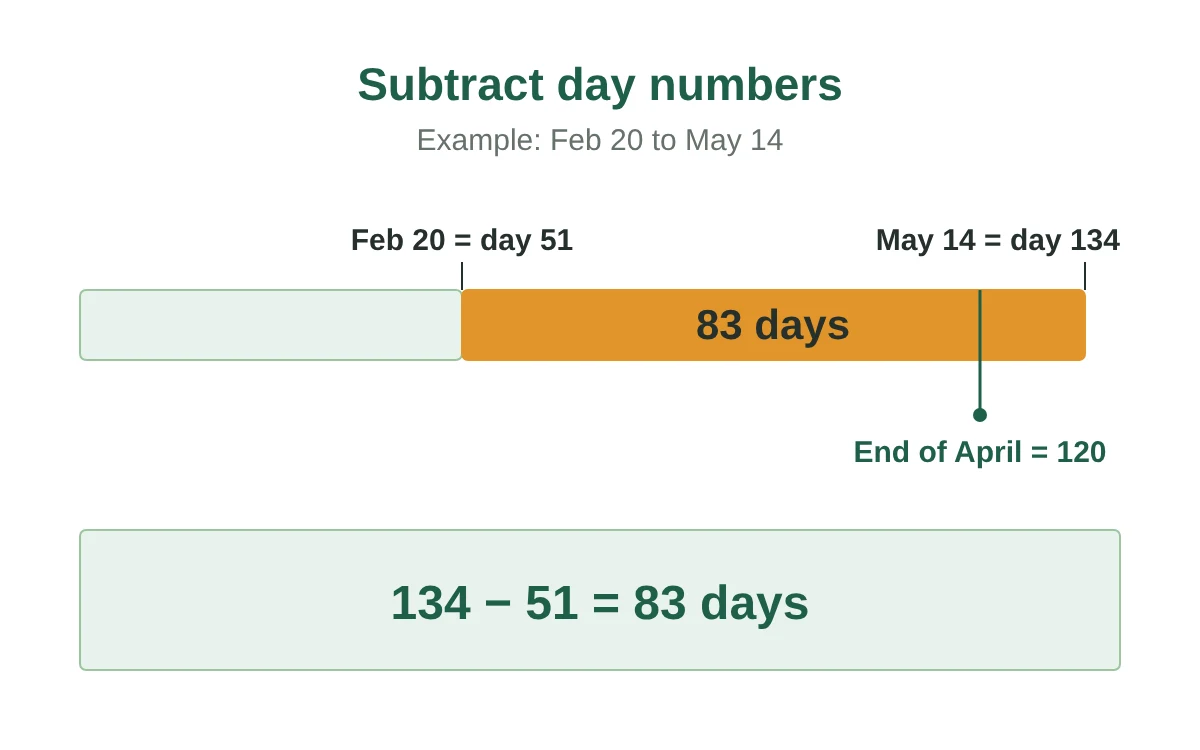
Every date has a position in the year, and subtraction is easier than adding months. May 14 is day 134 in a normal year and day 135 in a leap year. In the earlier example, February 20 is day 51 (31 days of January plus 20). Then 134 minus 51 is 83, matching the long method.
You can reach the day number mentally: a normal year has 120 days through the end of April (31, 28, 31, 30), and May 14 adds 14. Memorising 120 as the “end of April” anchor is useful for every spring date. If your start date and May 14 fall in the same year and both are after February, the leap day cancels out and you can ignore it. The shortcut breaks only when February 29 sits between the two dates.
Try this: Pick any date from last year and work out its distance to May 14 using both methods, the month-by-month sum and the 134 shortcut. If they disagree, you have found the month where you slipped.
Counting weekdays and weeks
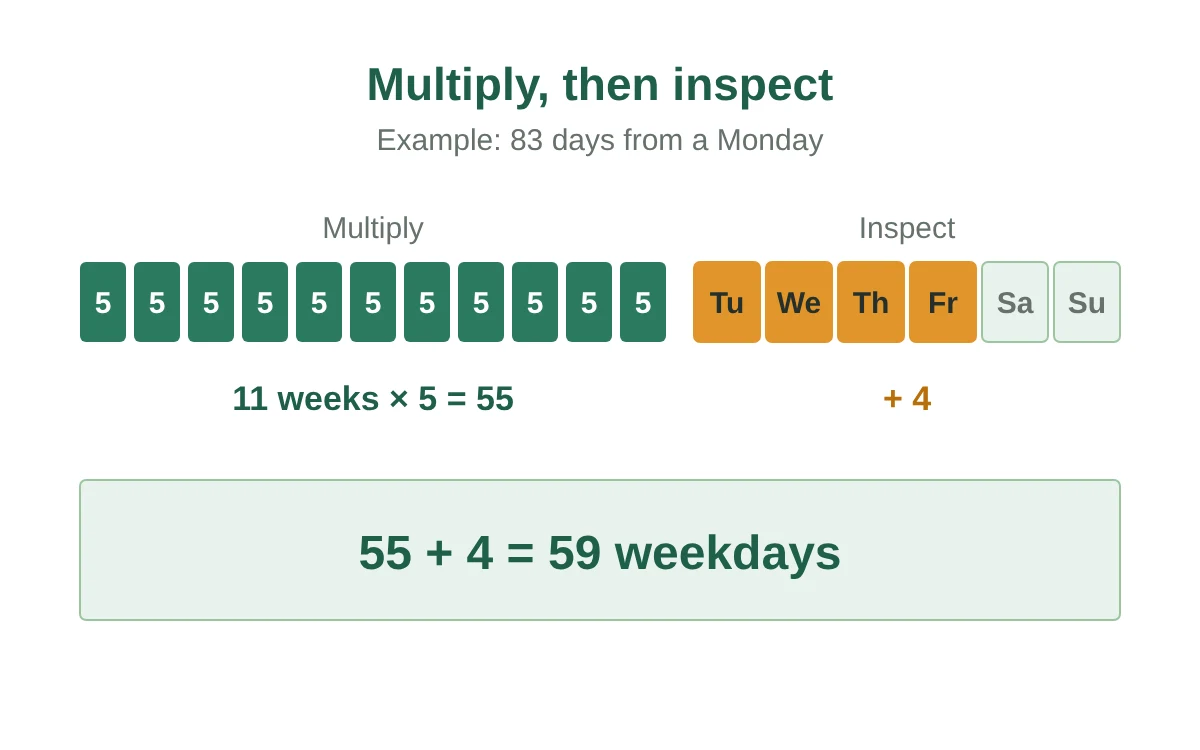
Dividing by 7 gives weeks and a remainder, and the remainder tells you how many extra days sit beyond the full weeks. Taking the 83 days from before: 83 is 11 weeks and 6 days. If the starting day were a Monday, six days later is a Sunday, so the target date would land on a Sunday.
Weekdays work the same way. Each complete week holds exactly five weekdays, so 11 weeks give 55. Then look only at the leftover days: Tuesday through Sunday contains four weekdays. That gives 59 weekdays, with the arrival day counted. The trick is to never count the full weeks one by one. Multiply, then inspect only the leftover stretch.
Public holidays are the part no formula handles. Subtract any weekday holidays in your region yourself, since they differ by country and sometimes by state. For a plain days-between calculation with an adjustable start date, the date calculator is the quicker option.
Why May 14 lands on a different weekday every year
The date moves one weekday later each year, and two weekdays later in the year after a February 29 has passed. This is because 365 days is 52 weeks plus one day, and a leap year gives 52 weeks plus two. The repeating cycle of weekday patterns takes 28 years in most centuries, so a May 14 that fell on a Friday will not return to a Friday on the very next leap cycle but follows the 5, 6, 11 year rhythm.
For planning, this means a May 14 event cannot be fixed to “the usual weekday”. An annual date that moves is awkward for recurring bookings, so many organisations anchor to “second Saturday of May” or similar, not to the numbered date. If the widget shows a Friday, a Sunday or a Monday in different years, that is the pattern at work.
What May 14 is known for
Several well-documented events share this date. Israel’s declaration of independence was made on May 14, 1948, though the national holiday, Yom Ha’atzmaut, follows the Hebrew calendar and moves around the Gregorian date each year. Paraguay marks its independence on May 14 and 15. The Jamestown settlement in Virginia was founded on May 14, 1607, and the Lewis and Clark expedition set out from Camp Dubois on May 14, 1804.
In parts of Europe, May 14 is the feast day of St. Boniface of Tarsus, the last of the four “Ice Saints” (May 11 to 14). In southern Germany, many gardeners do not plant until the end of the Eisheilige. The idea is that a late cold snap can bring a final frost, so tender plants wait until the saints have passed.
No tax filing deadline or national school cut-off date is tied to May 14 in a way that applies everywhere, so check local rules before treating it as one.
Planning around May 14
The US Mother’s Day rule creates a quirky fact: the holiday is the second Sunday of May, so it ranges from May 8 to May 14. When May 14 is itself a Sunday, it is the latest Mother’s Day possible. If you are counting to a date near it, the neighbouring pages for May 13 and May 15 help you compare the same distance on a day either side.
Think about the lead time that the count gives you. A gift that ships from overseas, a venue with a booking window, or a training plan all behave differently at 12 weeks than at 4. For longer runs, break the total into blocks of whole weeks, and use the live widget as the final check. If your goal is a Friday finish, the days until Friday page shows how to count to a weekday instead of a date.
Try this: Take the number of days shown in the widget, divide by 7, and write down the remainder. That remainder tells you how many “odd” days sit beyond the full weeks, and it is the number to check against your calendar.
Common mistakes that shift the answer by a day
The first mistake is mixing inclusive and exclusive counting between tools. The second is trusting a screenshot: a count copied today is wrong tomorrow, so a stored figure should always carry its start date. The third is the leap day. If you count across a February 29 using a fixed 365-day year, your answer is one day short.
A fourth issue is daylight saving. A count in hours across a clock change can differ by 1 hour from days multiplied by 24, which can flip a rounded answer. Counting in calendar days, as the widget does, avoids that problem. For a nearby comparison with a specific year attached, see May 10, 2027.
Frequently asked questions
Does the countdown to May 14 include the day itself?
The usual convention counts the days between now and the start of May 14, so the target day is not included. If you want to include both today and May 14 (for a trip or a deadline you work through), add one.
What day of the week is May 14?
It moves forward one weekday each year, or two after a leap day has passed in February. The live widget shows the weekday of the next May 14 for you, and the same pattern lets you check any future year.
Is May 14 ever Mother's Day?
Yes. In the US, Mother's Day is the second Sunday in May, which can fall anywhere from May 8 to May 14. May 14 is the latest possible date, and it happens whenever May 14 lands on a Sunday.
Why does my countdown differ from another site by one day?
Usually one tool counts inclusively and the other does not, or the two use different time zones. Counts also differ if one tool rounds to whole days and another reads the clock down to the second.