
How Many Days Until May 9th?
Calendar
Countdown chart
The exact number of days until May 9 depends on today’s date and your time zone, so the live countdown above is the answer. It runs on your own clock and rolls over to the following year’s May 9 once this one has passed. The rest of this page covers how to check that number by hand and how to turn it into weeks and weekdays.
May 9 is day 129 of a common year and day 130 of a leap year. That single fact powers the fastest manual method, and it also explains several quirks you will meet below.
The fastest way to count by hand
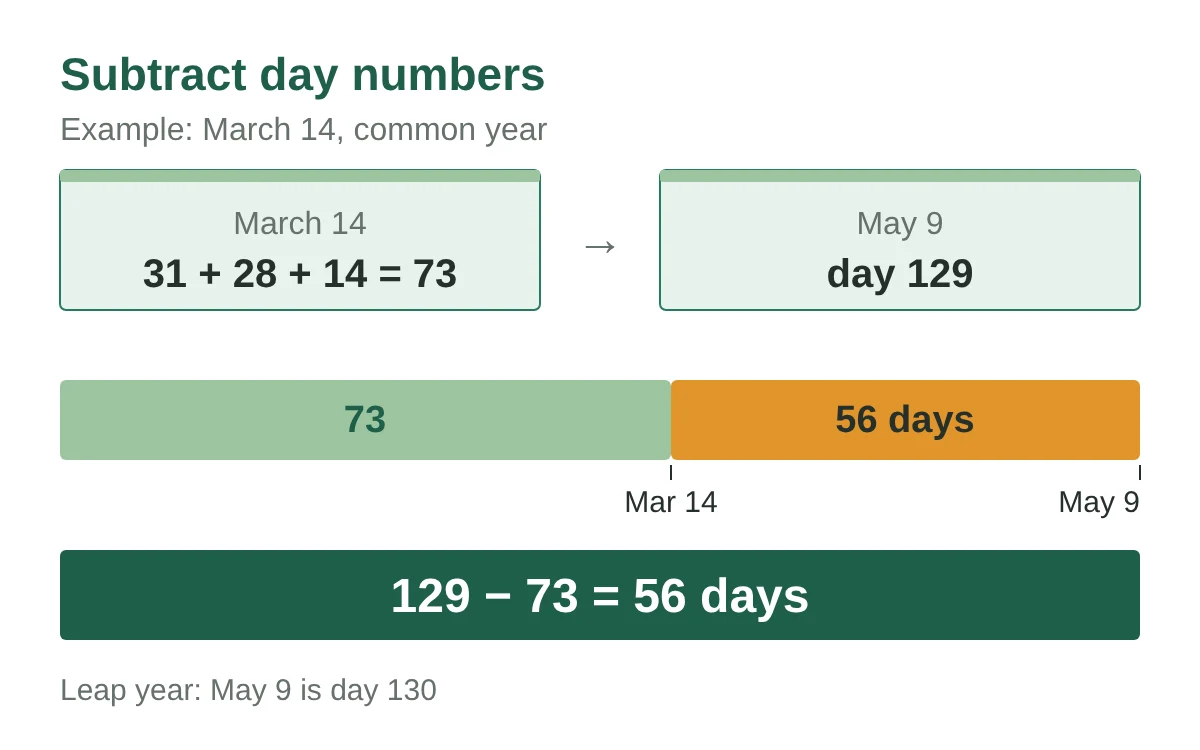
Skip the month-by-month addition. Convert both dates to day-of-year numbers and subtract. May 9 is 129 in a common year (130 in a leap year). Your start date is the days in all earlier months plus its day of the month. The difference is your answer.
The one trap is the leap day. If February 29 falls between your start date and May 9, the count is one higher than a common-year table would suggest. If you start in March or later, a leap year makes no difference to this particular count, because both dates sit after February.
Month lengths are easier to remember with the knuckle method: knuckles are 31-day months, the gaps between them are the shorter ones. For this target you only need January to April: 31, 28 (or 29), 31, 30.
A worked example you can copy
Take a hypothetical start date of March 14 in a common year. March 14 is day 31 + 28 + 14 = 73. May 9 is day 129. The gap is 56 days.
Check it the long way: 17 days left in March, 30 in April, 9 in May. That is 17 + 30 + 9 = 56. Both routes agree, and 56 happens to be exactly eight weeks, so May 9 would land on the same weekday as March 14.
Try this: Pick any date three to four months away and count it both ways, by day-of-year subtraction and by adding the leftover month pieces. If the two answers differ, you almost certainly miscounted a month length. Then compare with the date calculator.
Why the count changes at midnight, not at noon
A countdown to a calendar date ends at 00:00 on May 9 in a specific time zone. That is why a day count can look “off by one” if you compare with a friend in another region, or with a page that uses a server clock instead of yours. When it is still May 8 where you are, the whole-day count has not yet reached zero, even if it is already May 9 somewhere else.
If you are counting to an event rather than the date itself, say a 6 pm dinner, the date alone is the wrong target. Count to the date, then add the hours with a time-of-day countdown.
Counting weeks and weekdays
Divide the day count by 7. The quotient is full weeks and the remainder is loose days. For a quick sanity check, a result of 56 days (as in the example) gives 8 weeks and 0 days, which is a tidy planning unit if you are working in blocks. For other whole-week spans, 8 weeks in days gives the conversion.
Weekdays need one more step: multiply the full weeks by 5, then check each leftover day to see whether it falls on a weekend. The eight-week example gives exactly 40 weekdays before any public holidays are removed. Remember that the last day of the span is May 9 itself, so decide in advance whether it counts as a working day.
Try this: Write down the weekday of your start date and the weekday of May 9. If they match, the gap is an exact multiple of 7 and the weekday count is just weeks times 5. If they differ, the number of steps between them is your remainder.
The weekday May 9 lands on
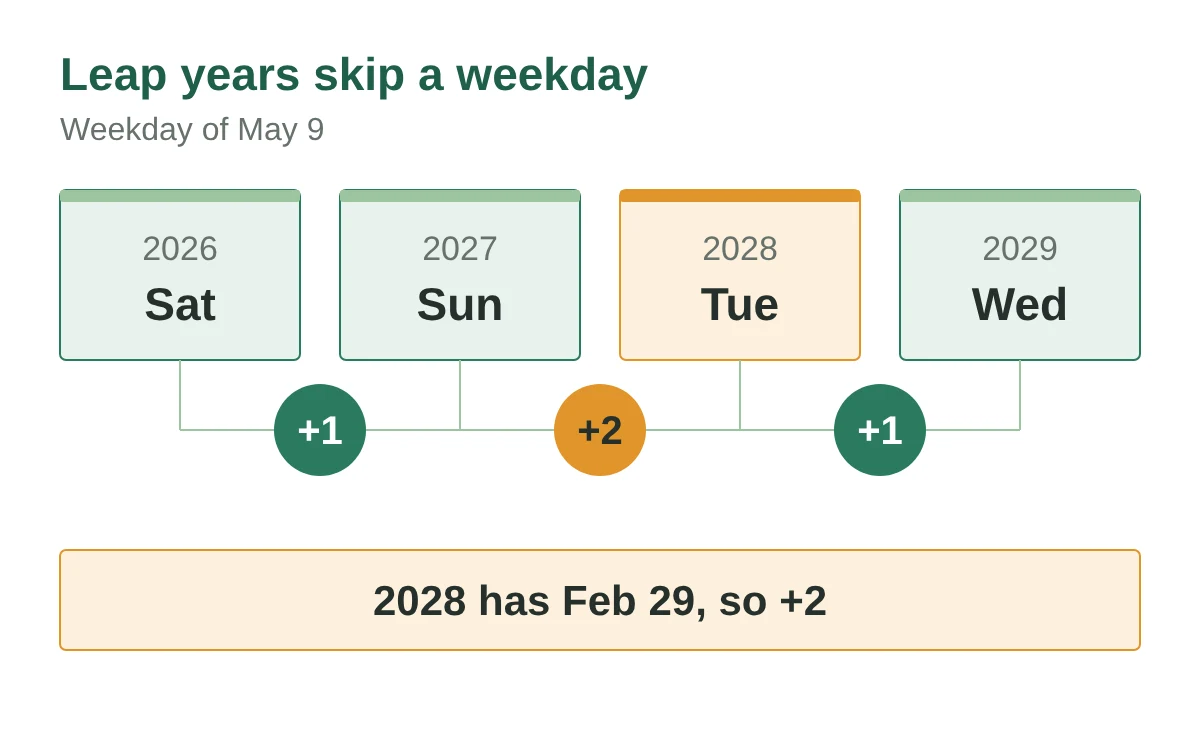
May 9 moves forward one weekday each year, and two weekdays when the following February has a leap day in the way. That is why it jumped from Sunday in 2027 to Tuesday in 2028. Over a full 28-year cycle the pattern repeats in the Gregorian calendar, apart from century years that are not leap years.
This matters for planning. Whether May 9 is a workday, a weekend or the lead-up to a long weekend changes how you should read the same day count. A count of 100 days sounds identical every year, but the number of working days inside it is not.
What May 9 is known for
In the European Union, May 9 is Europe Day, also called Schuman Day, commemorating the creation of the EU’s forerunner. The May 9 date was introduced in 1985 by the European Communities. It is a public holiday in only a few countries, such as Kosovo and Luxembourg, but EU institutions hold open days around it.
Across much of the former Soviet region, May 9 is Victory Day. The date differs from the May 8 observed by most other European countries because the Soviet government announced the victory early on 9 May, after the signing ceremony in Berlin. It is a national public holiday in places such as Russia, Belarus, Armenia, Azerbaijan and Kazakhstan. Ukraine changed course: in May 2023 its parliament made May 8 the public holiday and cancelled the May 9 one. Moldova is a notable edge case, where which day is marked depends on political allegiance.
Jersey and Guernsey also mark Liberation Day on May 9. In the United States, Mother’s Day falls on the second Sunday of May, so it lands on May 9 only in years when May 9 is a Sunday (2027 is one).
Why 5/9 can mean the wrong date
Written as 5/9, the date reads as May 9 in the United States and as September 5 in most other countries. This is the most common reason people get a wildly wrong day count from a form, spreadsheet or shared calendar invite. Spell the month out, or use the year-first format (2027-05-09), which no region misreads.
If you are mixing sources, check whether a spreadsheet has silently turned your entry into a different date. A count that is off by months, not days, is the giveaway.
Planning around the countdown
Treat May 9 as a fixed anchor and work backwards in whole weeks. Many people find it easier to set checkpoints at a set number of days out, such as 90 days from now for the first milestone, rather than tracking one big number.
If your plan really centres on a nearby date, compare it with neighbouring countdowns: May 7 for a weekend before, or May 12 for a few days after. For a longer horizon, months until May gives a coarser view that suits big goals, and the all date countdowns hub covers every other target.
Frequently asked questions
What day of the week is May 9?
It changes every year. The weekday moves forward by one each year, or by two when a February 29 sits between one May 9 and the next. The live widget above shows the weekday for the next occurrence.
Is May 9 the 129th day of the year?
In a common year, yes: 31 + 28 + 31 + 30 days make 120, plus 9. In a leap year it is day 130, because February has 29 days.
Does the countdown include May 9 itself?
No. The count ends at the first moment of May 9 in your time zone, so May 9 is the target, not a day you wait through. If you want to count May 9 as a full day on the calendar, add one.
Is May 9 a public holiday?
Not in most places. It is a public holiday in several former Soviet states as Victory Day, and in a few countries as Europe Day. In the United States it is only a holiday-adjacent date, since Mother's Day lands on it in some years.