
How Many Days Until May 10, 2027?
Calendar
Countdown chart
The live widget above gives the exact answer for your device, down to the second, using your own clock and time zone. May 10, 2027 is a Monday, the 130th day of a 365-day year, and the first day of ISO week 19. Those fixed facts are the base for every shortcut below.
This page does not print a day total, because it would be wrong by tomorrow. It covers what the widget cannot: why two countdowns to the same date can disagree, how to check the number yourself, and how a Monday target changes weekday and week counts.
Why other counts disagree
Search for this date on several sites on the same day and you will often see totals that differ by one. Three causes account for almost all of it. The first is the time zone: a countdown to “May 10” targets midnight at the start of the day, and that instant arrives hours earlier in Berlin than in Los Angeles. The second is whether the target day itself is counted. The third is a stale snapshot, where a page was generated earlier and never refreshed.
The widget above avoids all three by reading your device clock and aiming at local midnight, the start of May 10. If you want the count to include May 10 itself, for example when you are counting days of a project that ends on that date, add one to the figure.
Count it by hand in ten seconds
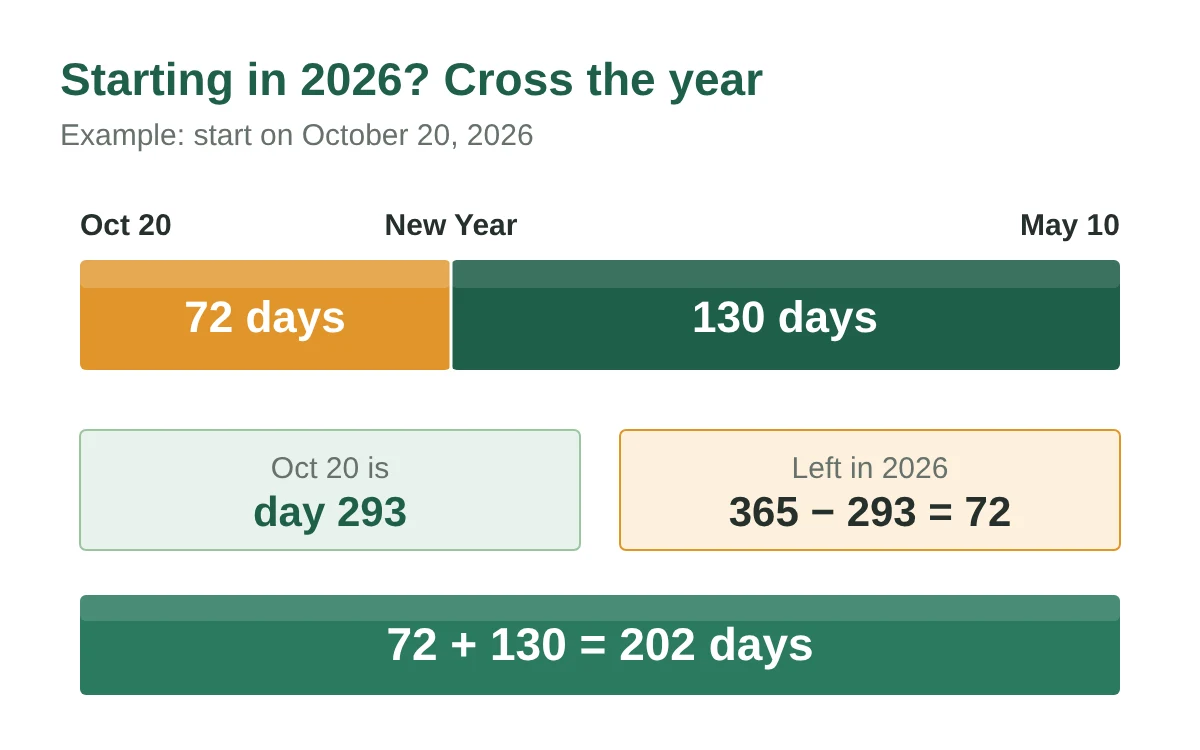
Every date in a non-leap year has a day number, and May 10 is number 130 (31 + 28 + 31 + 30 for January to April, plus 10). To find the gap, subtract the start day’s number from 130. If your start date is in 2026, the year boundary adds a step: take 365 minus the start’s day number, then add 130.
A worked example with a hypothetical start of October 20, 2026. Months January to September total 273 days, so October 20 is day 293. Then 365 minus 293 is 72 days left in 2026, and 72 plus 130 gives 202 days. A check by direct counting agrees: 11 days to the end of October, 30 for November, 31 for December, which is 72, then 130 more.
Try this: Pick any date you like, work out its day number, and apply the 365 minus start, plus 130 rule. Then compare your result with the date calculator to confirm you landed on the same figure.
The Doomsday shortcut for the weekday
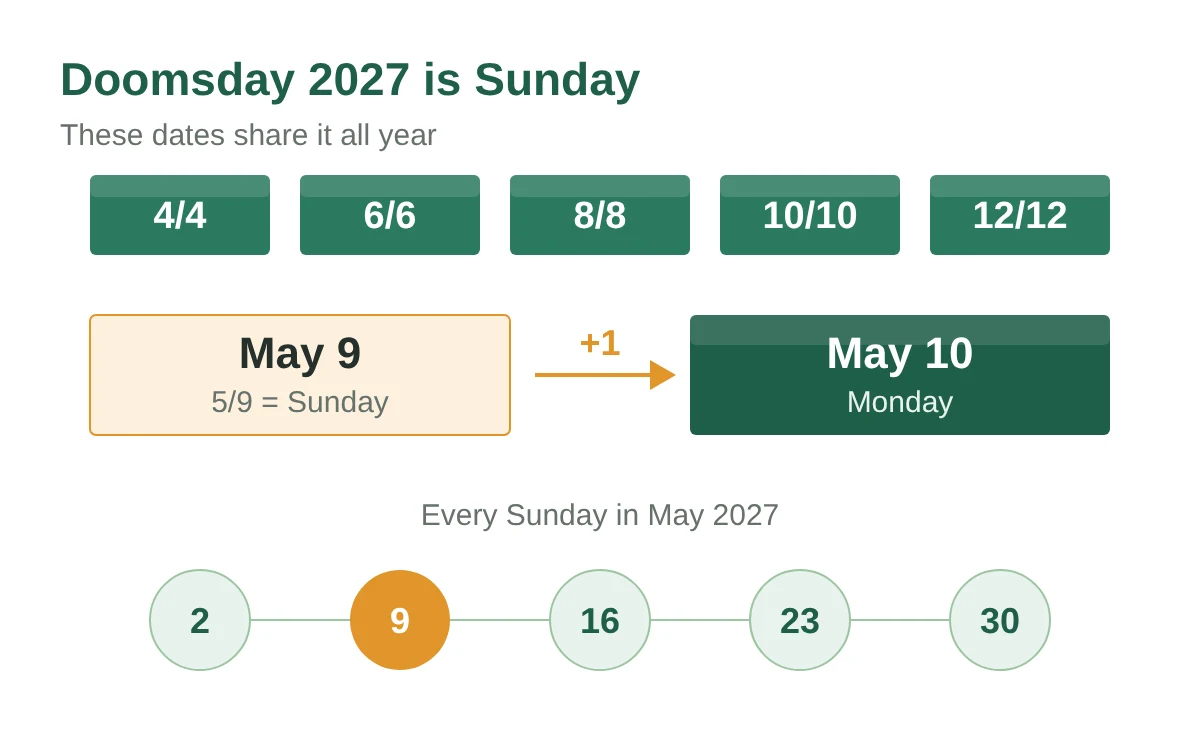
You can name the weekday of May 10, 2027 in your head. In the Doomsday method, certain easy dates share a weekday all year, including 4/4, 6/6, 8/8, 10/10 and 12/12, plus 5/9 and 9/5 (remember “9 to 5 at 7-11”). In 2027 the doomsday is Sunday, so May 9 is a Sunday and May 10 is a Monday.
The same anchor works for any other date that month: May 2, 9, 16, 23 and 30 are all Sundays in 2027. That is why a neighboring page such as days until May 9 lands on a Sunday while days until May 11 lands on a Tuesday.
Weeks, and the remainder that surprises people
A count of days divides cleanly into weeks only when the start date is also a Monday. Every other start leaves a remainder, and that remainder tells you the start weekday. If the widget shows a number that is a multiple of 7, today is a Monday. If it is one more than a multiple of 7, today is a Sunday, and so on backwards through the week.
Calendar weeks and elapsed weeks also differ. ISO week 19 starts on May 10, 2027, exactly 18 weeks after ISO week 1 begins on Monday, January 4, 2027. So “week 19” and “18 weeks since the year’s first Monday” describe the same moment. For converting a day total into weeks yourself, 8 weeks to days shows the multiplication in the other direction.
Business days to a Monday
A Monday target has a neat property. The Monday itself is a working day that has not been worked yet, so counting weekdays up to it does not include it. Between two Mondays the weekday count is exactly 5 times the number of weeks. From a start that is mid-week, count the weekdays left in that week, then add 5 for each full week.
Public holidays then come off that figure, and they differ by country. In the United States, Memorial Day falls later, on May 31, 2027, so it does not affect a count that ends on May 10. In the UK, the early May bank holiday is Monday, May 3, 2027, exactly one week earlier, and that one does reduce a working-day count.
Try this: Take a start date that is a Monday, multiply the full weeks to May 10 by 5, and see how it compares with a weekday-only result in the date calculator. If you got the holiday adjustment right, the two will match.
What sits around May 10, 2027
The day before is Mother’s Day in the United States and several other countries, since it falls on the second Sunday of May, which in 2027 is May 9. So May 10 is the Monday after a major family weekend, which matters for travel returns, deliveries and school or office scheduling. Western churches celebrate Ascension Day on Thursday, May 6, 2027, 40 days after Easter on March 28.
If your event is on the surrounding days, the related counts shift by a fixed amount: one day earlier or later changes the figure by exactly one. Pages such as May 8, 2027 and May 22, 2027 show the neighboring totals for the same year.
Counting in months without being fooled
“How many months until May 10” has no single answer in days, because months run 28 to 31 days. Whole calendar months are counted by matching day numbers: from the 10th of one month to the 10th of another is a whole number of months, whatever the day total. The leftover days after the last whole month are what the widget’s breakdown would show.
A common mistake is dividing days by 30 and trusting the result. Over several months that drifts by days, because the real average is about 30.44. For rough planning it is fine, for deadlines it is not. A question that is purely about the month itself is covered in how many months until May.
Time of day and the last 24 hours
Because the target is midnight at the start of May 10, the widget reaches zero the moment the Monday begins, not at the end of Sunday evening. If your event happens at a clock time during May 10, such as a 9 AM meeting, the real remaining time is longer than the widget shows by that many hours.
Daylight saving can also shift the true hours. In most of North America, clocks have already moved forward in March 2027, so a count that spans that change contains one 23-hour day. Day totals are unaffected, but an hours or minutes total will be an hour smaller than 24 times the days. For more of these, see the full list of days until countdowns.
Frequently asked questions
Why do different countdowns to May 10, 2027 show different numbers?
Usually the gap is one day, caused by time zones, by whether May 10 itself is counted, or by a page that was generated earlier and never refreshed. A countdown aimed at midnight at the start of May 10 reaches that moment earlier in Berlin than in Los Angeles. If a project should include May 10 as a day, add one to the figure.
What day of the week is May 10, 2027?
May 10, 2027 is a Monday. It is day 130 of a 365-day year and the first day of ISO week 19. The Doomsday method confirms it: 5/9 falls on the 2027 doomsday, a Sunday, so the next day is Monday.
How can I calculate the days until May 10, 2027 by hand?
Number the days of the year, where May 10 is day 130 because 2027 is not a leap year. For a start date in 2026, subtract the start's day number from 365, then add 130. For example, October 20, 2026 is day 293, so 365 minus 293 is 72, and 72 plus 130 gives 202 days.
Do public holidays change a business-day count to May 10, 2027?
It depends on the country. The UK early May bank holiday falls on Monday, May 3, 2027, so it removes one working day from a count that ends on May 10. US Memorial Day is May 31, 2027, which is after the target and has no effect.