
How Many Days Until May 5th?
Calendar
Countdown chart
The exact number of days until May 5 is shown in the live countdown above, calculated from your own clock and time zone. It always aims at the next May 5, and on the day itself it reads zero before switching to the following year.
If you want to check the widget, or work the answer out without a screen, the sections below cover a shortcut that takes about ten seconds, the traps that make two countdowns disagree by a day, and a few facts about the date itself.
Why two countdowns can disagree by a day
Most mismatches come from one choice: whether today is counted. Some tools count the gap between two calendar dates, so today to tomorrow is one day. Others count every date from today through the target, which adds one. A third group counts down to the start of May 5 (midnight), which means the final day shows 0 days and some hours.
The live widget counts to the first moment of May 5 in your time zone. That is the same logic as a rocket launch clock: the number reaches zero when the day begins, not when it ends. If you are planning something that happens during May 5, the day itself is your last day of preparation, so subtract one from any count that includes it.
The day-of-year shortcut
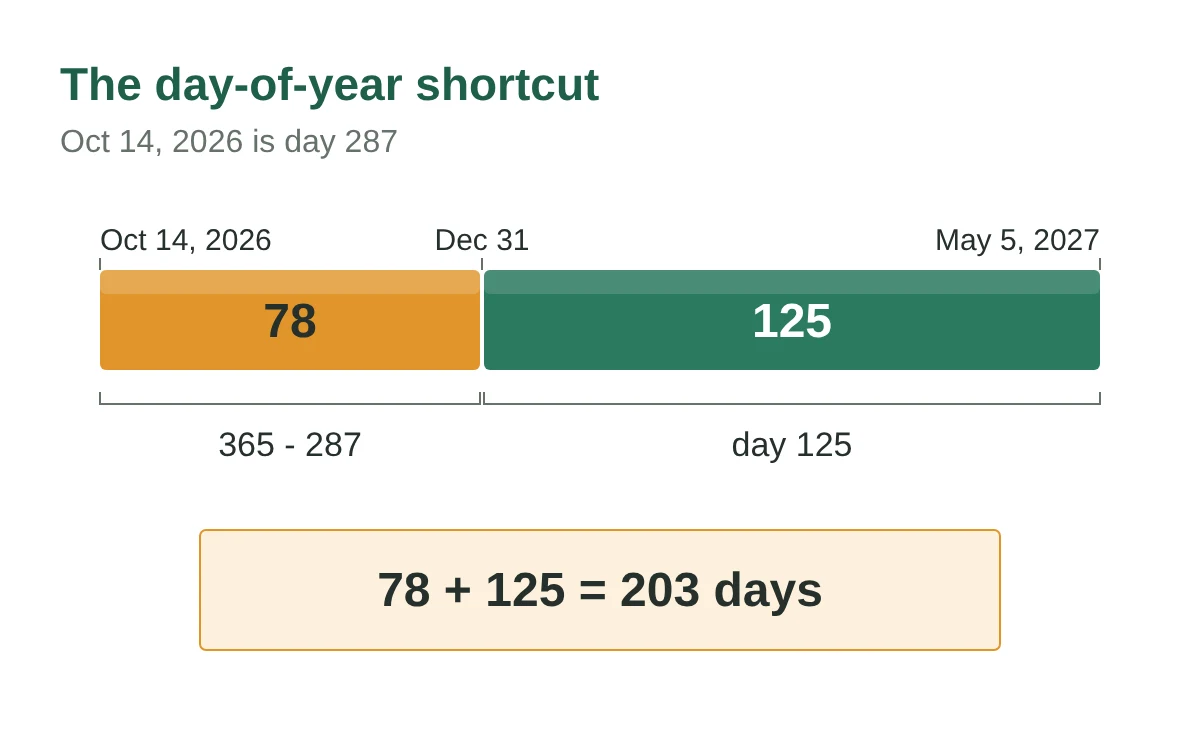
May 5 is the 125th day of a common year (126th in a leap year). That single number replaces the usual month-by-month addition. For any start date in the same year, the answer is 125 minus the start date’s day-of-year number.
When you start in an earlier year, add the days left in the start year. The formula is: (365 minus the start day number) plus 125.
Worked example with a hypothetical start of October 14, 2026. October 14 is day 287 (31, 59, 90, 120, 151, 181, 212, 243, 273 are the month-end totals through September, plus 14). That leaves 365 minus 287, or 78 days in 2026. Add 125 and the gap is 203 days. For arbitrary dates and cross-checks, the date calculator does the same arithmetic for any pair of dates.
Try this: Pick a random date in your head and compute its day-of-year number using month-end totals (31, 59, 90, 120, 151). Then subtract it from 125, or from 365 and add 125. Check the result against the widget.
The leap year trap
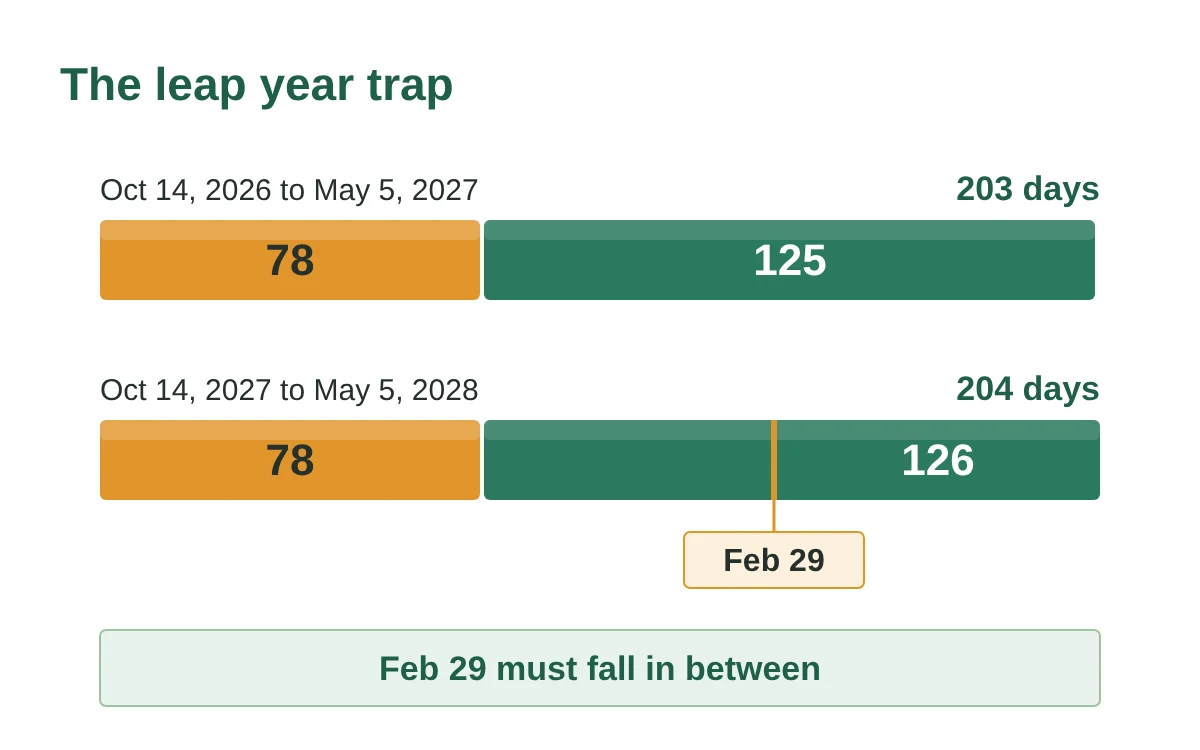
The 125 becomes 126 only if February 29 falls before May 5 in the target year. So the correction applies when the target is a leap year, not when the start year is one. Counting from October 14, 2027 to May 5, 2028 gives 78 plus 126, which is 204 days.
The mistake runs both ways. A start date in a leap year such as 2028 (say, October 14, 2028) heading to May 5, 2029 uses 366 minus the start day number, because that year’s leap day is already behind you only if the start is after February. Leap days matter only when they sit between the two dates, and for May 5 that means February 29 of the target year, or of the start year when the start is in January or February.
Counting weekdays and weeks
Divide the day count by 7. The quotient is full weeks and the remainder is the weekday shift. In the hypothetical example, 203 divided by 7 is exactly 29, so May 5, 2027 falls on the same weekday as October 14, 2026 (a Wednesday). A remainder of 2 would put the target two weekdays later than the start.
Weekdays follow from the same split. Every full week holds exactly five weekdays no matter where it starts, so 29 weeks is 145 weekdays. Only the leftover days need checking one by one. Public holidays come off afterwards, and they vary by country. If you only need the month gap, how many months until May covers the calendar-month view, which is a different measure from 30-day blocks.
Hours, minutes and the daylight saving catch
Converting days to hours by multiplying by 24 is exact only if no clock change sits in between. In regions that move clocks forward in spring, a countdown that crosses that change has one fewer hour than days times 24. A countdown crossing the autumn change has one extra. Since May 5 is after the spring change in the northern hemisphere, a countdown started in winter loses an hour on the way.
The target also moves with location. Midnight starting May 5 in Tokyo arrives many hours before it does in Mexico City, so a countdown to an overseas event should be set to that event’s zone. For the final stretch, how long until midnight shows the hours and minutes remaining in your day.
What May 5 is known for
Cinco de Mayo marks the Mexican army’s 1862 victory over French forces at the Battle of Puebla. It is often mistaken for Mexican Independence Day, which is September 16. In Mexico it is observed mainly in Puebla, while in the United States it has grown into a larger cultural celebration.
In Japan, May 5 is Children’s Day (Kodomo no Hi), a national holiday and the closing day of Golden Week, the string of holidays running from late April. Hotel and travel demand peaks around it, so prices for Japanese trips are worth checking early. In the Netherlands, May 5 is Liberation Day, marking the end of the German occupation in 1945, and the anniversaries ending in 0 and 5 get the biggest national attention. May 4 is the informal Star Wars Day, which makes May 5 the “Revenge of the Fifth” among fans, though neither is an official observance.
Planning backward from May 5
Counting down is more useful when it is turned into checkpoints. Eight weeks out is 56 days (see 8 weeks to days), a sensible point to book venues or travel. The date four weeks out is exactly the same weekday as May 5, which makes it easy to remember for deposits and final headcounts.
Neighbouring dates share most of the arithmetic. May 1 is four days earlier, and May 7 is two days later, so their counts differ from May 5 by a fixed amount. That is handy if you are lining up several dates in the same week.
Try this: Take the date of May 5 in the next year and write down the dates exactly 8, 4 and 1 week before it. Put each in your calendar with one task attached.
Which weekday May 5 lands on
The weekday of May 5 advances by one each year, and by two after a leap year. That is why 2027 is a Wednesday, 2028 a Friday and 2029 a Saturday. A Sunday May 5 in 2030 would push Japan’s Children’s Day observance to the Monday under the substitute holiday rule. The pattern repeats on a 28-year cycle within the same century, so the weekday you see this year will return in 28 years.
Frequently asked questions
How many days until May 5?
The live countdown above the article gives the exact figure on your own clock and time zone. It always targets the next May 5, so once the date passes it rolls over to the following year automatically.
Is May 5 a public holiday?
Not in most countries. It is a public holiday in Japan (Children's Day) and is Liberation Day in the Netherlands. Cinco de Mayo is widely celebrated but is not a federal holiday in Mexico or the United States.
What day of the week is May 5, 2027?
May 5, 2027 is a Wednesday. The weekday of May 5 moves forward one day each year, or two days when a leap day falls in between, so 2028 lands on a Friday.
What number day of the year is May 5?
May 5 is day 125 of a common year and day 126 of a leap year. That number is the fastest way to calculate the gap by hand.