
How Many Days Until May 16th?
Calendar
Countdown chart
The live counter above gives the exact answer for your clock and time zone, down to the second. It always targets the next May 16, and it rolls forward to the following year the moment this year’s date has passed. Everything below explains how to check that number yourself and how to use it.
May 16 is day 136 of the year, or day 137 in a leap year. That single fact is the key to every shortcut on this page.
Count it by hand in 20 seconds
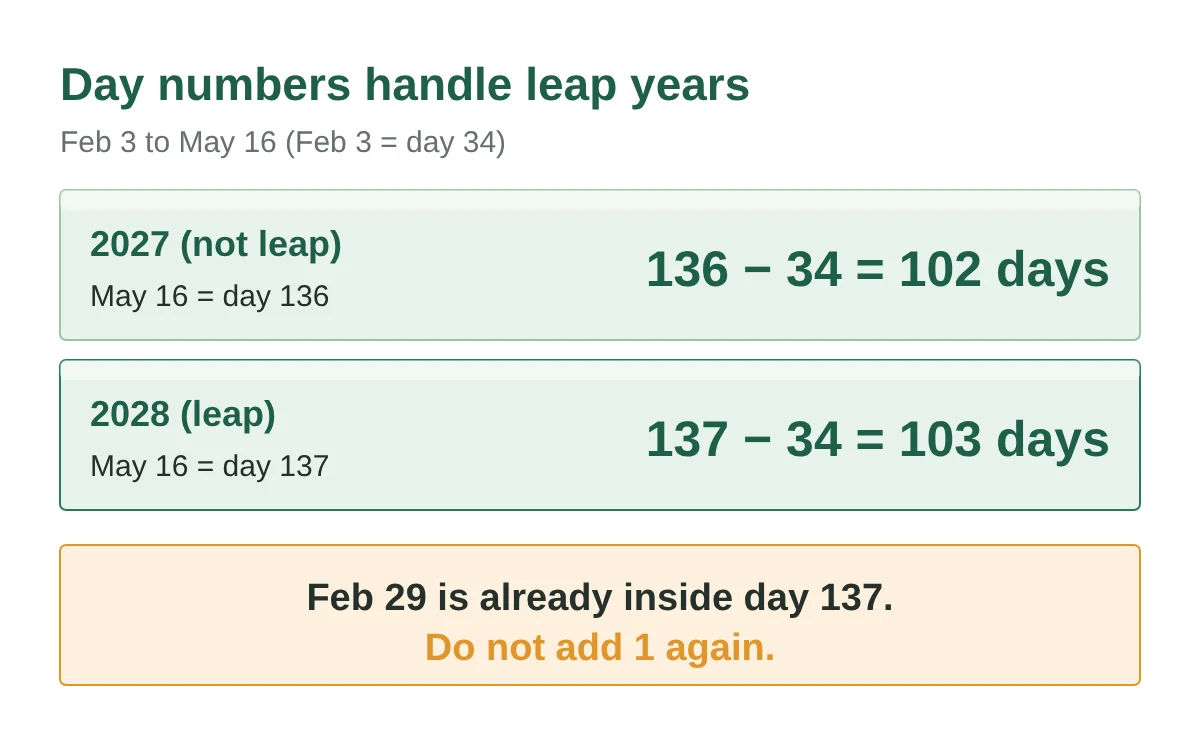
Subtracting day-of-year numbers beats walking month by month. Take a hypothetical start date of February 3 in a non-leap year. February 3 is day 34 (31 January days plus 3). May 16 is day 136. The gap is 136 minus 34, which is 102 days.
The month-by-month method agrees: 25 days left in February, then 31 for March, 30 for April, and 16 into May gives 102. The day-of-year method is faster because you only memorise a few anchors: March 1 is day 60, April 1 is day 91, May 1 is day 121.
The one trap is leap years. If a February 29 sits between your start date and May 16, add one day. In a leap year May 16 is day 137, and anything starting before March 1 needs that extra day.
Try this: Pick any date you like, find its day number from the anchors above, and subtract it from 136. Then check the result against the date calculator at /date-calculator/.
Why two counters can disagree
Counters differ by one day for three reasons. First, some include the starting day and some do not. Second, some count until May 16 begins at midnight, while others count until the end of it. Third, a counter set to UTC and one set to your local zone cross midnight at different moments, so for several hours each day they show different whole numbers.
The live widget uses your own clock and targets the start of May 16 in your time zone. If your event happens on the evening of May 16, the sensible number of days is the widget’s figure plus a fraction, and you can read the remaining hours from the same display. For a sunrise or midnight deadline, how long until midnight works on the same principle.
The hour count that is not 24 times the days
Between now and May, most places in the Northern Hemisphere that observe daylight saving time switch their clocks forward. That makes the real elapsed time one hour shorter than days multiplied by 24. A spreadsheet that multiplies days by 24 will overstate the hours by one in those regions.
The widget handles this because it works from your local clock. If you ever calculate hours manually, subtract one hour when your start date is in winter and your target is in summer time. In places with no clock changes, the simple multiplication holds.
Which weekday May 16 lands on
The weekday moves forward by one each year, or by two after a leap day has passed. So May 16 is a Saturday in 2026, a Sunday in 2027, a Tuesday in 2028 (the jump of two comes from February 29, 2028), a Wednesday in 2029 and a Thursday in 2030.
A Saturday May 16 is rare enough to track. It only repeats after 11 years in this stretch, with the next one in 2037. That matters because some observances are tied to the third Saturday of May, and the third Saturday only equals the 16th when May 16 is itself a Saturday.
What May 16 is known for
May 16 has no federal holiday in the United States and is not a public holiday in most countries. What it does have is a cluster of observances. Armed Forces Day is held on the third Saturday in May, so it lands on May 16 only in years when the date is a Saturday. National Defense Transportation Day, set for the third Friday in May, can fall anywhere from May 15 to May 21, as the date can move from year to year.
Fixed-date observances include the UNESCO International Day of Light, which marks the first laser operation, by Theodore Maiman on May 16, 1960. The UN also marks the International Day of Living Together in Peace on this date. National Biographer’s Day commemorates the first meeting of Samuel Johnson and James Boswell in 1763. The first Academy Awards ceremony took place on May 16, 1929.
In the Northern Hemisphere May 16 falls in spring, a few weeks before the start of meteorological summer on June 1. In the Southern Hemisphere it is late autumn.
Weeks and weekdays to May 16
Divide the day count by 7. The whole number is full weeks, and the remainder is leftover days. The leftover days matter more than people expect, because they decide how many weekdays you get.
Using the hypothetical Wednesday, February 3, 2027 as a start, the gap to May 16 is 102 days, which is 14 weeks and 4 days. Each full week holds exactly 5 weekdays, so 14 weeks gives 70. Then look at the remainder: the days after those 14 weeks run Thursday, Friday, Saturday, then May 16 itself on a Sunday. Only Thursday and Friday count, so the total is 72 weekdays. The start day and May 16 are excluded here.
Public holidays you could subtract: Easter Monday, Victoria Day in Canada and Memorial Day in the US all sit near this date, but check your own country, because they vary by year and place. For a quick comparison, how many weeks until May 21 shows the same calculation for a nearby date.
Try this: Take your starting date and find its weekday. Add the leftover days from your weeks-and-days split to that weekday. If you land on May 16’s weekday, your arithmetic is right.
Planning backwards from May 16
Counting down is more useful when you convert it to milestones. A date exactly 90 days before has its own page at 90 days from now, and the same logic works backwards. Subtract multiples of 7 from May 16 and every milestone lands on the same weekday as the target, which is handy for weekly check-ins.
- 12 weeks out: a good point to book travel or venues.
- 8 weeks out: time to send invitations or lock in deadlines.
- 4 weeks out: confirm the details.
- 1 week out: final checks.
Neighbouring dates have their own pages if your plans are flexible: May 15 and May 17.
Common mistakes to avoid
The most frequent error is mixing up “days until” with “days including”. If a form asks for the number of days “between” two dates, it usually excludes one end. A second error is forgetting February 29 when the range crosses it. A third is trusting a counter that is fixed to another time zone, which can be off by a day for hours at a time.
When it matters, cross-check the widget with the day-of-year method. If both agree, the number is solid.
Frequently asked questions
What day of the year is May 16?
May 16 is day 136 in a regular year and day 137 in a leap year. To find the days remaining, look up your start date's day number and subtract it from 136 (or 137 if February 29 falls in between).
Why do two countdowns to May 16 show different numbers?
The usual causes are whether the starting day is counted, whether the count ends at the start or the end of May 16, and whether the counter uses UTC or your local time zone. A UTC counter and a local one cross midnight at different moments, so they can differ by one for several hours each day.
Does a leap year change the number of days until May 16?
Only if February 29 falls between your start date and May 16. A start date before March 1 in a leap year gets one extra day, while a start date after February 29 is unaffected.
Is Armed Forces Day always on May 16?
No. It is held on the third Saturday of May, which can fall anywhere from May 15 to May 21. It lands on May 16 only when May 16 is a Saturday, as in 2026, and the next time is 2037.