
How Many Days Until May 11th?
Calendar
Countdown chart
The live counter above shows exactly how many days, hours and minutes remain until the next May 11, calculated on your own device clock. Once May 11 passes, it automatically points at the following year, so the page works all year round.
The rest of this page covers what the widget cannot: how to verify the number by hand, why different tools report different weekday totals, and a few quirks that make May 11 a surprisingly tidy date to count toward.
Counting by hand with day numbers
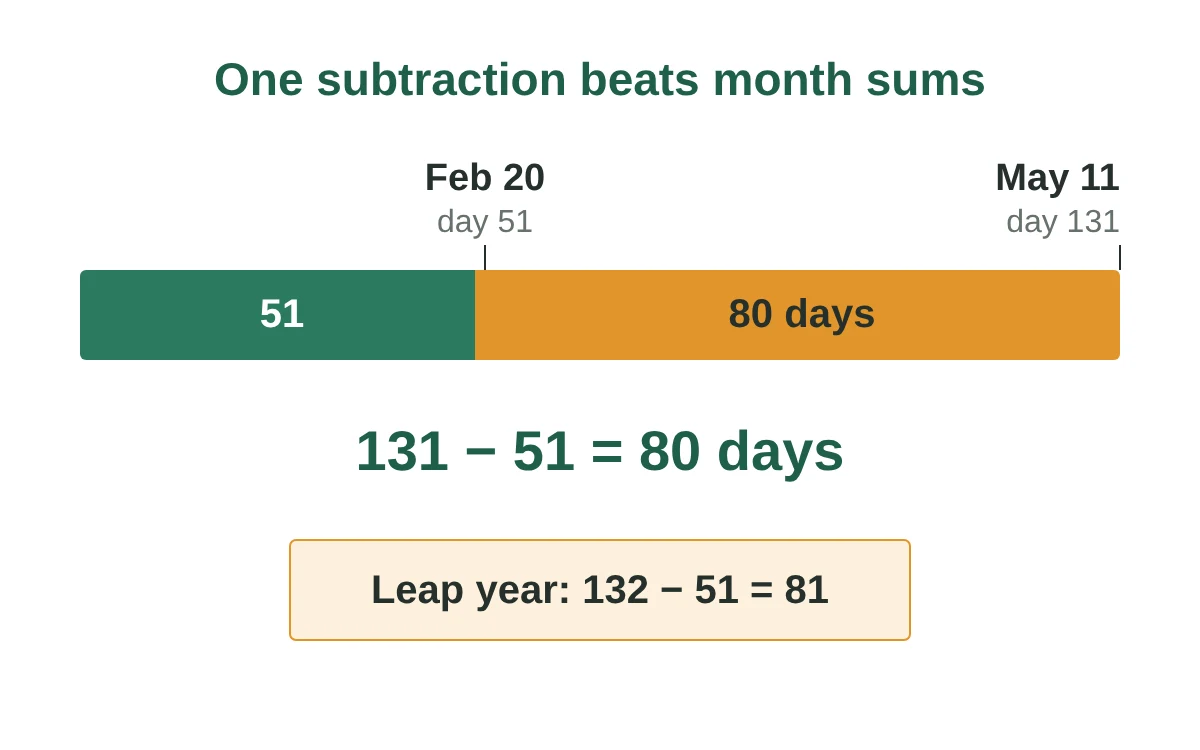
The fastest manual method is the day-of-year number. May 11 is day 131 in a normal year (31 + 28 + 31 + 30 = 120 days before May, plus 11) and day 132 in a leap year. Find the day number of your starting date, then subtract it from 131 or 132. This beats adding up the leftover days of each month, because you only do one subtraction.
Worked example with a hypothetical start of February 20 in a non-leap year. February 20 is day 51 (31 for January plus 20). Then 131 minus 51 gives 80 days. Checking the long way agrees: 8 days left in February, 31 in March, 30 in April and 11 in May also make 80. In a leap year the same start gives 81, because February 29 sits in the way.
Try this: Pick any date in the next month, write down its day-of-year number from memory of month lengths, and subtract it from 131. Then compare your answer with the widget above. Two or three rounds and the month lengths stick.
Weekdays until May 11
If you only care about working days, start from the total and split it into whole weeks. Each full week holds five weekdays, so multiply the full weeks by 5 and then count the weekdays in the leftover days by hand. Using the same hypothetical start of Saturday, February 20, 2027, the 80 days are 11 full weeks (55 weekdays) plus three extra days: Sunday, Monday and Tuesday. That adds 2 weekdays, giving 57 if May 11 counts and 56 if it does not.
Public holidays are the second adjustment. Weekday counts ignore them, so subtract any bank holiday that falls inside your window. In the US that rarely matters before May 11 beyond Memorial Day (which comes later), but in the UK, early May has a bank holiday that can sit just ahead of the date. For a flexible tool that handles start and end dates both ways, the date calculator is built for this.
Why your count can be off by one
Different countdown sites often disagree by a day, and the cause is almost always one of three conventions. The first is whether the target day is included. The second is whether the count is measured from midnight or from the current moment: at 3 PM, there are still hours left of today, and some tools round up while others round down. The third is the time zone the tool assumes, which may be a server’s zone rather than yours.
The widget on this page uses your device clock, so it follows your local midnight. That is usually what you want for personal planning. If you are counting toward a shared event across zones, such as a call or a livestream, agree on one reference zone first.
The leap year quirk
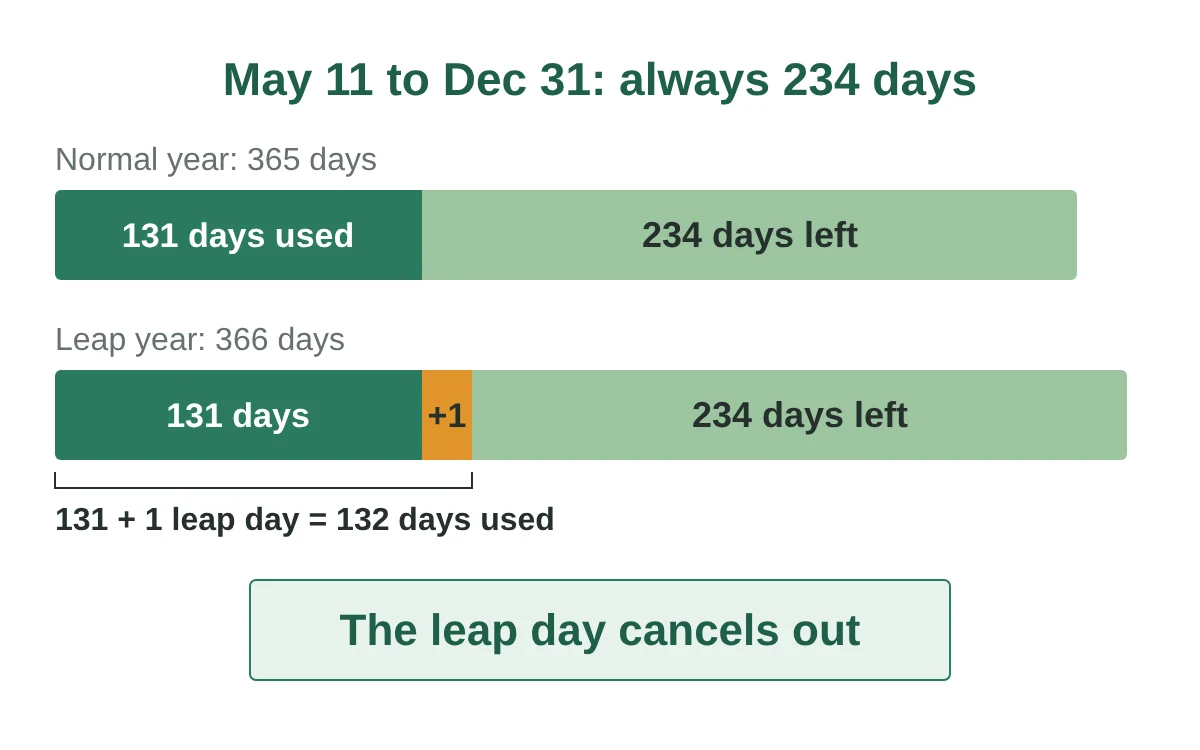
Here is a neat pattern: from May 11 to the end of the year, there are 234 days in both normal and leap years. The leap day sits before May 11, so it pushes May 11 from day 131 to 132 and the year from 365 to 366 days, cancelling out. That means a countdown from May 11 to December 31 never changes length, while a countdown from January 1 to May 11 does.
It also means the gap between the previous May 11 and the next is 365 days unless a February 29 falls between them. A leap day in 2028 makes the gap from May 11, 2027 to May 11, 2028 a full 366 days.
Which weekday May 11 lands on
The weekday shifts forward by one each year and by two when a February 29 has passed since the previous May 11. This gives a repeating, predictable drift:
- 2026: Monday
- 2027: Tuesday
- 2028: Thursday (the skip is the leap day)
- 2029: Friday
- 2030: Saturday
A useful side effect: the week before May 11 holds the same weekday pattern as the weeks before it, so you can tell at a glance whether your countdown ends on a workday. Neighbouring pages help if your plans straddle the date: May 10 and May 12 each have their own live counters.
What May 11 is known for
May 11 is not a federal holiday in the US or a public holiday in most countries, which makes it a clean date for personal events. It does intersect with Mother’s Day in the US, which falls on the second Sunday of May, so it can land between May 8 and May 14. May 11 itself is Mother’s Day only when it is a Sunday, as in 2025 and 2031. If you are counting down to the holiday rather than the date, the May 9 countdown covers a recent year when the holiday fell on that day.
Historically, May 11, 1858 is the date Minnesota became the 32nd US state. Seasonally, May 11 sits in mid-spring in the Northern Hemisphere (mid-autumn in the Southern Hemisphere), after the April 15 US tax deadline and before most school years end, so it often marks the last stretch before exams and graduations.
One notation quirk: written as 5/11, the date reads as May 11 in the US but as 5 November in most of the world. When sharing a deadline internationally, write the month as a word.
Planning around the countdown
Fixed milestones beat a daily tally. Mark 100 days out, then 10 weeks, 30 days and 7 days, and attach one small task to each. Because May 11 is day 131, a reliable rule of thumb is that it arrives about 36 percent of the way through the year in a normal year, which is a useful anchor for annual goals.
For a longer wait, convert the total into weeks and remaining days, since a plan that says “17 weeks and 3 days” is easier to schedule than “122 days”. The months until May page shows the month-level view of the same stretch.
Try this: Take your countdown total, divide by 7, and write the result as whole weeks plus leftover days. Put a task on the calendar for the last whole-week boundary, so you have a fixed checkpoint before May 11.
Daylight saving and hour counts
If you convert days to hours by multiplying by 24, the result can be one hour off. In regions that spring forward in March, a countdown spanning that Sunday is one hour shorter than days times 24, and in regions that fall back it is one hour longer. In 2027, US clocks go forward on March 14 and many European clocks on March 28.
This matters only for hour-level or minute-level planning, such as scheduling a launch or a flight. Day counts between calendar dates are unaffected, because the calendar day count ignores clock changes.
Frequently asked questions
How many days until May 11th?
The live countdown at the top of this page gives the exact figure for your own clock and time zone, always aimed at the next May 11. To check it yourself, subtract today's day-of-year number from 131 (or 132 if May 11 falls in a leap year).
What day of the week is May 11th?
It changes every year. May 11 is a Monday in 2026, a Tuesday in 2027, a Thursday in 2028, a Friday in 2029 and a Saturday in 2030. It moves forward one weekday per year, or two after a leap day.
Is May 11th ever Mother's Day?
Yes, but only in years when May 11 is a Sunday. In the US, Mother's Day is the second Sunday of May, so it can land anywhere from May 8 to May 14. May 11 was Mother's Day in 2025 and will be again in 2031.
Does the countdown include May 11th itself?
A standard day count does not include the target day: it counts the midnights between now and May 11. If you want to count May 11 as a working or event day, add one to the total.