
How Many Days Until May 22, 2027?
Calendar
Countdown chart
The exact answer is in the live countdown above. It reads your device clock and time zone, so it is correct for where you are. May 22, 2027 is a Saturday, which makes it a weekend date: day 142 of a 365-day year, in ISO week 20.
The rest of this page covers what a countdown widget does not show: how to get the number yourself in ten seconds, why two tools can give answers one day apart, and how to turn the count into weeks or working days.
The day-of-year shortcut
Counting month by month is slow and error-prone. A faster method is to convert both dates to a day-of-year. May 22, 2027 is day 142, because 2027 is not a leap year and the months before May add up to 120 days (31 + 28 + 31 + 30), plus 22.
Memorise three anchors: March 1 is day 60, April 1 is day 91, and May 1 is day 121. For any start date in 2027, the answer is 142 minus that date’s day-of-year. For a start date in 2026, add the days left in 2026 (365 minus its day-of-year), then add 142.
Worked example with a hypothetical start date
Take an invented start of January 10, 2027. Its day-of-year is 10, so the gap to May 22 is 142 minus 10, which is 132 days. Check it the long way: 21 days left in January, plus 28 for February, 31 for March, 30 for April and 22 for May gives 132.
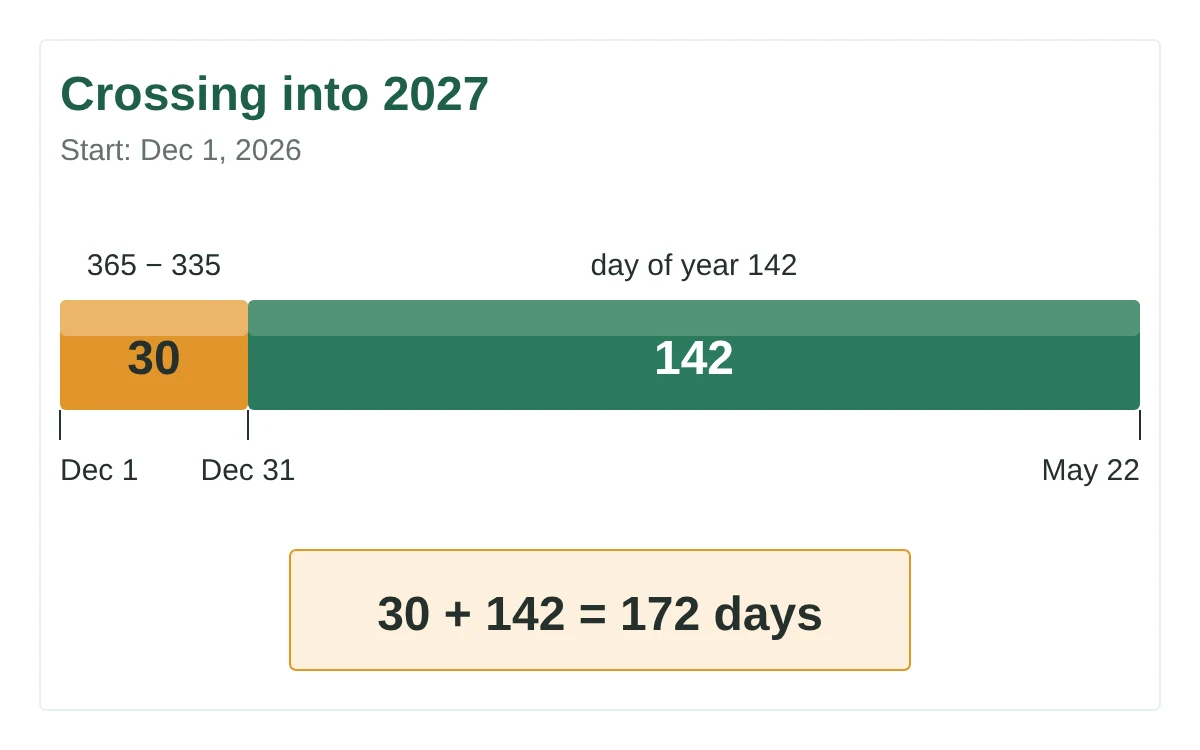
Now a start in 2026, say December 1, 2026. That is day 335 of 2026, so 30 days remain in the year. Add 142 and the gap is 172 days. Use your own date in place of these examples, or the date calculator will do the same sum between any two dates.
Try this: Pick any date in early 2027 and find its day-of-year using the anchors (60, 91, 121). Subtract it from 142, then confirm with the countdown tool. Two or three rounds and you will not need the anchors.
Why two countdowns can disagree by one day
Different tools give different answers for the same date, and the cause is usually one of three things. The first is the end point: a countdown to midnight at the start of May 22 treats the day as not yet begun, while a calendar-day count treats it as the target. The second is the time zone: a clock running in UTC is already on the next date for part of the evening in the Americas. The third is inclusive counting, where both the first and last day are counted, as in “a 5-night stay is 6 calendar days”.
The widget above uses your own clock and counts to the start of the date. If you need a figure for a form, a lease or a deadline, check which convention it expects before you copy a number.
The hour count and daylight saving time
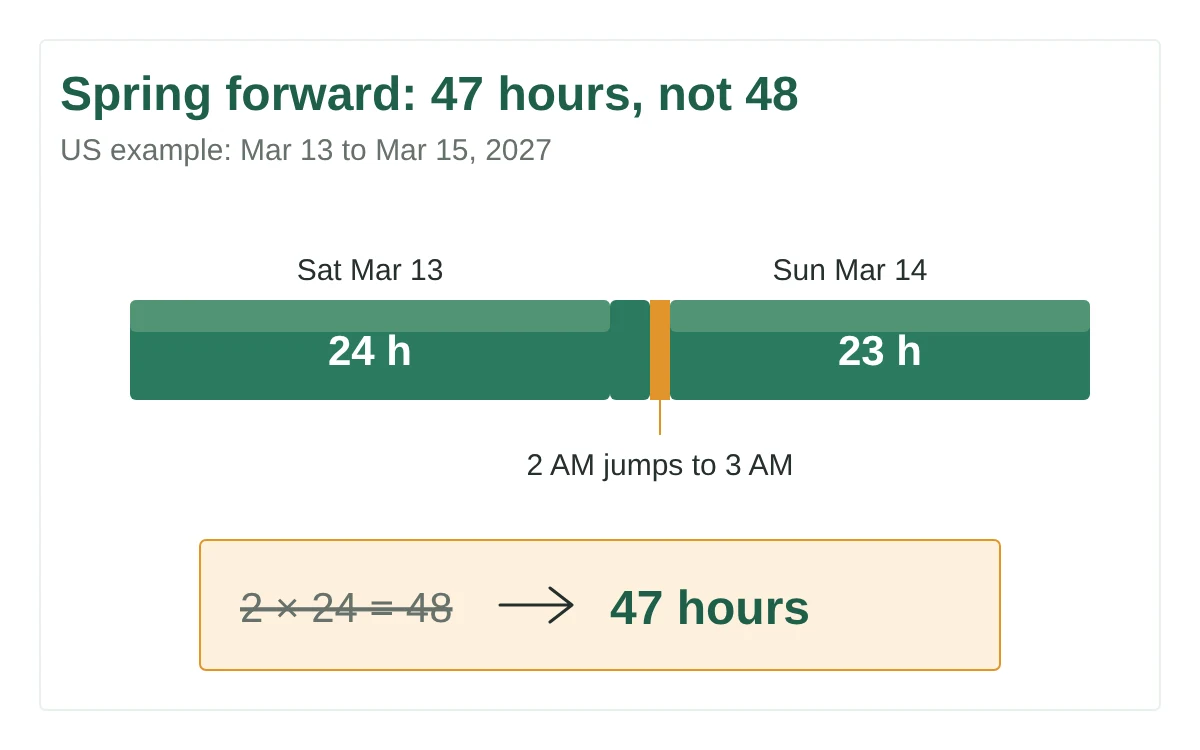
Days are calendar units, but hours are not always 24 per day. The US clocks move forward on March 14, 2027, and most of Europe follows on March 28. Any countdown in hours that spans one of those dates will be exactly one hour shorter than the days multiplied by 24.
This is why a countdown in hours can look “off” by one if you multiply the day count by 24 in your head. The widget handles it for you. Places with no clock changes, such as Arizona or India, see a clean multiple of 24. If you are counting small chunks of time instead, pages such as what is 72 hours from now show the same logic at short range.
Counting weeks and working days
Day 142 is exactly 20 weeks and 2 days after December 31, 2026 (a Thursday), which is why the date lands on a Saturday. That gives a handy trick: a Saturday date is a whole number of weeks away from any other Saturday. If you start counting from a Saturday, divide the day count by 7 and the remainder should be zero.
For working days, count the full weeks between your dates and multiply by 5, then add the weekdays left over in the partial week. Because May 22 is a weekend date, it never counts as a working day itself. Subtract any public holidays that fall on a weekday in your range, since a plain weekday count ignores them. For a weeks view of a neighbouring date, how many weeks until May 21st is a useful cross-check.
Try this: Count the Saturdays between today and May 22, 2027 by dividing the day count by 7 and rounding down. That is how many full weekends you have before the date arrives.
What else is happening around May 22, 2027
The Saturday falls one week before US Memorial Day weekend. Memorial Day is the last Monday of May, which in 2027 is May 31, so the long weekend is May 29 to 31. For anyone planning travel, this is the quiet weekend just before the busy one.
Neighbouring dates have their own pages if you are choosing between options: May 21st is the Friday before, and May 23rd is the Sunday after. A Friday-to-Sunday trip around this date covers all three.
Planning backwards from May 22, 2027
Countdowns work in reverse too. A common method for deadlines is to subtract in blocks of weeks, since weekday alignment is preserved: 12 weeks before a Saturday is another Saturday. Eight weeks is 56 days, which is the sum 8 weeks to days covers, and it puts you on April 24, 2027.
For a project, set milestones at fixed week counts from the target (for example 16, 8 and 4 weeks out) and write the dates once. That is easier than recomputing a changing day count every morning.
Frequently asked questions
What day of the week is May 22, 2027?
May 22, 2027 is a Saturday. It is day 142 of 2027 and falls in ISO week 20.
Is the countdown to the start or the end of May 22?
It runs to midnight at the start of May 22 in your time zone. If your event happens later that day, add the hours between midnight and the event.
Does daylight saving time change the number of days?
No. Calendar days stay the same. Only a count in hours can shift by one when your start date is before a clock change, such as the US spring change on March 14, 2027.
How do I count the days without a calculator?
Subtract the day-of-year of your start date from 142, which is the day-of-year of May 22, 2027. If you start in 2026, add the days left in 2026 to 142.