
How Many Days Until March 14th?
Calendar
Countdown chart
The live counter above gives the exact answer for your own clock and time zone, so there is no need to trust a number typed into a page. This article explains how to check it yourself, where the counts of different sites disagree, and what makes March 14 an unusually loaded date.
March 14 is day 73 of a normal year and day 74 of a leap year. That one fact turns almost any “how many days until” question into a single subtraction.
Counting by hand with the day-of-year shortcut
Every date has a position in the year. March 14 sits at 73 in a common year (31 days of January, 28 of February, plus 14). If your start date is earlier in the same year, the answer is 73 minus your day number. If you start later in the year, take the days remaining in it (365 minus your day number) and add 73.
Here is a worked example with a hypothetical start of December 20. It is day 354, so 365 minus 354 leaves 11 days to the end of the year. Add 73 and the total is 84 days. Counting month by month gives the same result: 11 + 31 (January) + 28 (February) + 14 = 84.
The one catch is February 29. If a leap day sits between your start and March 14, add one. A leap year also pushes March 14 to day 74, which is why the shortcut needs the right constant for the year the target falls in.
Try this: Pick any date at random, work out its day-of-year number from the month lengths, and subtract it from 73. Then enter the same date in the date calculator to confirm you got it right.
Why your count can be off by one
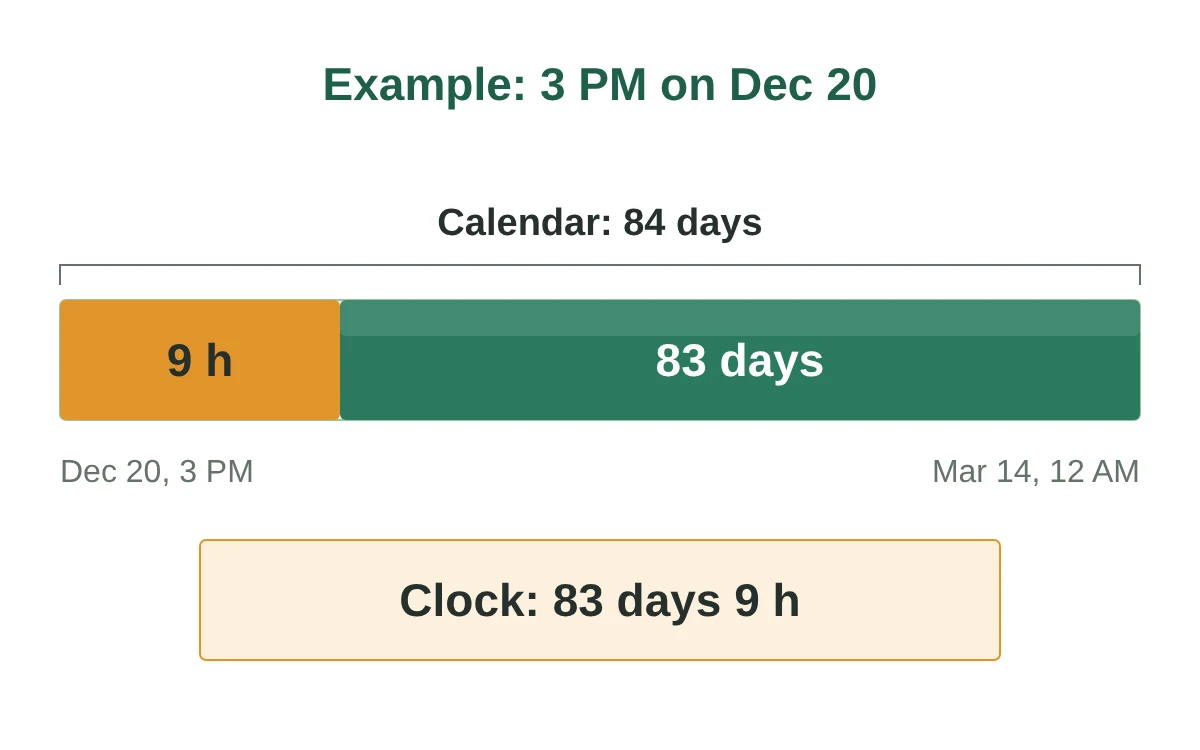
Two correct methods can disagree by a day. A calendar difference counts how many midnights separate two dates. An elapsed-time count measures the clock. At 3 pm on the hypothetical December 20, the calendar difference to March 14 is 84, yet only 83 days and 9 hours remain before March 14 begins.
The live counter above runs to the start of March 14 in your time zone, so it falls to zero at your local midnight. Counting both end dates inclusively adds a day, which is a common error when planning “days available”. Time zones matter too: a reader in Tokyo reaches March 14 many hours before a reader in Los Angeles.
Weeks and weekdays without a calendar
Any 7 consecutive days contain exactly 5 weekdays, whatever the start day. That makes long spans easy. The 84-day example is exactly 12 weeks, so it holds 60 weekdays, with no need to look at a calendar. See what 84 days from now looks like for a longer treatment of that span.
For other lengths, split the total into whole weeks and a remainder. Multiply the weeks by 5, then check only the leftover days against the start weekday. For 90 days, that is 12 weeks (60 weekdays) plus 6 leftover days, which hold 4 or 5 weekdays depending on where they begin. Public holidays are not subtracted in this method, so remove them by hand if you are counting working days.
When March 14 lands on each weekday
The date drifts forward one weekday every year and two after a leap year. March 14, 2027 is a Sunday, 2028 is a Tuesday, 2029 is a Wednesday and 2030 is a Thursday. The 2028 jump of two days comes from the leap day in February 2028.
Weekend years change the practical picture. When March 14 falls on a Sunday, school Pi Day events usually move to the Friday before or the Monday after, and the last full working day before the date is the Friday. The same weekday returns roughly every 28 years within the 1900 to 2099 range, apart from a few century quirks.
The daylight saving trap
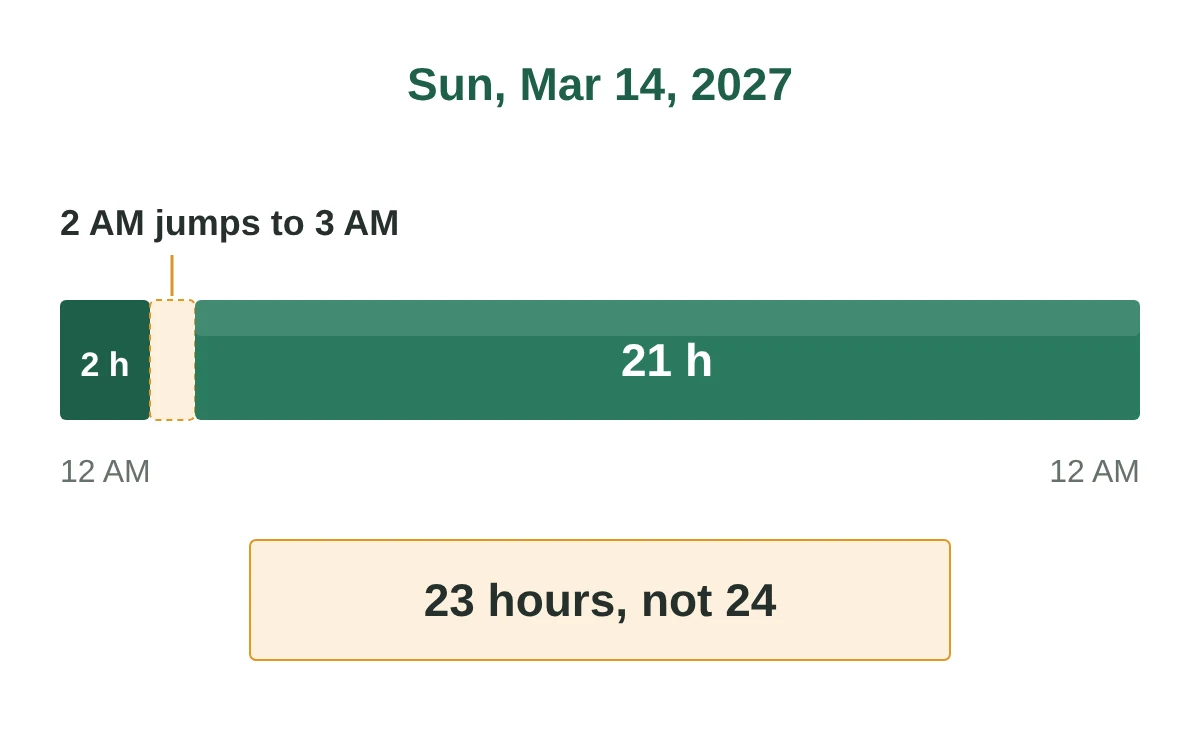
In the United States, clocks go forward on the second Sunday of March. That Sunday can land anywhere from March 8 to March 14, and in 2027 it is March 14 itself, under current US rules. The day is then 23 hours long, because the clock jumps at 2 am.
A countdown to midnight at the start of the day is unaffected, since the change happens afterward. A countdown to 1:59 pm that day, or to the end of the day, is an hour shorter than the plain “days times 24” arithmetic. For hour-level math, run the figures through a time conversion only after checking whether a clock change sits inside your span. Europe changes on the last Sunday of March, so for about two weeks the gap between New York and London drops from 5 hours to 4.
What March 14 is known for
The best-known observance is Pi Day. Physicist Larry Shaw devised it at the Exploratorium in San Francisco in 1988, and the first celebration began at 1:59 pm, following the next digits of pi. Congress recognized March 14, 2009 as National Pi Day. UNESCO proclaimed March 14 the International Day of Mathematics in 2019.
It is also Albert Einstein’s birthday (1879). Shaw’s daughter discovered the coincidence a few years later, and an Einstein celebration was added to the festivities. Stephen Hawking died on March 14, 2018.
In Japan, South Korea and Taiwan, White Day is the occasion when people who received Valentine’s Day chocolates return the gift. It falls exactly one month after February 14. The day before is the Ides of March, which you can count to with the March 15 countdown.
Why Pi Day only works in some date formats
Pi Day depends on the month/day order. Einstein, as a European, would have written his birthday as 14/3. In day/month countries the date has no connection to 3.14, which is why Pi Day is mainly an American tradition. Those countries often use Pi Approximation Day on July 22 (22/7) instead.
The same ambiguity causes real scheduling errors. A form reading 03/14 is clearly March 14, but 03/04 could be either March 4 or April 3. When you share your countdown date with someone abroad, write the month name.
Planning around the countdown
A date this far out is best handled in blocks of weeks. Setting checkpoints from the finish backwards keeps the plan honest:
- 12 weeks out: decide the goal and book anything with a lead time.
- 6 weeks out: confirm dates, travel and guests.
- 1 week out: do the final checks, including a clock-change check for time-sensitive plans.
March 14 also sits about a week before the spring equinox, which usually arrives on March 20 or 21 (see the March 20, 2027 countdown). Daylight is growing fast by then, which suits outdoor plans and spring-themed events. If you want a longer horizon, the days until hub lists countdowns for other dates.
Try this: Take the live day count, divide by 7, and write the whole weeks and leftover days on a sticky note. Then multiply the weeks by 5 to get your weekday total, and add the leftover days that fall Monday to Friday.
Frequently asked questions
How many days until March 14?
The live countdown above shows the exact figure for your own clock and time zone, down to the second. To check it by hand, subtract today's day-of-year number from 73 (or 74 in a leap year), and add the days left in this year if March 14 falls in next year.
What day of the week is March 14?
It changes every year. March 14, 2027 is a Sunday, and the date moves forward one weekday each year, or two after a leap year, so 2028 gives a Tuesday.
Is March 14 a public holiday?
Not in most countries. It is widely observed as Pi Day and International Day of Mathematics, and Andorra marks Constitution Day on it, but offices and schools usually run as normal.
Why is March 14 called Pi Day?
In the month/day format the date reads 3/14, matching the first three digits of pi. Physicist Larry Shaw started the tradition at San Francisco's Exploratorium in 1988.