
How Many Days Until July 19th?
Calendar
Countdown chart
The live counter above gives the exact answer for your clock and time zone, down to the second. It is aimed at the next July 19, which is a Monday in 2027. Once you know how the count is built, you can also check it by hand and work out weekdays and weeks.
A few details decide whether two countdowns agree: where the count starts, whether the target day is included, and whether a clock change falls in between. The sections below cover each one.
Why a countdown to July 19 can disagree with your own count
A countdown aims at the first instant of July 19, which is midnight local time. That is why the day figure reads 0 for the whole of July 18 while hours and minutes still tick down. It also means a person in Auckland reaches July 19 many hours before a person in Los Angeles. If you are comparing with someone in another zone, you are both right.
The other source of disagreement is the start point. A hand count from today’s date to July 19 treats both dates as whole days and ignores the time. The live widget uses the actual moment, so it can show a partial day. To compare the two, use the widget’s whole-day figure and your hand figure at the same hour. For a fixed start and end date with no clock involved, the date calculator gives the plain difference.
Doing the count by hand
The month method is reliable and quick. Take a hypothetical start of March 3, 2027. Count the days left in that month (28), then add full months until July (April 30, May 31, June 30), then add the 19 days of July. That gives 28 + 30 + 31 + 30 + 19 = 138 days.
The common error is counting the start day, or counting July 19 twice. Decide on a rule first. “Days until” should exclude the start day and include the target, which is what the sum above does.
Try this: Pick any start date next spring and do the month method. Then check it with the day-of-year shortcut below. If the two answers differ, you almost certainly counted a month’s last day twice.
The day-of-year shortcut
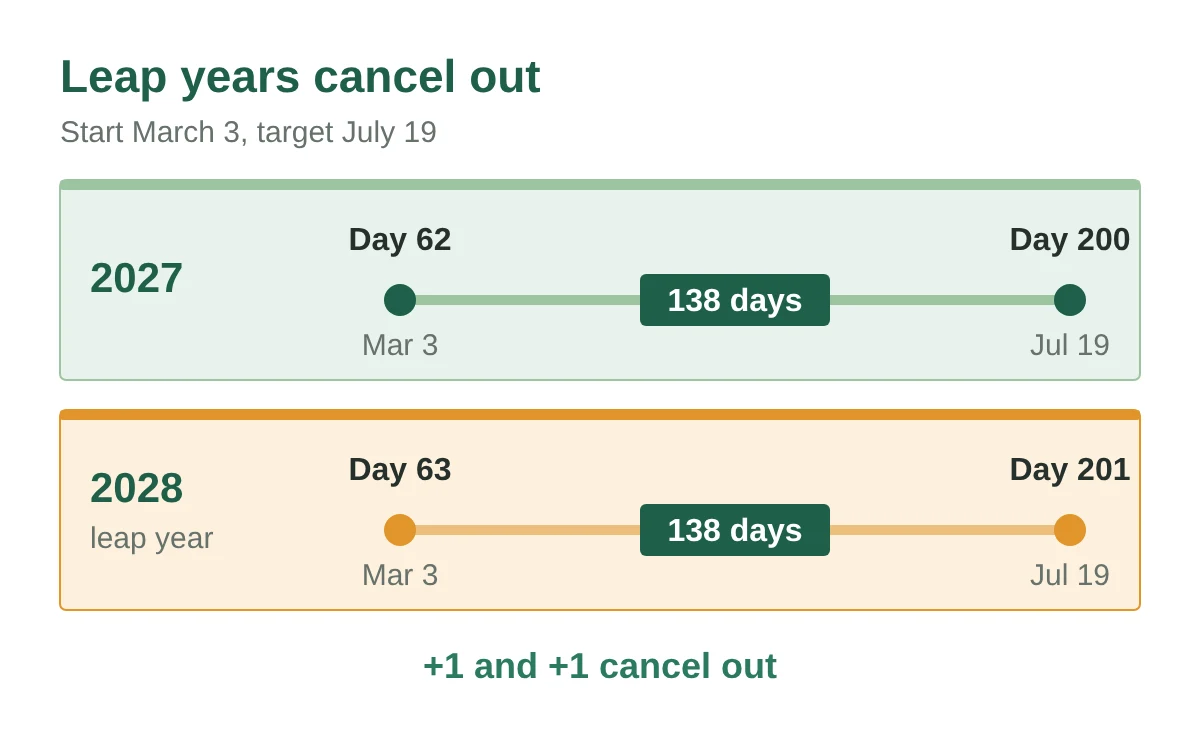
July 19 is the 200th day of the year, or the 201st in leap years. That gives you a one-step method: subtract the day number of your start date from 200. March 3 is day 62 (31 + 28 + 3), and 200 minus 62 is 138, matching the month method.
This works because every month before July is a fixed length. The only trap is a leap year, where any start date after February 28 shifts up by one and the target becomes 201. The two shifts cancel, so for starts after February the subtraction still works without adjusting anything. It only matters when the start is in January or February and the leap day sits between you and July 19.
A side note: the midpoint of a 365-day year is July 2 (day 183). July 19 is about 17 days past it, so it falls just after the year’s halfway mark.
Counting weekdays and weeks to July 19
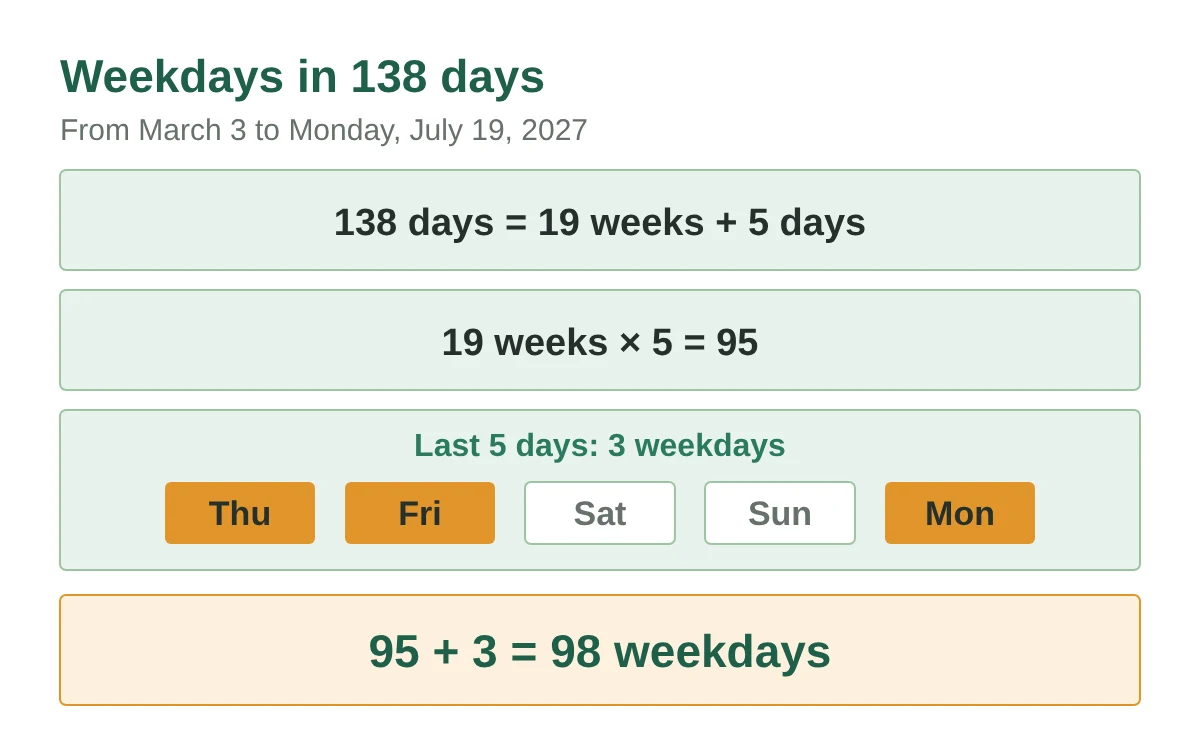
Weeks come from dividing by 7, but the remainder tells you more than the quotient. Take the 138 days from the earlier example: that is 19 weeks and 5 days. Each full week holds exactly 5 weekdays, so 19 weeks give 95. The leftover 5 days are the last five before the target, and they are Thursday to Monday if July 19 is a Monday. Those include 3 weekdays (Thursday, Friday, Monday), so the total is 98 working days.
This is the fastest way to get weekdays without listing them: count the weekdays in the leftover days, working backwards from the target. Public holidays still need subtracting by hand, since they differ by country. If you need to turn week counts into days, 8 weeks is 56 days, and the same multiplication scales to any number of weeks.
Week numbering gives a second label. July 19, 2027 is the 200th day of 2027 and falls in week 29. That matches the ISO week count used by many European calendars and payroll systems.
Which weekday July 19 lands on
The weekday moves forward by one each year, and by two when a February 29 sits in between. The 2027 to 2030 sequence shows it: Monday in 2027, Wednesday in 2028, Thursday in 2029 and Friday in 2030. The jump from Monday to Wednesday is the leap day at work.
You can use this in reverse. If a document or event says “July 19” with no year, the weekday often tells you which year is meant. A Monday points to 2027, and a Wednesday to 2028. The previous July 19 fell on a Sunday in 2026.
What July 19 is known for
July 19 is a national day in two countries. In Myanmar, Martyrs’ Day commemorates eight leaders of the pre-independence interim government who were assassinated in 1947. In Nicaragua, the holiday marks July 19, 1979, when the Sandinista National Liberation Front overthrew the Somoza dictatorship.
In the US, the date carries lighter, unofficial observances, including National Daiquiri Day and Flight Attendant Safety Professionals’ Day. The latter was officially declared in 1990 through a presidential proclamation. National Ice Cream Day is the one that moves. It falls on the third Sunday of July, so it lands on July 19 only some years. In 2027 that Sunday is July 18, the day before. If you are counting to July 19 for an ice cream plan, check the countdown to July 18 as well.
History also marks the date. The first Tour de France ended on July 19, 1903, and the Paris Metro opened on July 19, 1900. July 19 is not a standard school or tax deadline in the US or UK, so any deadline on that date is set locally.
The hours trap with clock changes
A countdown is not always a multiple of 24 hours. In regions that observe daylight saving, a count that begins in winter crosses the spring clock change before July 19 arrives. In the US, clocks go forward on the second Sunday in March, so the hours figure is one less than the days figure times 24.
The same applies the other way if you count back from July 19 into winter. The day figure is always correct, because days follow the calendar. Hours follow the physical clock. If you need an hours figure for a schedule, use the widget instead of multiplying.
Try this: Multiply the day count from the widget by 24 and compare it with the hours figure. A one-hour gap means a clock change sits between now and July 19.
Planning around the countdown
July 19, 2027 is a Monday, which makes the weekend before it a natural three-day buffer for travel or setup. Anything you must have finished “by July 19” is really due the Friday before, unless the Monday itself is a working day for everyone involved.
Useful checkpoints to set against the countdown:
- 100 days out, to lock in bookings and budgets
- 8 weeks out, when most venues and flights stop being flexible
- The final Friday, for a buffer before a Monday target
For near neighbours of this date, there are countdowns to July 4 and August 1, which help when you are laying out a whole summer. For the full list, see the all date countdowns page.
Frequently asked questions
What day of the week is July 19, 2027?
July 19, 2027 is a Monday. In 2028 it moves to Wednesday, because the leap day adds an extra step.
Is July 19 the 200th day of the year?
Yes, in a common year. In a leap year it becomes day 201, because February 29 comes before it.
Why does a countdown to July 19 show zero days on July 18?
A countdown targets midnight at the start of July 19 in your time zone. On July 18 fewer than 24 hours remain, so the day figure reads 0 and the hours and minutes carry the rest.
Is July 19 a public holiday?
Not in most countries. It is Martyrs' Day in Myanmar and Liberation (Sandinista Revolution) Day in Nicaragua. In the US it is a day for informal food and awareness observances.