
How Many Days Until May 23rd?
Calendar
Countdown chart
The live countdown above gives the exact answer for your clock and time zone, down to the second. To check it by hand, subtract the day-of-year of your start date from 143, which is where May 23 sits in a normal year (144 in a leap year).
The next May 23 is a Sunday, in 2027. That matters more than it sounds: it decides how many working days you have, where the long weekend falls, and whether the date is a deadline or a day off.
The day-of-year shortcut
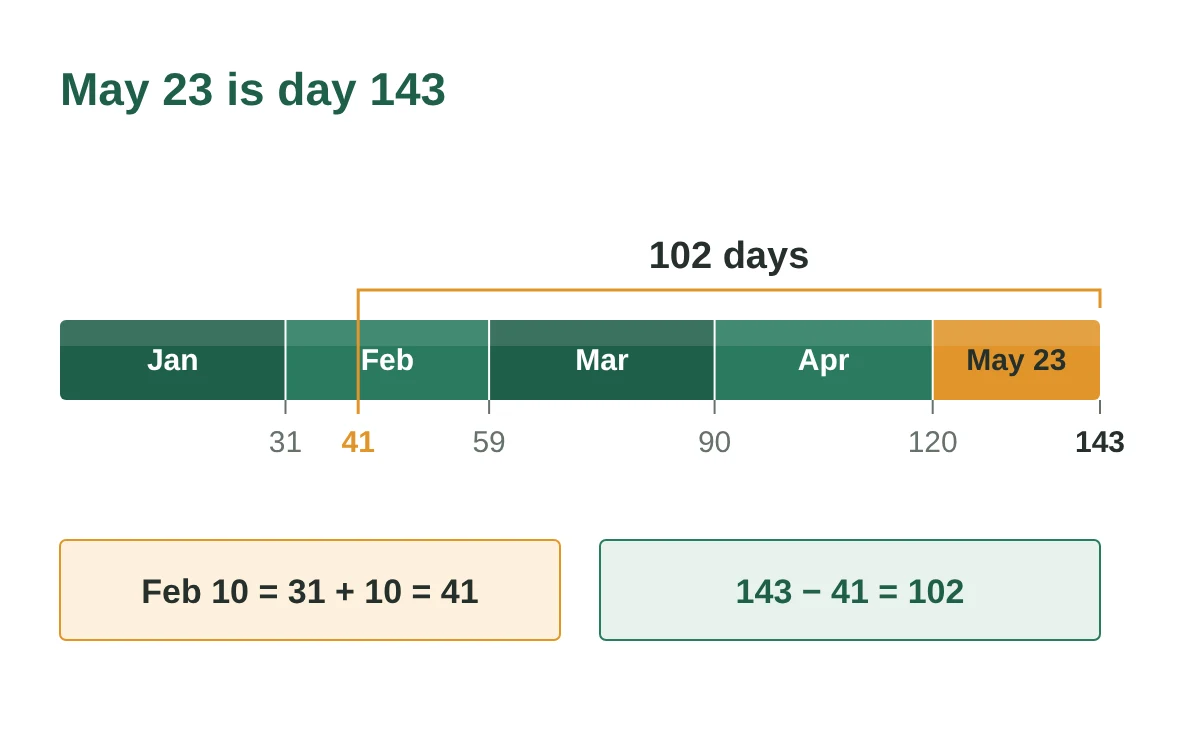
Counting month by month is slow and easy to botch. A faster method: every date has a position in the year, and May 23 is number 143 (January 31, February 28, March 31, April 30, plus 23). Find your start date’s position, then subtract.
You do not need a table. Memorize the running totals at month ends: 31, 59, 90, 120, 151. Your start date’s position is the previous month-end total plus the day of the month. For a start in the same year before May 23, the answer is 143 minus that position, adding one day to the answer for years with a February 29 that falls after your start date.
If you start in a different year, the count is the days left in your start year plus 143 (or 144 in a leap year). Days left in a year is 365 minus the day-of-year, or 366 minus it in a leap year.
A worked example
Take a hypothetical start date of February 10, 2027. Its position is 31 + 10 = 41. Subtract from 143 and you get 102 days until May 23, 2027.
Check it the long way: 18 days remain in February after the 10th (28 minus 10), then 31 for March, 30 for April, and 23 for May. That is 18 + 31 + 30 + 23 = 102. The two methods agree, which is a good habit whenever a date matters.
For spreadsheets, subtracting two date cells gives the same difference. A formula that builds the date from year, month and day, minus the start cell, returns the count. Spreadsheets treat dates as whole day numbers, so they follow the “start day counted, end day not” convention described next.
Which day gets counted
Most countdowns count the start day and stop at the beginning of May 23, so May 23 itself is not included. That is why the result of 143 minus the start position is “days until” and not “days through.” If you want to include May 23 as a day you will be living through, add one.
The edge case is the final day. On May 22 the answer is 1 day, but on May 23 itself it is 0, and a well-built tool then rolls over to the following year. If you search on May 23 and see a count near 365, that is the next occurrence, not a bug.
Try this: Pick today’s date and compute 143 minus its day-of-year in your head, then compare with the widget. If you are off by one, you counted the wrong end of the span.
Time zones and daylight saving
A countdown to a date means a countdown to midnight at the start of that date in your local time. Two people in different time zones can see different day counts for the same moment, and a friend abroad may reach May 23 hours before or after you do. If you are planning around an event in another city, check what time it is in Central Time or the relevant zone first.
There is also an hour trap. A countdown that starts in winter crosses the spring clock change in places that observe daylight saving. Multiplying the days by 24 then overshoots by an hour, because one of those days is only 23 hours long. Skip the multiplication and let the widget count real elapsed time.
What day of the week May 23 falls on
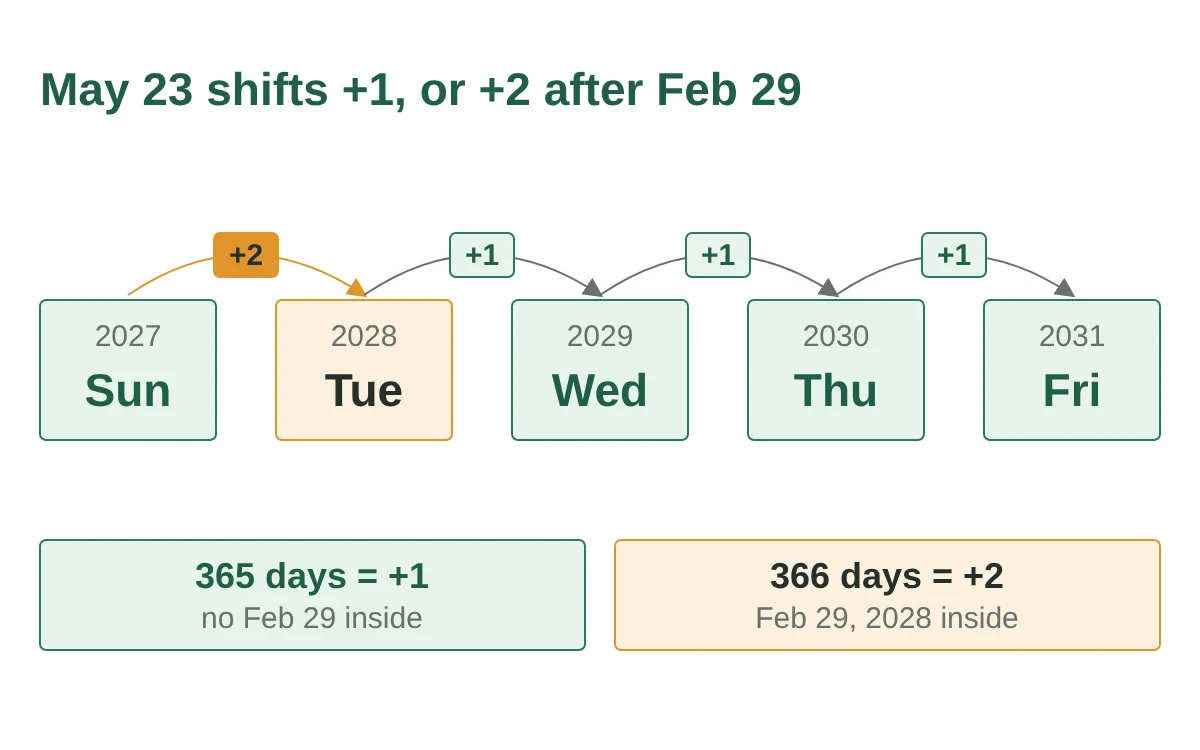
The weekday moves forward by one each year, and by two when a February 29 sits between one May 23 and the next. That gives a clear sequence:
- 2027: Sunday
- 2028: Tuesday (the jump of two comes from the 2028 leap day)
- 2029: Wednesday
- 2030: Thursday
- 2031: Friday
Because 2027 lands on a Sunday, the last working day before it is Friday, May 21. If you need a deadline met by the date, that Friday is the real one. Counting down to May 21 or May 22, 2027 separately is useful for exactly this reason.
Counting weekdays and weeks
Divide the day count by 7. Each full week holds exactly 5 weekdays, so multiply the whole weeks by 5, then count the weekdays in the leftover days by hand. The leftover is at most 6 days, so this takes seconds.
Using the hypothetical February 10, 2027 start (a Wednesday), 102 days is 14 weeks and 4 days. Fourteen weeks give 70 weekdays. The last 4 days run Wednesday to Saturday, adding 3 more, for 73 weekdays before May 23. Public holidays are not subtracted, so reduce the figure if any fall in your window.
Weeks work as a pacing unit too. Splitting a goal into weekly targets avoids the trap of dividing days by 30 for months, which drifts because months run 28 to 31 days. For a clean week count, see how many weeks until May 21 and adjust by two days.
Try this: Write your remaining count as “W weeks and D days,” then set one milestone at each full week mark. Add a spare week before the end as a buffer.
What May 23 is known for
May 23 is World Turtle Day, an annual observance started in 2000 by the American Tortoise Rescue organization to encourage protection of turtles and tortoises. It is not a public holiday anywhere.
In Canada, Victoria Day is the Monday before May 25, so it can fall anywhere from May 18 to May 24. It lands on May 23 itself only when that date is a Monday, as it did in 2022. In 2027, Victoria Day is Monday, May 24, so May 23 is the Sunday in the middle of that long weekend. In the US, Memorial Day is the last Monday of May, which can never be as early as the 23rd; in 2027 it is May 31.
Historically, May 23, 1788 is the day South Carolina ratified the US Constitution, becoming the eighth state. For Christians who follow the Western calendar, May 23, 2027 is also Trinity Sunday, the Sunday after Pentecost. There is no fixed tax or school deadline attached to the date, so check your own institution before assuming one.
Planning around the countdown
Nearby dates make good cross-checks. If you are working toward late May, compare with May 27 or May 29 to see how much room a slip would cost you. For a very specific range, the date calculator returns days between any two dates and handles leap years.
A long weekend in some regions and a Sunday elsewhere makes May 23, 2027 a natural date for outdoor events and trips. Book travel early for the Victoria Day weekend if you are going to Canada, and confirm whether any venue closes on the Monday.
For a quick sense of scale, how many months until May helps when you want a rough picture. For anything with a deadline, trust the exact day count.
Frequently asked questions
How do I calculate the days until May 23 without a calculator?
Subtract the start date's day-of-year from 143, since May 23 is day 143 in a normal year and day 144 in a leap year. Month-end totals of 31, 59, 90 and 120 make it easy to find the start date's position. If the start is in an earlier year, add the days left in that year to 143.
What day of the week is May 23, 2027?
May 23, 2027 is a Sunday, so the last working day before it is Friday, May 21. The weekday then moves to Tuesday in 2028 because the February 29 leap day adds a second step.
Does a days-until-May-23 countdown include May 23 itself?
No. Most countdowns run to midnight at the start of May 23 in your local time zone, so May 22 shows 1 day and May 23 shows 0. Add one if you want to count May 23 as a day you live through.
Is May 23 a public holiday?
May 23 is not a public holiday anywhere, though it is World Turtle Day. In 2027 it falls on the Sunday of Canada's Victoria Day long weekend, because Victoria Day lands on Monday, May 24 that year.