
How Many Days Until July 21st?
Calendar
Countdown chart
The live countdown above shows exactly how many days remain until July 21, based on your own clock and time zone. If this year’s July 21 has already passed, it counts toward next year’s. The rest of this page explains how to verify that number by hand and why two correct-looking answers sometimes differ by a day.
July 21 never moves, so the interesting variables are the weekday it lands on, whether a leap day sits in the way, and exactly when you decide the countdown ends. Each is covered below.
Count it by hand in under a minute
Use a start date that is clearly invented: March 10 in an ordinary (non-leap) year. Count the days left in each month, then add the target day. March has 21 days left after the 10th, April adds 30, May adds 31, June adds 30, and July adds 21. The total is 133 days.
The common mistake is counting the starting day as well, which gives 134. A countdown measures the gaps between midnights, so the first day is not included. Counting “March 10 through July 21” inclusive is a different question, and it is the one people answer by accident.
If you want to skip the arithmetic for any pair of dates, the date calculator returns the gap and also lets you toggle whether the end date is counted.
The day-of-year shortcut
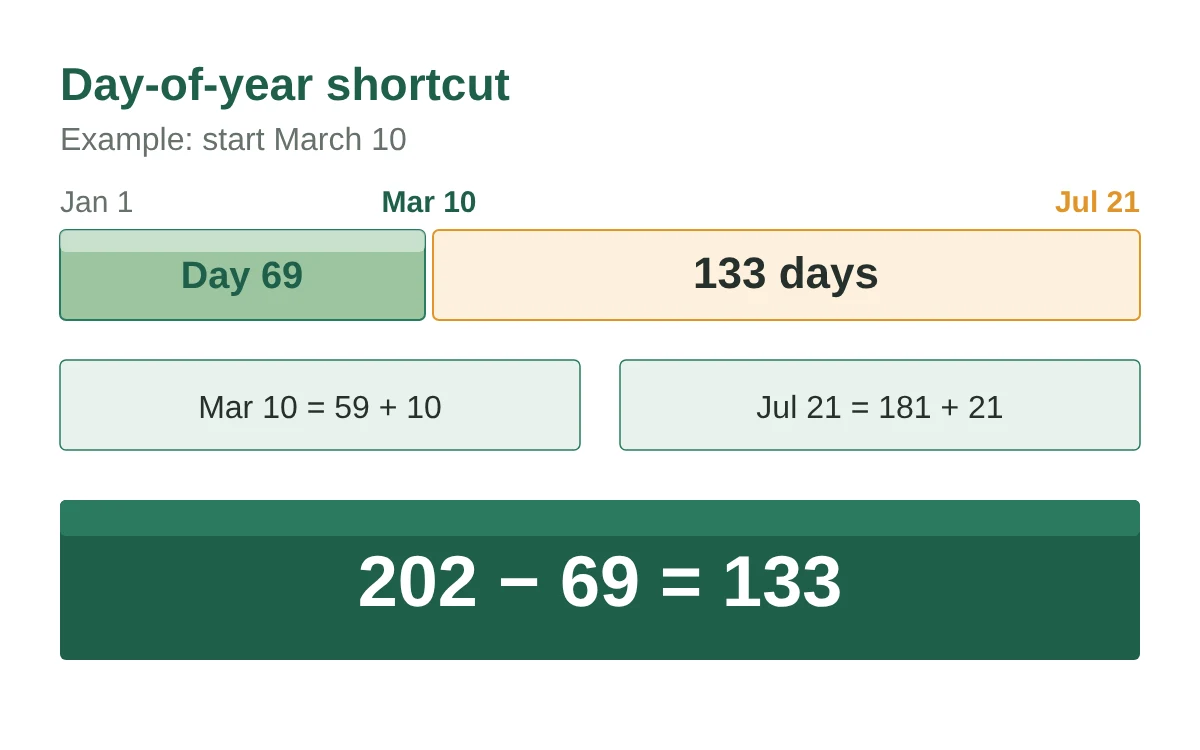
July 21 is day 202 of a normal year and day 203 in a leap year. Every other date has a day-of-year number too, so the whole calculation collapses to one subtraction: 202 minus your start date’s number. March 10 is day 69 (59 days through February, plus 10), and 202 minus 69 is 133, matching the month-by-month count.
You only need to memorize the month totals: 31, 59, 90, 120, 151, 181 for the ends of January through June. July 21 is then 181 plus 21. After that, any date in the first half of the year is a quick sum.
The number also helps in reverse. Subtract from 202 to find how many days of the year remain after July 21: 163 in a normal year.
Try this: Pick any date from January to June, convert it to a day-of-year number with the month totals above, and subtract it from 202. Compare your answer with the live countdown for that start date.
Weeks and weekdays to July 21
Divide the day count by 7. Our 133-day example is exactly 19 weeks, which tells you something useful: the start and end dates fall on the same weekday. If the remainder is not zero, the remainder tells you how many weekdays the end date sits past the start’s weekday.
For weekdays only, multiply the full weeks by 5, then count the weekdays in the leftover days. In the example, 19 weeks gives 95 weekdays, with nothing left over. A start date 131 days out would be 18 weeks and 5 days, so you would add the weekdays among those last 5 days, which depends on the starting weekday.
Working days are lower still, because holidays on weekdays come off the total. In a US calendar, Memorial Day, Juneteenth and Independence Day would trim 95 to 92 for that example. Check your own region’s holidays, since the list differs widely.
Why the answer can differ by one
Three things cause a one-day disagreement between sources. The first is inclusive counting, covered above. The second is the cutoff: the widget counts down to the start of July 21 in your local time, so on July 20 you may see “0 days” even though the date has not arrived, because fewer than 24 hours remain. If you care about the end of July 21, add a day.
The third is time zones. A site that computes in UTC and one that uses your local clock can disagree for several hours each day. Guam is ten hours ahead of UTC, so July 21 begins there while it is still July 20 afternoon in Europe and the evening before in the Americas. The midnight countdown works the same way for any single day boundary.
Apollo 11 is a famous case. Neil Armstrong’s first step on the Moon came at 02:56 UTC on July 21, 1969, yet in US time zones it was still the evening of July 20.
Leap years and weekday drift
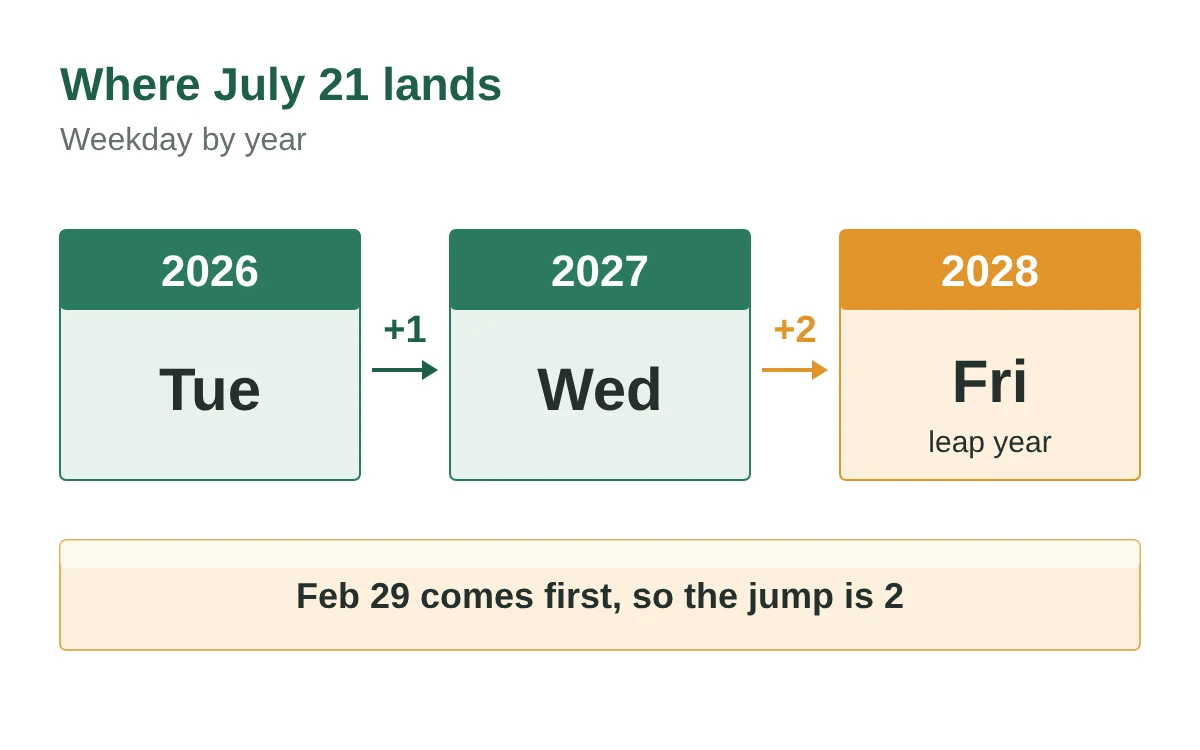
A year with a February 29 between your start and July 21 adds one day to the count. For a countdown spanning a whole year starting on a July 21, that means 366 days instead of 365 whenever the next February 29 comes before the next July 21.
The same fact explains the weekday pattern. July 21 shifts forward one weekday each year, and two weekdays in a leap year, because the leap day sits before July in that year. So the date’s weekday is not just “plus one forever”: it jumps by two every fourth year.
This matters if you plan around a weekday, such as a Friday event or a Monday deadline. Look up the specific year rather than assuming last year’s pattern applies. For a nearby comparison, the countdowns to July 25th and July 4th share the same leap-year behavior.
Hours and minutes can mislead you
If you convert the countdown to hours, do not simply multiply by 24. Each daylight saving clock change inside the span adds or removes an hour. A countdown that crosses the spring change has one hour fewer than days times 24. One that crosses the autumn change has one more.
Calendar days are unaffected, which is why the day count stays stable while the hour count can shift. The widget handles this automatically. If you calculate hours yourself, check which clock changes fall between your start and July 21 for your region, since the US and Europe change on different dates.
What July 21 is known for
July 21 is not a US federal holiday, and there is no widely observed school or tax deadline on it, so it is an ordinary day in most calendars. Elsewhere it carries real weight. It is the National Day of Belgium, marking Leopold I taking the oath as the first King of the Belgians in 1831. In Guam it is Liberation Day, commemorating the US landings of 1944.
In history, the First Battle of Bull Run (Manassas) was fought on July 21, 1861, and Ernest Hemingway was born on July 21, 1899. It also falls in northern-hemisphere midsummer, well after the solstice but before most school years restart.
Planning milestones backward from July 21
Working backward is where the day-of-year number pays off. A date 100 days before July 21 is day 102 in a normal year, which is April 12. Ninety days before is day 112, April 22 (see the 90 days from now page for forward counts of that length). Half a year before is around January 22.
Eight-week blocks are also handy for training plans or project sprints. The 8 weeks to days page shows the conversion, and you can step back from July 21 in 56-day chunks.
Try this: Choose one task you want finished by July 21 and write down its start date 56 days earlier, then 28 days earlier as a midpoint check. Compare both with the live countdown to see how much time each stage has.
If July 21 is only a stop on the way to something later, the countdown to August or July as a whole gives the wider view.
Frequently asked questions
How many days until July 21?
The live countdown above gives the exact figure on your own clock and time zone. If the date has already passed this year, it counts to July 21 of next year. To check it yourself, subtract today's day-of-year number from 202 (or 203 if July 21 falls in a leap year).
Is July 21 a public holiday?
Not in the United States, where it is an ordinary day. It is the National Day of Belgium and Liberation Day in Guam. Other observances vary by country, so check your local calendar.
What day of the week is July 21 each year?
It moves forward one weekday each year, and two weekdays in a leap year, because February 29 lands before July 21. The pattern fully repeats only every 28 years within the same century.
How many weekdays are there until July 21?
Multiply the full weeks by 5, then add the weekdays in the leftover days. Subtract any public holidays that fall on weekdays if you need working days. The date calculator can do this without the manual steps.