
How Many Days Until July 25th?
Calendar
Countdown chart
The live counter above shows the exact days, hours and minutes left, using your device’s clock and time zone. The next July 25 is Sunday, July 25, 2027, and the counter targets the first moment of that day, midnight local time.
The sections below cover what the counter cannot: how to get the same answer on paper, how to turn it into weeks and working days, and a few traps that make hand counts disagree with a calculator.
How to count the days by hand
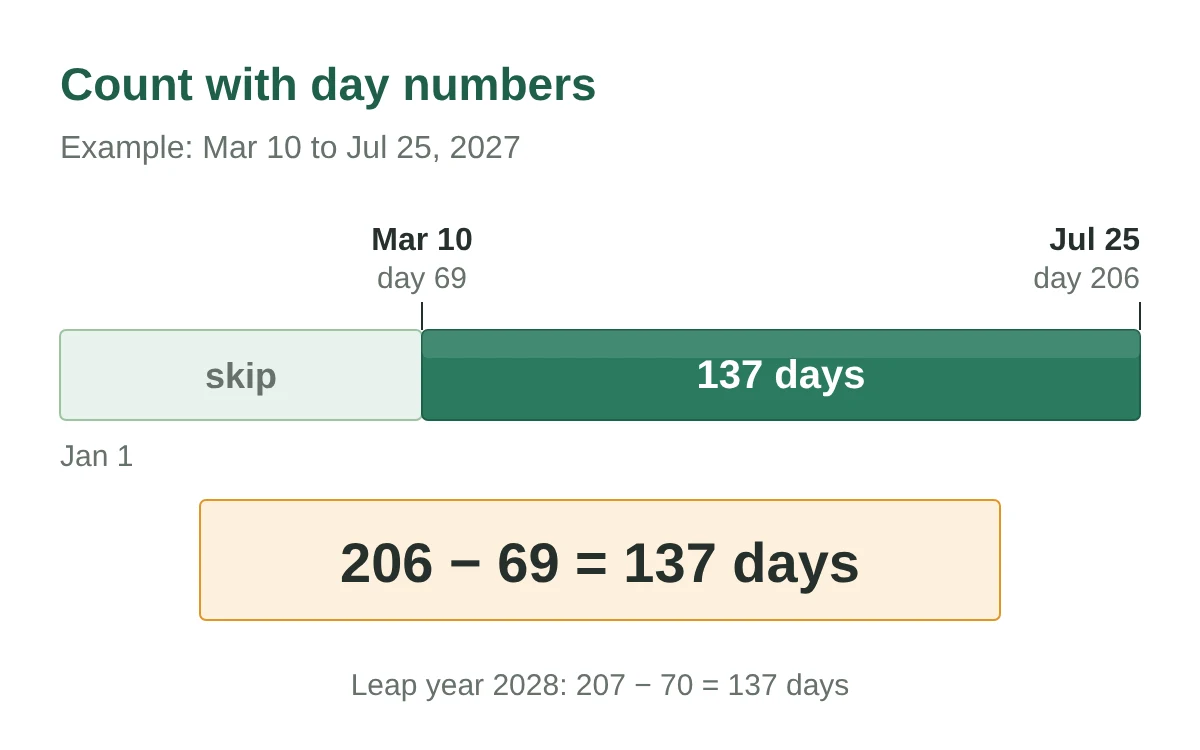
The fastest method uses day numbers. In a normal year, July 25 is day 206 (31 + 28 + 31 + 30 + 31 + 30 = 181 days before July, plus 25). In a leap year it is day 207. Convert your start date to its day number, then subtract.
Take a hypothetical start of March 10, 2027. That is day 69 (31 + 28 + 10). The gap is 206 minus 69, which gives 137 days. Checking month by month agrees: 21 days left in March, 30 in April, 31 in May, 30 in June and 25 in July make 137.
The only trap is the start and end convention. A countdown to the start of July 25 counts the days after your start date, so the target date itself is not included. If you want July 25 counted as a full day (a trip that includes it, say), add one.
The 206 rule and counting backward
Day numbers also work in reverse, which is useful for deadlines set relative to July 25. Subtract the number of days from 206 and read off the date: 100 days before is day 106 (April 16), and 200 days before is day 6 (January 6). That is a handy pair if you want a “200 days to go” marker that lands near New Year.
For anything not on a round number, the date calculator adds or subtracts days from July 25 and handles leap years for you. In a leap year, shift every answer after February 29 by one day.
Counting weeks and weekdays
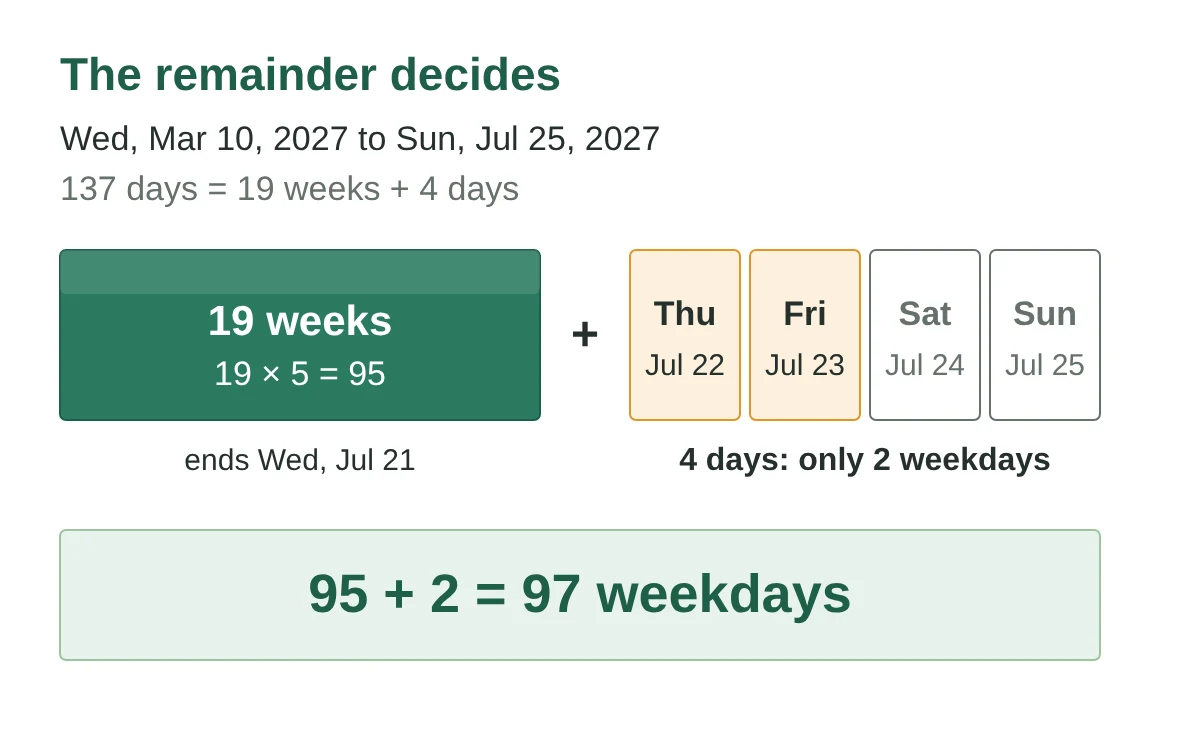
Divide the day count by 7 and keep the remainder. In the hypothetical example, 137 days is 19 weeks and 4 days. That remainder matters more than the weeks, because it decides how many weekdays you get.
March 10, 2027 is a Wednesday, and July 25, 2027 is a Sunday. Nineteen full weeks hold 95 weekdays. The 4 leftover days are Thursday, Friday, Saturday and Sunday, which adds 2 more, so 97 weekdays in total. Public holidays have to be subtracted separately, and they depend on your country.
Try this: Pick any start date and work out its weekday from the gap alone. Divide the gap to July 25 by 7, take the remainder, and count that many weekdays backward from the target day. Check it against a calendar.
Why the hours total can be off by one
Multiplying days by 24 gives the right number of hours only if no clock change falls in between. A spring-forward night is 23 hours long and an autumn one is 25, so a countdown that crosses one is an hour off from the simple multiplication. The live counter uses real elapsed time, so it is correct. A hand calculation is not unless you adjust.
Time zones add a second wrinkle. Midnight on July 25 happens at a different moment in each place, so a friend in another zone sees a different remaining time. When you plan an event with someone abroad, agree on one city’s clock, or use central time as a shared reference.
What day of the week July 25 falls on
The weekday moves forward by one each year and by two when a leap day sits in between. That gives Sunday in 2027, Tuesday in 2028, Wednesday in 2029 and Thursday in 2030. The 2028 jump is the leap day at work.
A Sunday July 25 has special weight in Spain. Years when July 25 falls on a Sunday are Compostela Holy Years (Xacobeo), which happens at intervals of 6, 5, 6 and 11 years. 2027 is one of them, so expect extra pilgrimage traffic to Santiago de Compostela in the months around the date.
What July 25 is known for
July 25 has no worldwide holiday, but it matters in several places:
- Puerto Rico Constitution Day: a public holiday on July 25 every year, marking the signing of the 1952 constitution. It was formerly called Occupation Day, for the 1898 landing of American troops at Guánica.
- Guanacaste Day (Costa Rica): the law annexing Guanacaste to Costa Rica was signed on July 25, 1824.
- Feast of Saint James: the patron saint of Spain, and the date National Day of Galicia is observed. Several Puerto Rican towns, including Loíza and Fajardo, hold their patron saint festivals on this day.
- Lighter observances: National Hot Fudge Sundae Day in the United States, and Tenjin Matsuri in Osaka.
For astrology fans, the date sits in the Leo season. It falls in northern summer and southern winter.
Planning milestones before July 25
The calendar window matters when you build a plan backward. Using the hypothetical March 10, 2027 start, three US federal holidays fall on weekdays inside it: Memorial Day (May 31), Juneteenth (observed Friday, June 18, since June 19 is a Saturday) and Independence Day (observed Monday, July 5, since July 4 is a Sunday). Taking those from 97 weekdays leaves 94 working days.
That Independence Day shift is easy to miss. If your plan has a checkpoint around early July, the July 4th countdown shows how close it sits, and the July countdown helps with the start of the month. To count the other way, the August 1st countdown gives you a one-week buffer after the date.
Try this: Mark the 100-day, 50-day and 10-day points on a calendar by subtracting from day 206. Put the 100-day mark on April 16, then check whether each one lands on a weekend and move it if so.
If the date is personal, such as a birthday on July 25, the same arithmetic applies, and the birthday countdown can handle the recurring version automatically.
Common mistakes when counting to July 25
Three errors cause most disagreements:
- Counting the start day and the target day both, which adds one.
- Using 30 days for every month. June has 30, but July and May have 31, and that alone can shift a hand count by a day or two.
- Forgetting that on July 25 itself, a “next July 25” counter either shows zero or jumps a year ahead, 365 or 366 days later, depending on how it is built.
When two sources disagree by exactly one day, the cause is almost always the first item, a different start or end convention rather than a calendar error.
Frequently asked questions
What day of the week is July 25?
It moves forward one weekday each year, or two after a leap day. The next July 25 is a Sunday (2027), then Tuesday in 2028 and Wednesday in 2029.
Is July 25 a public holiday?
Not in the United States. It is a public holiday in Puerto Rico (Constitution Day) and Costa Rica (Guanacaste Day), and the Feast of Saint James is a regional holiday in parts of Spain.
How do I count business days until July 25?
Count full weeks and multiply by 5, then add the weekdays left in the partial week. Subtract any public holidays that fall on a weekday inside the range.
Does the countdown change with my time zone?
Yes. The countdown ends at midnight at the start of July 25 on your own clock, so someone further east reaches zero hours earlier than someone further west.