
How Many Days Till March 11?
Calendar
Countdown chart
The live counter above gives the exact number of days until March 11, calculated from your own clock and time zone. The next one is Thursday, March 11, 2027, and the count reaches zero at midnight as that date begins on your device.
The widget answers the question, so the rest of this page covers what it cannot show: how to check the number yourself, how to turn it into weekdays, and the odd details that make March 11 a trickier target than it looks.
Counting it by hand
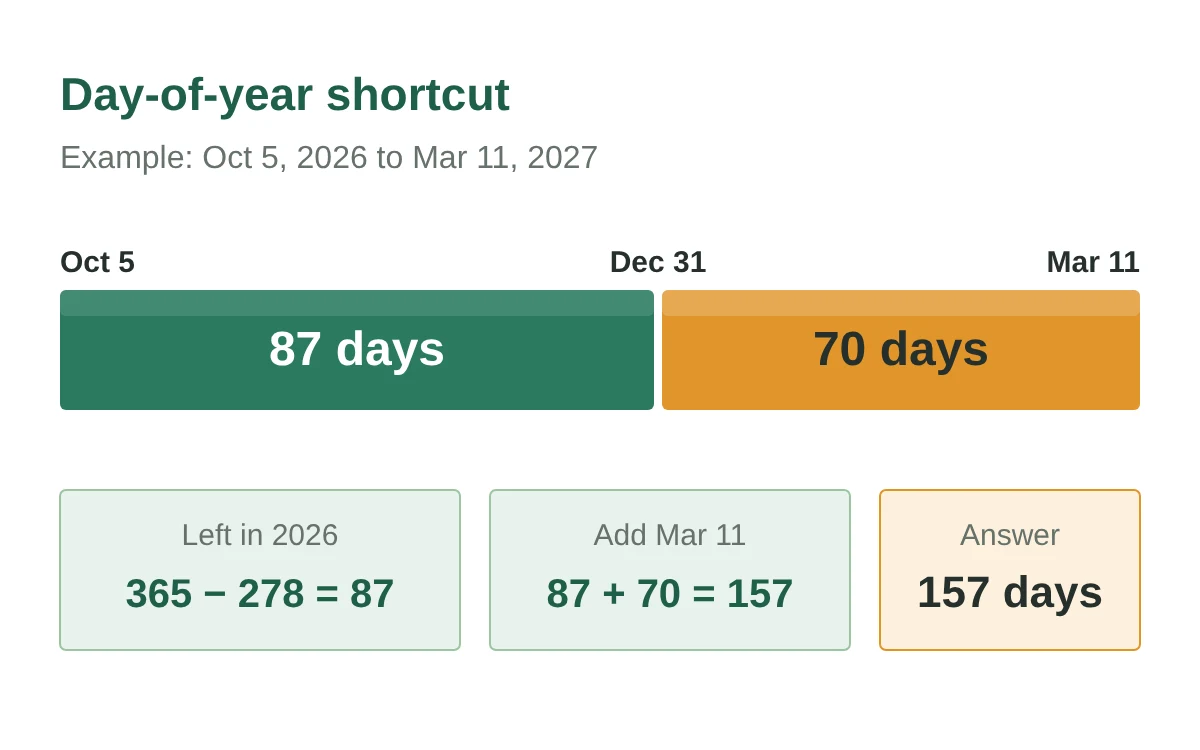
The fastest method is day-of-year arithmetic. March 11 is day 70 of a common year and day 71 in a leap year. If the date you are counting from is in the same year as the target, subtract its day-of-year from 70. If it is in the previous year, take the days left in that year and add 70 (71 if the target year is a leap year, like 2028).
Here is a worked example with a hypothetical start of October 5, 2026. October 5 is day 278 of 2026, so 365 minus 278 leaves 87 days remaining in the year. Add 70 for March 11, 2027, and the answer is 157 days. Checking by months confirms it: 26 days left in October, then 30, 31, 31 and 28 for November through February, then 11 in March.
The leap-year trap only bites when February 29 sits inside your span. A count from October 2027 to March 11, 2028 gains one day. A count from October 2026 to March 11, 2027 does not, because 2027 has no February 29.
Try this: Pick any date six months from now and count the days to March 11 using the day-of-year method, then check it against the date calculator. If the two disagree, the cause is nearly always a leap year or a miscounted month length.
Weekdays and weeks to March 11
Total days hide two useful numbers: how many weeks you have and how many of them are working days. Using the same hypothetical 157 days from October 5, 2026: that is 22 weeks and 3 days. Every full week holds exactly five weekdays, so 22 weeks gives 110. The October 5 start is a Monday, so the 3 leftover days are Tuesday, Wednesday and Thursday, all weekdays. That makes 113 weekdays.
The leftover days are the only part that needs care. A quick check: the weekday of your target equals your start weekday shifted forward by the remainder. Start on Monday, remainder 3, land on Thursday. If that does not match the calendar, your day count is off.
Weekday counts do not remove public holidays, so a span crossing Thanksgiving, Christmas and New Year’s Day has fewer real working days than the arithmetic says. For a longer horizon in weeks, 8 weeks in days shows how week blocks convert.
The weekday March 11 lands on
March 11 moves forward one weekday each year, or two after a leap day. That gives Thursday in 2027, Saturday in 2028, Sunday in 2029, Monday in 2030 and Tuesday in 2031. In 2032 it jumps to Thursday again.
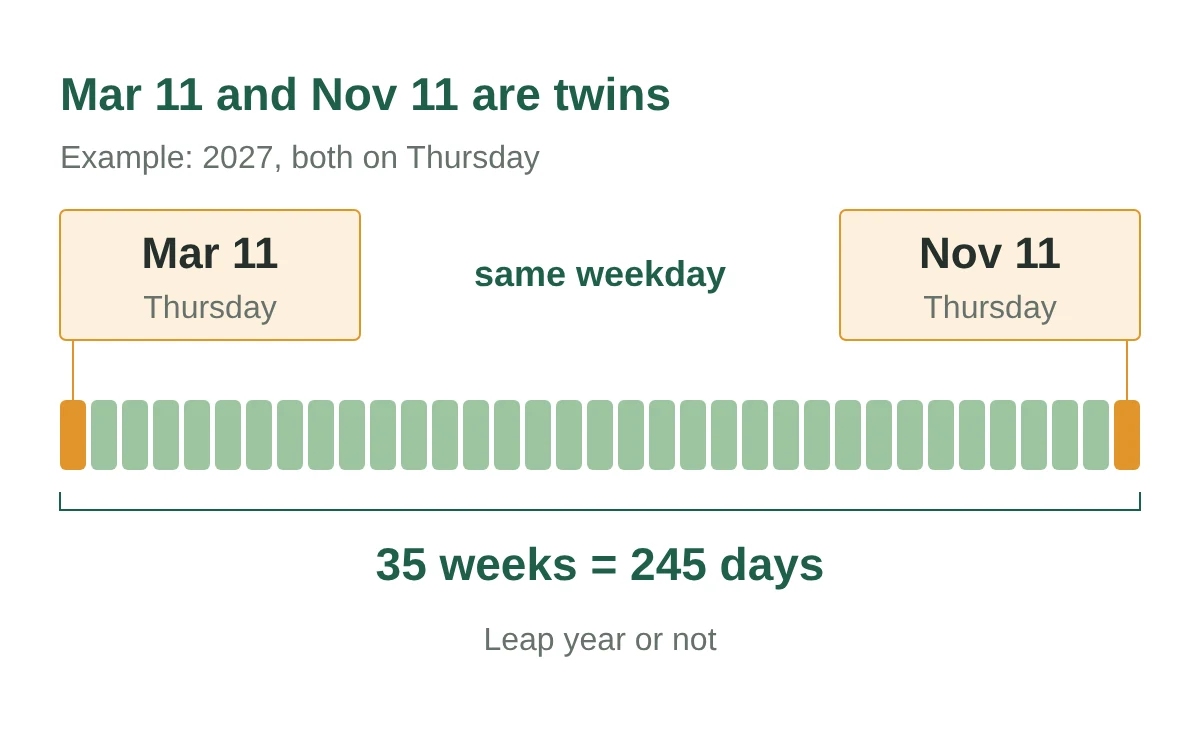
A less obvious pattern: March 11 and November 11 always fall on the same weekday, in every year, leap or not. The gap between them is 245 days, exactly 35 weeks, and both sit after any February 29. In a common year, February 11 shares the weekday as well.
What March 11 is known for
March 11 is a national day in Lithuania, which marks the Restoration of Independence declared on March 11, 1990. It is also Moshoeshoe I’s Day in Lesotho, honouring the country’s first king, and Saudi Arabia marks Flag Day on it.
It also carries several modern anniversaries. The World Health Organization described COVID-19 as a pandemic on March 11, 2020. The 2011 Tōhoku earthquake and tsunami in Japan, known as 3/11, struck on this date, and the 2004 Madrid train bombings, called 11M in Spain, happened on it too. World Plumbing Day is also observed on March 11.
Some observances move, so check the year. The UK’s No Smoking Day falls on the second Wednesday of March, which is March 10 in 2027, not March 11. March 11 has no widely observed public holiday in the United States, and no universal tax or school deadline, so any deadline you are counting to should come from your own school, employer or tax authority.
Daylight saving and March 11
In the United States and Canada, daylight saving time begins on the second Sunday of March. That Sunday can only land between March 8 and March 14, so March 11 is sometimes the very day clocks change. It happens in 2029, when March 11 is a Sunday and the clocks jump forward at 2 AM.
For 2027 the change comes three days after March 11, on March 14, so it does not touch your count. When it does fall inside a span, a countdown in “24-hour days” and one in calendar days disagree by an hour. A widget that counts calendar days to local midnight is unaffected, but a raw hours figure can be an hour off.
Most of Europe changes on the last Sunday of March, so the two regions can differ by an hour for a few weeks. This matters if the date you are counting to is a call or event with someone across the Atlantic.
Mistakes that cause off-by-one answers
Three errors account for most wrong counts:
- Including both the start day and March 11. A true difference counts only one end.
- Writing the date as 3/11 or 11/3. In the US, 11/3 means November 3. Most other countries read 11/3 as March 11.
- Forgetting that the countdown targets the first second of the day, not the end of it.
The last one matters for events. If something happens at 7 PM on March 11, the widget reaches zero nearly nineteen hours early. Add the hours manually, or check the time with how long until 7 PM on the day itself.
Rounding is the other source of arguments. A countdown showing 40 days and 6 hours can honestly be called 40 days or 41, depending on whether you floor or round up. Floor is the convention for “days left”.
Planning around the countdown
March 11 sits just before several dates people anchor to. Pi Day on March 14 is three days later, the Ides of March on March 15 is four days later, and the spring equinox arrives around March 20. If you are building a plan that ends in March, a short chain of milestones tied to those dates is easier to hold in mind than one long number.
A practical way to use the count is to split it into whole weeks and set a checkpoint at each quarter. With 157 days, as in the example, that means checkpoints near days 39, 78 and 118. Checkpoints keyed to a weekday, such as every fourth Thursday, avoid the drift that comes from counting in raw days.
Try this: Take your current day count from the widget and divide it by four. Mark the dates where each quarter ends on a calendar, then move any that land on a weekend to the Friday before.
Frequently asked questions
What day of the week is March 11, 2027?
March 11, 2027 is a Thursday. In 2028 it moves to Saturday, because 2028 is a leap year and the weekday jumps two places instead of one.
Is March 11 the same day of the year every year?
It is day 70 in a common year and day 71 in a leap year, because February 29 pushes everything after it back one slot. The calendar date never changes, only its position in the year.
Does the countdown change if I travel to another time zone?
Yes. The widget reads your device clock, so the count follows wherever your device thinks it is. Someone in Tokyo reaches March 11 many hours before someone in Los Angeles.
How do I count weekdays only until March 11?
Divide the total days by 7, multiply the whole weeks by 5, then walk through the leftover days one at a time and count only Monday to Friday. Public holidays in between need to be subtracted separately.