
How Many Days Until March 3rd?
Calendar
Countdown chart
The live counter above gives the exact number of days, hours and minutes until the next March 3, using your own clock and time zone. It rolls over to the following year the moment March 3 begins, so it always points at the next occurrence. The rest of this page covers how to check that figure yourself and where counts like this tend to go wrong.
March 3 is a good date to understand because it sits right after February’s variable length. That makes it a clean test case for leap-year handling, weekday patterns and the common off-by-one slip.
What the countdown is actually measuring
The target is the first instant of March 3, which is midnight at the start of that date in your time zone. On the evening of March 2 the counter shows only hours, because less than one full day remains. During March 3 itself the next target jumps a year ahead.
This means “days until” counts the midnights you still have to cross. If you want to know how many full days you can use before the date arrives, that is the same number minus nothing, but if you mean “including March 3 itself”, add one. Decide which meaning you need before comparing numbers across sites, because many of them silently differ.
Counting it by hand
Use the day-of-year method. In an ordinary year, March 3 is day 62 (31 days of January, 28 of February, plus 3). Take your start date’s day number, subtract it from 365, then add 62.
Worked example with a hypothetical start of December 10: December 10 is day 344, so 365 minus 344 leaves 21 days to the end of the year. Add 62 and you get 83 days to the following March 3. Check it a second way: 21 days left in December, 31 in January, 28 in February, 3 in March gives the same 83.
Try this: Pick any date in the next few weeks, count to March 3 with both methods above, then confirm with the date calculator. If the two hand counts disagree, the error is almost always the start date’s own day number.
Leap years and March 3
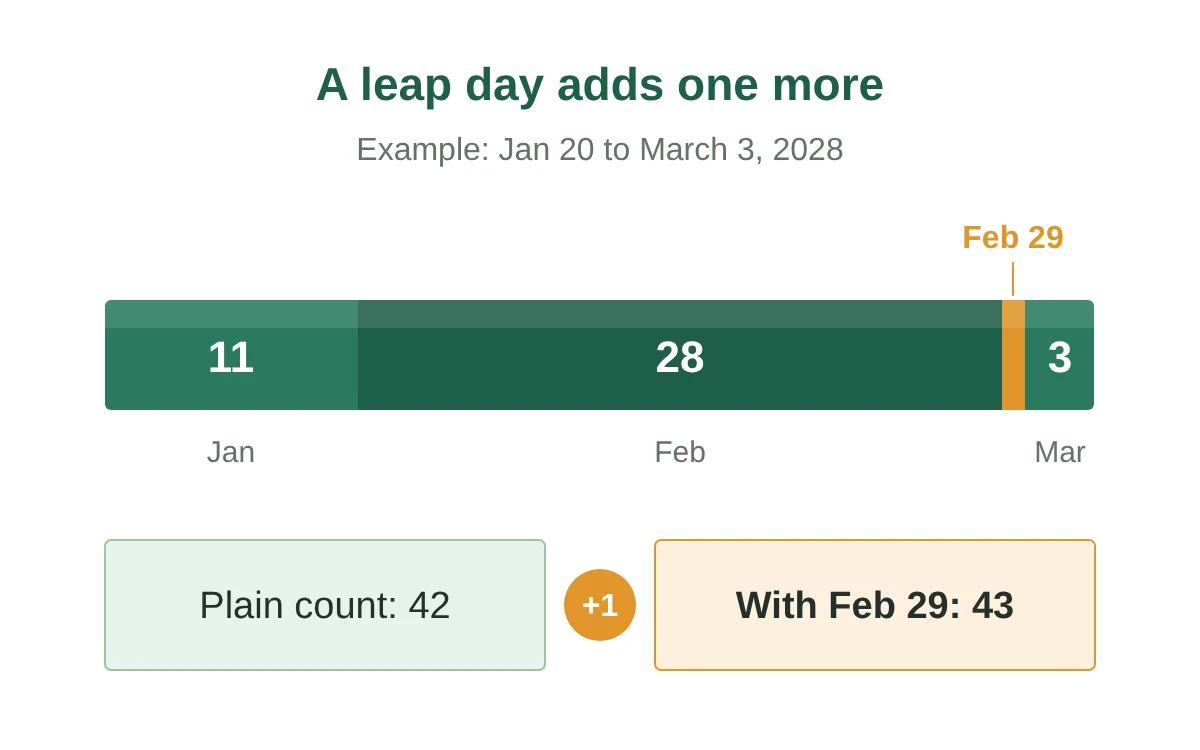
If the span crosses a February 29, March 3 becomes day 63 and every count through it grows by one. The next leap day after the coming March 3 falls in 2028, so a countdown that starts in late 2027 and aims at March 3, 2028 has to include it.
The reverse catch matters too. Starting in January or February of a leap year, your count to March 3 is one longer than the same start date would give in a normal year. The quick test: if a February 29 sits between your start and March 3, add one.
Counting weekdays and weeks
Divide the total days by 7. The whole number is the weeks, and the remainder is the stray days that decide your weekday count. In the 83-day example, that is 11 weeks and 6 extra days. Eleven weeks hold 55 weekdays, so only the 6 stray days are uncertain.
List those 6 days starting from the day after your start date. If the start is a Thursday, the stray days are Friday through Wednesday, which include 4 weekdays. The total comes to 59 weekdays, not counting the start day and counting March 3 itself. Public holidays between now and then are not removed, so subtract any that you observe.
A related shortcut: any 7 consecutive days contain exactly 5 weekdays, so the remainder days are the only ones worth listing. For converting larger blocks, 8 weeks to days shows the same logic on a round number.
Which weekday March 3 lands on
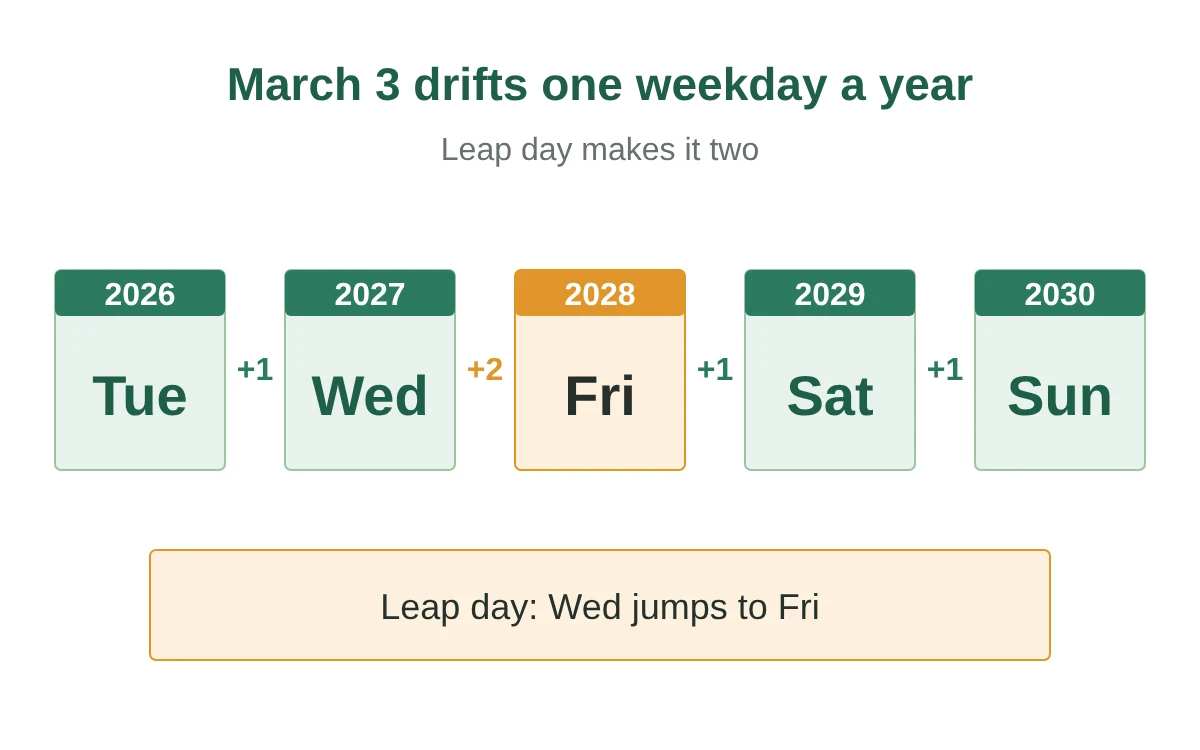
March 3 is always three days after the last day of February. Find that weekday and add three. In ordinary years it also matches the weekday of February 3 and of November 3, because both gaps are an exact number of weeks (28 and 245 days).
The weekday then drifts: one step forward each year, two after a leap day. That gives Wednesday in 2027, Friday in 2028, Saturday in 2029 and Sunday in 2030. If you plan a fixed March 3 event, the drift tells you quickly which years fall on a weekend.
What March 3 is known for
In Japan, March 3 is Hinamatsuri, also called Girls’ Day or the Doll Festival. It is an annual festival but not a national holiday. Families display ornate dolls, and the decorations typically go up in mid-to-late February and stay until the end of March 3. The date is part of the traditional set of festivals on doubled odd numbers, which were considered especially auspicious.
Elsewhere, March 3 is Liberation Day in Bulgaria, a national holiday. The UN’s World Wildlife Day and the WHO’s World Hearing Day are also held on this date. Historically, it is the birthday of Alexander Graham Bell (1847), and in 1931 “The Star-Spangled Banner” was made the US national anthem.
Planning around the countdown
The Hinamatsuri tradition gives a useful template for any March 3 plan: set-up begins weeks ahead, not days. Working backwards is easier with a fixed block, and 90 days from now is a handy anchor if you want a three-month runway.
Time changes also sit close by. In the United States, clocks go forward on the second Sunday of March, so March 14 in some years falls a few days later. Because March 3 comes before the change, hour-level countdowns to it are not affected. For neighbouring dates, March 2 is the natural comparison, and the full list lives under all date countdowns.
Try this: Choose one task to finish by March 3 and write down three checkpoints at equal gaps, counting backwards from the date. Dividing the remaining days by four gives you three evenly spaced reviews.
Mistakes that shift the answer by one
The most frequent error is counting both endpoints. Counting from today to March 3 and including both days gives one more than the number of midnights between them. The second is forgetting that a start time after midnight still means today counts as already underway.
A third trap is the year boundary: from late in the year, March 3 belongs to next year, and its leap status is next year’s, not this year’s. Check which February you will cross before trusting any quick estimate.
Frequently asked questions
Does the countdown reach zero at the start or the end of March 3?
The start. A countdown to a calendar date ends at 12:00 a.m. on March 3 in your own time zone. If you want the end of the day, add one day to the figure.
What day of the week is March 3?
It moves forward one weekday each year, or two after a leap day. For example, March 3 is a Wednesday in 2027, a Friday in 2028 and a Saturday in 2029.
Is March 3 a public holiday?
Not in the United States, and not in Japan, where Hinamatsuri is a festival rather than a national holiday. Bulgaria is the notable exception, since March 3 is its Liberation Day.
Why does the count change if I switch time zones?
Midnight on March 3 arrives at different moments around the world. A device set to an earlier time zone shows slightly more time left than one set further east.