
How Many Days Until March 6th?
Calendar
Countdown chart
The exact number of days until March 6th is shown in the live countdown above, calculated from your own clock and time zone. After March 6 passes, it rolls over to the next year automatically. To work it out by hand, find the day-of-year number for today (March 6 is day 65 in a common year), then subtract.
A hand count is worth learning because it exposes the places where countdowns quietly disagree: leap years, time zones and whether the start day counts. The sections below cover those traps, plus weekday patterns and planning ideas.
The day-of-year shortcut
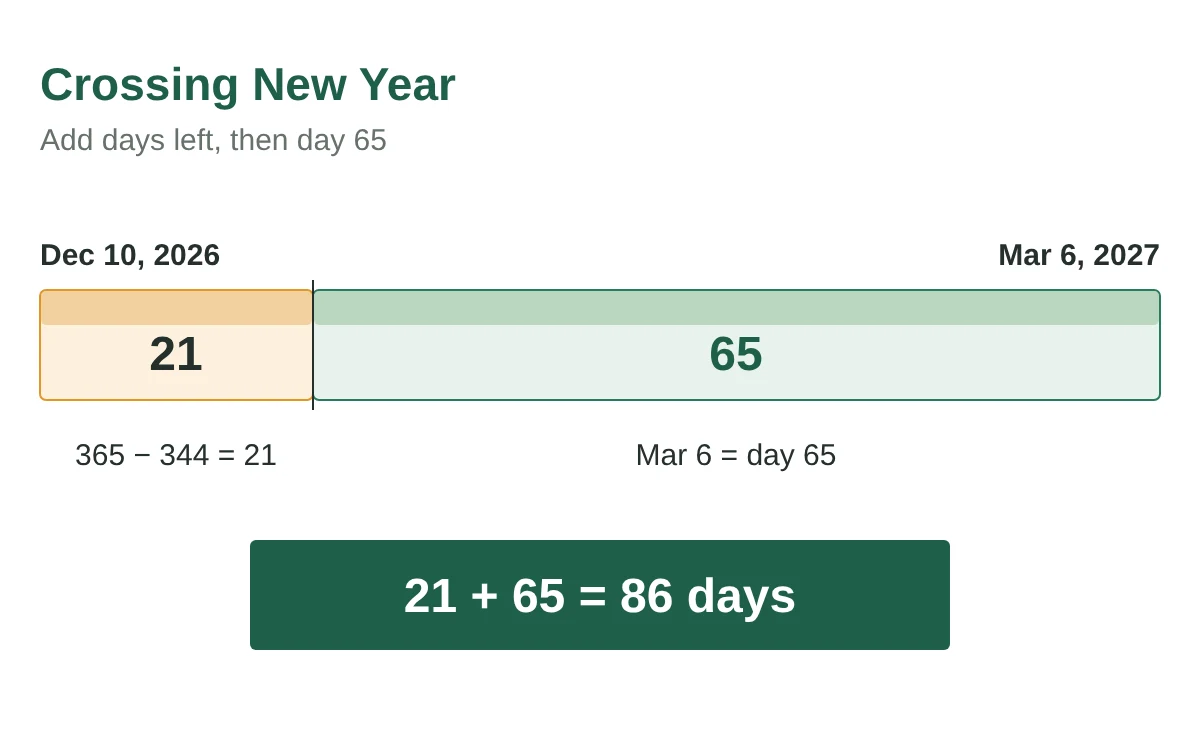
Counting month by month invites arithmetic slips. A cleaner method is to convert both dates to day-of-year numbers and subtract. March 6 is always day 65 in a common year (31 days of January, 28 of February, plus 6) and day 66 in a leap year.
Take a hypothetical start of January 20, 2027, which is day 20. Subtract: 65 minus 20 gives 45 days. If the start falls in the previous year, add the days left in that year first. From a hypothetical December 10, 2026 (day 344 of 365), 21 days remain in the year, and 21 plus 65 gives 86 days.
Try this: Pick any date in the next two months. Write down its day-of-year number, subtract it from 65 (or 66 if the target year is a leap year), and compare your answer with the widget.
Which weekday March 6 lands on
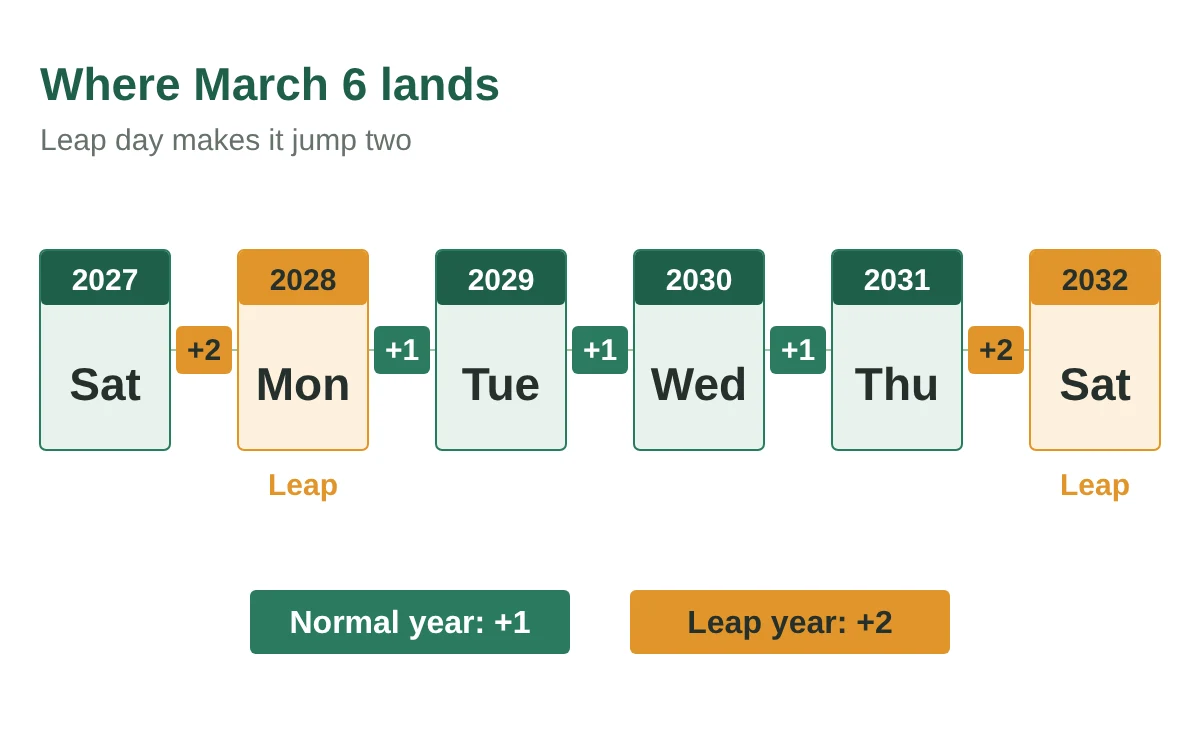
Because March 6 comes after February 29, it shifts forward one weekday per year, except that a leap year makes it jump two. March 6 is a Saturday in 2027, then a Monday in 2028 (Sunday is skipped), a Tuesday in 2029, a Wednesday in 2030 and a Thursday in 2031. In 2032 it jumps from Thursday to Saturday.
This matters for planning. A date that lands on a weekend in 2027 will not recur on a weekend the next year, so a recurring event on March 6 needs its venue, travel and time off rebooked around a different day each year. The pattern fully repeats only every 28 years within a century, so you cannot rely on last year’s calendar.
Counting weekdays and weeks
To convert days to weeks, divide by 7 and keep the remainder. The 45 days in the example above are 6 weeks and 3 days. The remainder tells you the weekday shift: your start day is 3 weekdays before the target, so a Saturday target means a Wednesday start.
For weekdays only, multiply whole weeks by 5, then check the leftover days one by one against the calendar. Counting from the day after a Wednesday start up to Saturday, March 6, 2027, gives 30 weekdays from the six full weeks, plus Thursday and Friday, which makes 32. Public holidays reduce that further. Presidents’ Day (Monday, February 15, 2027) would take it to 31 working days in the United States. If you want the weeks fixed in your head, 8 weeks in days is a handy benchmark for a standard two-month lead time.
Why the countdown can differ by one
Two countdowns for the same date often disagree by a single day, and both can be right. The usual cause is inclusive versus exclusive counting. The method above treats today as day zero, so tomorrow is one day away. If you count today as day one, you get a number that is one higher.
The second cause is the time of day. A calendar count compares dates, so at 11 PM on March 5 it says 1 day, even though the target is an hour off. A countdown measured in full 24-hour periods says 0 days and 1 hour. When you are timing a deadline rather than a date, trust the hours figure, and see how long until midnight for the final stretch.
Time zones add a third wrinkle. March 6 arrives at local midnight, so the same event reaches New Zealand about 18 hours before it reaches the US West Coast. If you are coordinating with someone abroad, agree on whose midnight you mean.
Leap years and the 366-day gap
The gap between one March 6 and the next is 365 days, except when the span contains a February 29. From March 6, 2027 to March 6, 2028 is 366 days, because the leap day of 2028 falls in between. Starting counts in the other direction behave the same way: any window that crosses February 29 is one day longer than the calendar-month arithmetic suggests.
This is the classic mistake in homemade spreadsheets. Adding 365 days to a date and expecting the same date a year later fails in leap windows. Use a proper date function, or the date calculator, which accounts for February 29 automatically.
Clock changes and hour counts
If you count in hours instead of days, daylight saving time can shift the total. In the United States, clocks spring forward on the second Sunday of March, which is March 14 in 2027, eight days after March 6. That means a countdown running to March 6 itself does not cross the spring change, but one running to a date a week later does, and it loses an hour. The autumn change works the other way, adding an hour to any window that spans it.
If your countdown runs from early November or later, it is safe to treat every day as 24 hours. For anything longer, let a tool convert calendar dates rather than multiplying days by 24. If you are looking at nearby dates, March 8 and March 14 have their own countdowns.
What March 6 is known for
March 6 is not a public holiday in most countries, but it carries a few firm anniversaries. Ghana became independent from Britain on this date in 1957, and the day is still marked there as Independence Day. The Alamo fell on March 6, 1836, and the Supreme Court issued the Dred Scott decision on March 6, 1857. Michelangelo was born on March 6, 1475.
In the Northern Hemisphere it falls in meteorological spring, a couple of weeks before the March equinox. For deadlines, there is no major US tax date on it, but the US filing deadline for calendar-year partnerships and S corporations is March 15, nine days later. For tax planning, April 15 is the one most people are tracking.
Planning milestones that work
A long countdown works better with checkpoints than with a single end date. Mark the 100-day, 50-day and 30-day points, and set the 30-day mark as the moment to finalise anything with lead time, such as bookings, orders or paperwork. The 90 days from now page can show you where a 90-day checkpoint lands.
If March 6 falls on a weekend, as in 2027, plan the real deadline for the preceding Friday. Offices, couriers and banks will not act on a Saturday, so the effective date is earlier than the one on the calendar.
Try this: Choose the Friday before March 6 as your working deadline, then count back four whole weeks from it and set a reminder for that date.
Frequently asked questions
What number day of the year is March 6?
March 6 is day 65 in a common year and day 66 in a leap year, because February 29 pushes everything after it back by one. That is why the same date can be one day further from January 1 in 2028 than in 2027.
What day of the week is March 6 in 2027?
March 6, 2027 is a Saturday. In 2028 it moves to Monday, because the leap day makes the weekday jump forward by two.
Does the countdown change if I travel to another time zone?
Yes. March 6 begins at midnight in your own location, so someone farther east reaches it earlier than someone farther west. The live widget uses your device clock, so it follows you.
Is March 6 a public holiday?
It is not a public holiday in the United States, the UK or most of Europe. Ghana marks its independence on this date, and the date is tied to several historical anniversaries.