
How Many Days Until March 12th?
Calendar
Countdown chart
The live counter above gives the exact answer on your own clock and time zone, down to the second. It always points to the next March 12, so once the date passes it rolls over to the following year without any input from you.
If you want to check the number yourself, or count weeks and weekdays instead, the methods below work for any starting date. They also explain why two countdown sites can give different answers for the same date.
The day-of-year shortcut
March 12 is the 71st day of a common year and the 72nd in a leap year. That fixed number is the fastest route to a manual answer. Find your start date’s day-of-year number, subtract it from 71, and you have the gap. Counting month by month works too, but it needs more steps and more chances to slip.
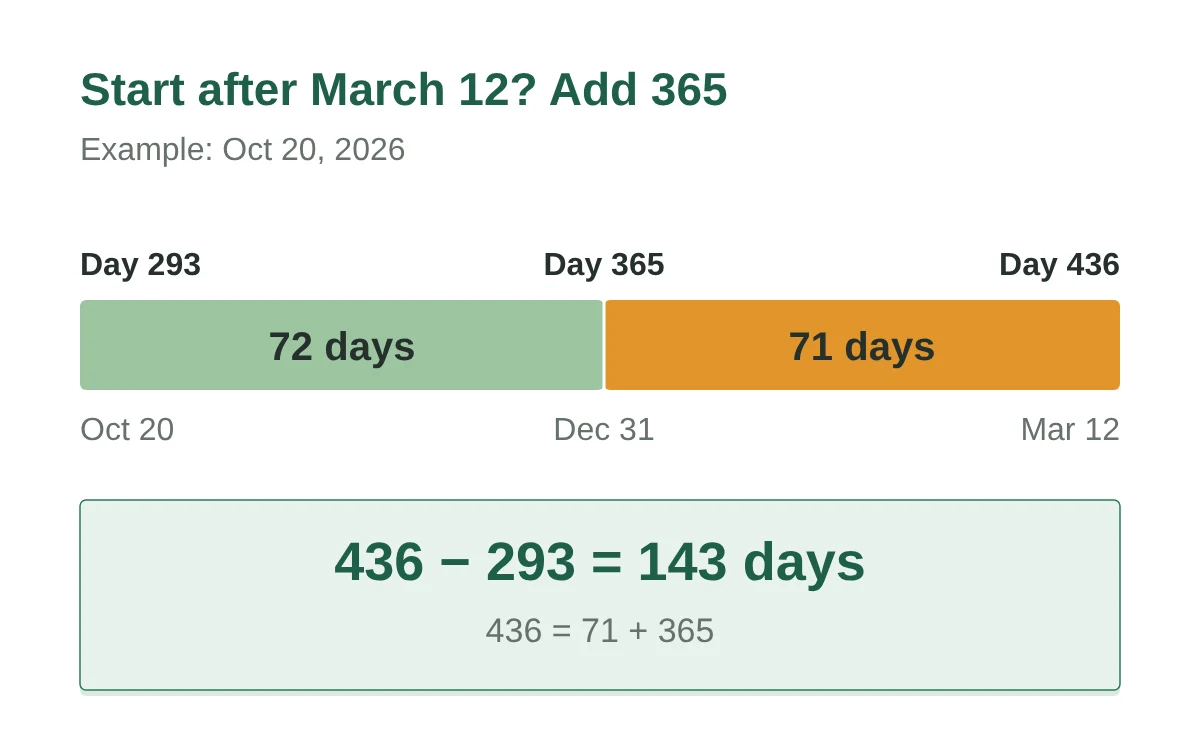
When the start date falls after March 12, the subtraction goes negative. In that case, add the length of the year (365, or 366 if the span crosses February 29) before subtracting.
Take a hypothetical start of October 20, 2026. October 20 is day 293 of 2026. March 12, 2027 is day 71 of the next year, which is day 436 on a running count (71 + 365). So 436 minus 293 gives 143 days.
You can verify it the slow way. October 20 to the end of October is 11 days, then add November (30), December (31), January (31), February (28) and 12 for March. That totals 143.
Try this: Pick any date in your own diary and find its day-of-year number. Subtract it from 436, or from 71 if it falls before March 12. Then compare your result with the widget. A difference of exactly one points to a counting convention, not an error.
Why two countdowns can disagree
Most disagreements come down to whether the target day is counted. A standard countdown stops when March 12 begins, so the day itself is excluded. A “days I have to use” count includes it, which makes it one larger.
Time zones add a second source of difference. A countdown that is fixed to the server’s location can differ from yours by up to a day at the edges. The widget above uses your device clock, so its answer matches your local midnight.
Rounding is the third cause. A page that shows “114 days” at 3 p.m. may be flooring a figure that is closer to 113.4 days of time remaining. If you need an exact figure for a deadline, read the hours rather than the rounded days.
Counting weeks and weekdays
Divide the day count by 7. The quotient is the full weeks and the remainder is the leftover days. In the October 20 example, 143 days is 20 weeks and 3 days.
For weekdays, start from five per full week. The 20 weeks give 100 weekdays. Then look at the leftover days. The remainder always ends on March 12, so check which weekdays those last few days are. In 2027 the final three days are Wednesday, Thursday and Friday, which adds 3 and makes 103 if you include March 12.
Public holidays then reduce that number. Counters that quote a plain weekday figure do not subtract them, so a working-day plan needs a manual adjustment for any holidays in the span.
Leap years and the weekday drift
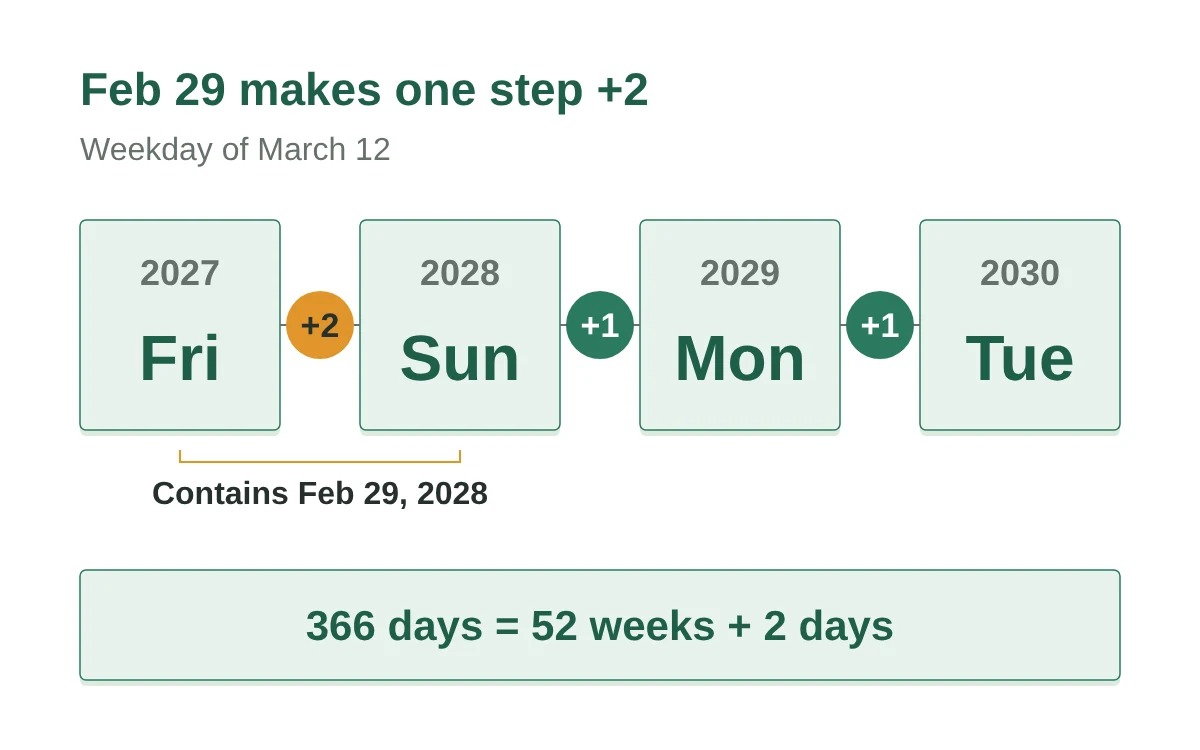
Any span that includes February 29 is one day longer than the same span in a common year. A count to March 12, 2028 therefore includes that extra day if you start before it. A count starting in March 2027 or later does too.
The weekday of March 12 drifts predictably. It moves forward one weekday each year and two after a leap year. The sequence runs Friday (2027), Sunday (2028), Monday (2029), Tuesday (2030).
The same logic helps with backward planning. Twenty-eight days before March 12 is February 12 in a common year but February 13 in a leap year, because February’s length changes.
What March 12 is known for
The Girl Scouts of the USA trace their start to March 12, 1912, when Juliette Gordon Low held the first meeting in Savannah, Georgia. The date is marked each year as Girl Scout Day. Informal observances such as Plant a Flower Day are also tied to it, though these have no official status.
Gandhi began the Salt March on March 12, 1930, a 24-day walk to the coast to protest the British salt tax. Mauritius celebrates its National Day on March 12, which marks independence in 1968.
March 12 is not a public holiday in most countries. It is also not an official tax or school deadline in the United States. The nearby dates are more useful for planning. March 14 is Pi Day, and April 15 is the usual US federal income tax deadline.
March 12 and the daylight saving window
In the United States and Canada, clocks go forward on the second Sunday of March. That Sunday can only fall between March 8 and 14, so March 12 always sits inside the window. In some years it is the changeover day itself, as in 2023 and 2028.
This matters for countdowns that run to a specific time on or near March 12. If the clocks change in between, the span contains 23 hours on one day, and a naive “days times 24” calculation will be an hour out.
In 2027 March 12 is a Friday, so the clocks go forward two days later, on Sunday, March 14. The countdown to March 12 itself is unaffected, but a countdown to a later time that day or a later date would be.
Europe works differently. Its summer time starts on the last Sunday of March, so it never touches March 12.
Planning around the countdown
Spring is close. The March equinox arrives around March 20, about eight days after March 12, and the March 21 page covers the days just after. For a monthly view, March 1 marks the first day of the month, 11 days earlier.
Useful milestones to set in a calendar:
- The 100-day, 50-day and 30-day marks, which are easy to calculate once you know the target.
- The Friday before, if you need a working buffer.
- The last full week, which is a natural point to finalise bookings or deliveries.
For anything involving arbitrary start and end dates, the date calculator handles days between dates and adding days. It also copes with leap years, which is where manual counting tends to go wrong.
Try this: Work backwards from March 12 in blocks of 28 days. Write down the date for each block and check which ones land on a weekend. Shift any milestone that does to the nearest weekday.
Frequently asked questions
What day of the week is March 12?
It changes every year. March 12 moves forward one weekday each year, or two after a leap year. It falls on a Friday in 2027, a Sunday in 2028 and a Monday in 2029.
Is March 12 the same day everywhere?
The calendar date is the same, but it begins at different moments around the world. A countdown to local midnight reaches zero hours before or after one set in another time zone.
What number day of the year is March 12?
It is the 71st day of the year in a common year and the 72nd in a leap year. Subtracting today's day number from 71 (or 72) gives the gap when March 12 is still ahead this year.
Does the countdown include March 12 itself?
Most countdowns do not count the target day. They stop when March 12 begins at midnight. If you want the days to be inclusive, for a trip or deadline you must use up, add one.