
How Many Days Until March 21st?
Calendar
Countdown chart
For the exact answer, read the live countdown above. It uses your own clock and time zone, so it is correct for where you are. To check it yourself, find today’s day-of-year number, subtract it from 365, then add 80. March 21 is day 80 of an ordinary year and day 81 in a leap year.
That one formula covers any start date after March 21. If your start date comes before March 21 in the same year, just subtract: 80 minus today’s day number. The sections below show the traps that make hand counts go wrong.
The day-of-year shortcut
Counting month by month is slow and invites errors. Day-of-year numbers are faster. In 2027, March 21 is the 80th day of the year, and that holds in every non-leap year: 31 days of January, 28 of February, plus 21.
Learn a few anchor numbers and you can do this in your head. The first of each month is day 1, 32, 60, 91, 121, 152, 182, 213, 244, 274, 305 and 335 in a common year. Add the day of the month, subtract one, and you have the day number.
A worked example
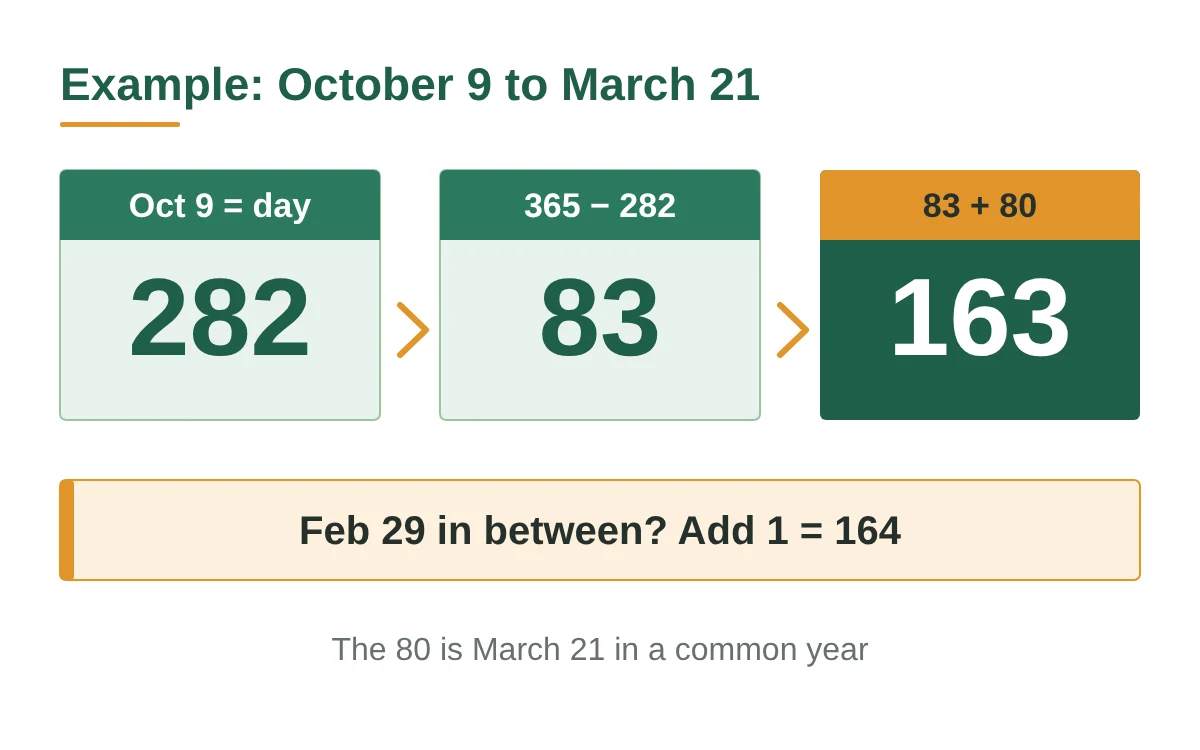
Take a purely hypothetical start date of October 9, with no leap day in between. October 9 is day 282 (273 days through September, plus 9). The year has 365 days, so 365 minus 282 leaves 83 days to December 31. Add 80 for March 21 and the total is 163 days.
You can verify it the slow way: 22 days left in October, plus 30 for November, 31 for December, 31 for January, 28 for February and 21 for March. That also gives 163. If the gap crosses a February 29, the answer is 164.
Try this: Pick any date six months from now, work out its day number, and run the formula. Then paste both dates into the date calculator and see whether you agree.
The leap year trap
Only one thing matters about leap years here: does February 29 sit between your start date and March 21? If it does, add a day. If you are counting from, say, March 5 to March 21 of the same year, the leap day is already behind you or irrelevant.
A subtler error is applying the leap rule to the wrong year. Counting from December 2027 to March 2028 crosses February 29, 2028. Counting from January 2028 to March 2028 does too. Counting from March 2028 onward to March 2029 does not, because the leap day has already passed.
Counting weeks and weekdays
Divide the day count by 7. The remainder is the useful part, because it tells you how the weekday of March 21 relates to your starting weekday. A remainder of 2, for example, means March 21 falls two weekdays later in the week than your start day.
For working days, multiply the full weeks by 5, then count the leftover days one by one against the calendar. Public holidays between now and then are not removed by this method, so subtract those separately. This is also the trick for any deadline that sits near the date: a project due the week of March 21 may lose a day to a weekend you did not account for.
The weekday of March 21 itself follows a clean pattern. It shifts forward by 1 day each year, or 2 days after a leap year. That gives Saturday in 2026, Sunday in 2027, Tuesday in 2028 and Wednesday in 2029.
Why March 21 is not always the equinox
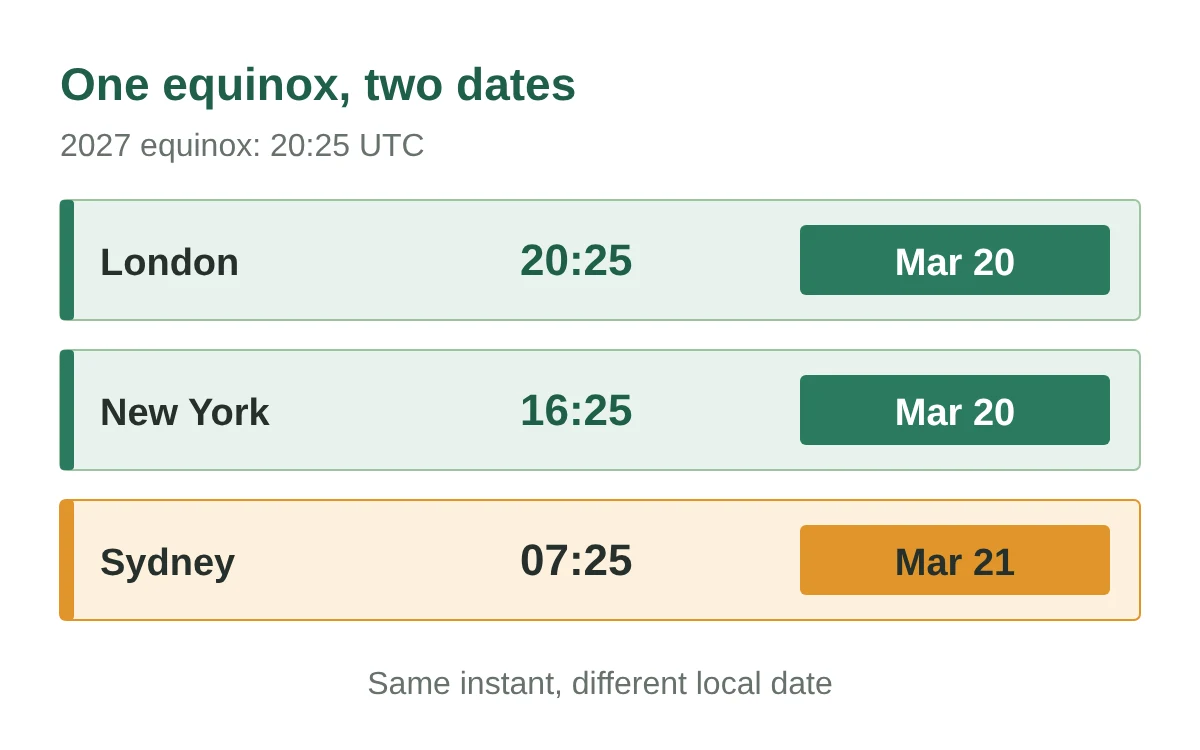
Many people treat March 21 as the first day of spring, but that is a calendar convention. The real equinox is one instant. In 2027 the sun crosses the celestial equator at 20:25 UTC on March 20, which makes it March 20 in the Americas and the UK. In Sydney the same moment is 21 March at 07:25.
Over the long run the UTC date wanders. The March equinox ranges from March 19 to March 21 in Universal Time, with the last March 21 equinox in 2007. So a countdown to March 21 is a countdown to a date, not to the astronomical event. If you need the equinox itself, count to March 20 instead using the March 20, 2027 countdown.
What March 21 is known for
Several fixed observances fall on this date. They are worth knowing if your countdown is for an event, a class or a campaign.
- World Down Syndrome Day, chosen because the 21st day of the 3rd month echoes three copies of chromosome 21.
- International Day of Forests and World Poetry Day, both observed annually.
- International Day for the Elimination of Racial Discrimination, a UN day connected to the Sharpeville events of 1960, which is also why South Africa observes Human Rights Day on March 21.
- Nowruz, the Persian new year, which is tied to the equinox and begins on March 20 or 21 depending on the year and country.
In astrology, Aries is generally counted from approximately March 21 onward.
The Easter connection
March 21 has a quiet role in the calendar. The First Council of Nicaea in 325 fixed the spring equinox at 21 March for the purpose of calculating Easter. Easter is the first Sunday after the first full moon on or after that nominal date. Because of this rule, Easter can never fall before March 22.
So the date works as a hard floor for Easter. If March 21 lands on a Saturday and the full moon is that day, Easter is the next day. That is the practical reason church calendars keep using March 21 even though the astronomical equinox usually comes a day earlier.
Planning around the countdown
Work backwards from March 21 rather than forwards. A date that sits at day 80 gives you roughly 11 weeks after New Year, which suits quarter-end projects, spring-break travel booking and garden planning. Block your checkpoints at 8 weeks, 4 weeks and 1 week out; the 8 weeks to days converter helps if you need exact counts.
Watch for clock changes. In the US, daylight saving time begins on the second Sunday of March, which in 2027 is Sunday, March 14. A countdown measured in hours across that weekend is one hour shorter than days times 24. See the March 14 countdown if that date matters to you.
Try this: Write down March 21 minus 8 weeks, 4 weeks and 1 week as three checkpoints. Check which of them land on a weekend and move those to the Friday before.
Why two countdowns can disagree
Two counters often give answers that differ by exactly one. The cause is inclusive versus exclusive counting: some tools count today, some count the target day, and some do both. A countdown to midnight at the start of March 21 gives a different total from one to the end of the day.
Time zones add another source of difference. A site that calculates from UTC can be a day off from your local midnight for part of the day. The live widget above reads your device clock, so it follows the date you actually see on your phone. For the nearest neighbours, compare with the countdowns to March 19 or March 23, which differ by a fixed number of days.
Frequently asked questions
How many days until the 21st of March?
The live countdown above gives the exact answer for your own clock and time zone. To check it by hand, subtract today's day-of-year number from 365 and add 80 (add 81 if the March in question falls in a leap year).
Is March 21 the first day of spring?
Traditionally yes, but the real equinox is a single instant that usually lands on March 20 in UTC. In 2027 it falls on March 20 in the Americas and Europe, and on March 21 local time in Australia and New Zealand.
What day of the week is March 21?
It moves forward one weekday each year, or two after a leap day. It is a Sunday in 2027, a Tuesday in 2028 and a Wednesday in 2029.
Is March 21 a public holiday?
In some countries, yes. South Africa marks Human Rights Day on March 21, and Nowruz is a public holiday in several countries, though the exact day depends on the country and the year. In most places it is an ordinary working day.